Sunday, September 9, 2012

Atteva aurea, Ailanthus Webworm Moth

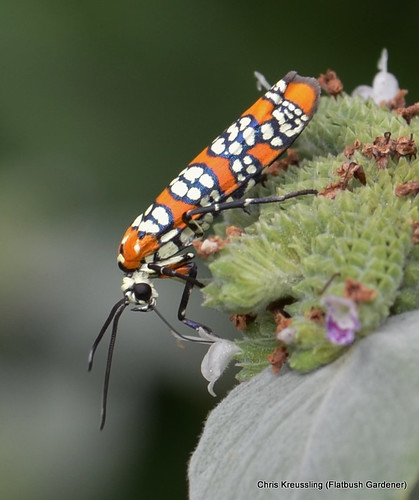
Atteva aurea, Ailanthus Webworm Moth, on Pycnanthemum, Mountain-Mint, in my garden last weekend. The intense colors are believed to be aposematic, a warning coloration to deter predators, probably because they would be distasteful.
Atteva aurea, Ailanthus Webworm Moth, on Pycnanthemum, Mountain-Mint


The larvae - caterpillars - feed in communal aggregations, like tent caterpillars. Around the globe, caterpillars in the genus Atteva are known to feed on plants from at least a half-dozen plant families. But they favor plants in the Simaroubaceae, the Quassia Family.

The Quassia Family includes the infamous invasive tree, Ailanthus altissima, Tree-of-heaven, probably best known as "that tree what grew in Brooklyn." So, as Ailanthus has invaded here, Atteva aurea discovered a new suitable host. It's likely this has supported an increase in its numbers, and possibly its range, from its original native populations.

Atteva aurea, Ailanthus Webworm Moth, on Pycnanthemum, Mountain-Mint

Atteva aurea, Ailanthus Webworm Moth, on Pycnanthemum, Mountain-Mint

Atteva aurea, Ailanthus Webworm Moth, on Pycnanthemum, Mountain-Mint

Taxonomic notes

Atteva is the sole genus in the subfamiuly Attevinae, the Tropical Ermine Moths, of the lovely-named family Yponomeutidae, the Ermine Moths. "Ermine" because the moths' coloration resembles that of the spotted forms of the coat of the Ermine, Mustela erminea. This is a photo of another Ermine Moth, Yponomeuta evonymella, showing the classic "ermine" pattern of that species. Image ©entomart, via Wikipedia/Wikimedia.


Per BugGuide, the family name, and the genus from which it arises, is likely a typographic error:
Family is named for genus Yponomeuta Latreille, 1796. That name was apparently a typographic error (!) for Hyponomeuta. That would be a combination of Greek prefix hypo under, plus nomeuta (unknown, perhaps from Greek pno air; breathing, plus meuta?)
The many ecotypes across the wide range of this species give rise to variations of color patterns. These variants have identified under many different specific epithets, and even other genera. (BugGuide notes: "This moth belongs to a species complex that was recently split"). Because of this, searching taxonomic-based resources, such as the Caterpillar Host Plants Database,  for this species may not identify all relevant records.

Related Content

Flickr photo set

Links

BugGuide
BAMONA
Wikipedia
HOSTS Database: Genus Atteva
The Plant List: Simaroubaceae
USDA Plants: Ailanthus altissima

Thursday, September 6, 2012

Papilio polyxenes, Eastern Black Swallowtail

Update 2012-09-10: Only one caterpillar remains.

The morning of the day we left on our last road trip - which led us to the Adirondack Hudson, among other places - I saw this in one of our vegetable beds:
Papilio polyxenes, Eastern Black Swallowtail

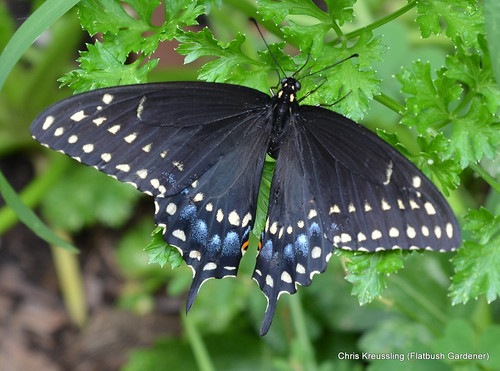
This is a female Eastern Black Swallowtail Butterfly, Papilio polyxenes. I caught her at the moment she discovered our group of parsley plants (Petroselinum hortense, or P. crispum). She was laying eggs, carefully placing just one under separate leaves of two of the plants.