
Showing posts with label Macro. Show all posts

2021-11-19

Hot Sheets Habitat

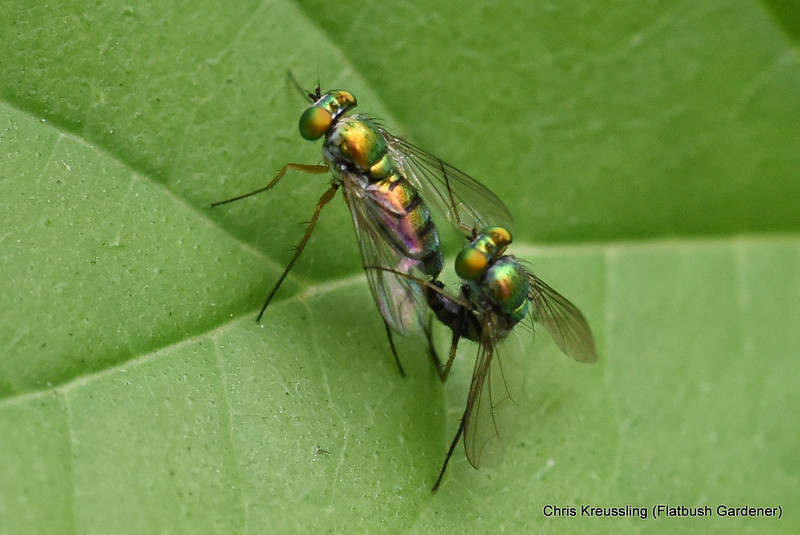
A mating pair of NOID Dolichopodidae, long-legged flies, in my backyard, September 2018

My garden is registered as both a National Wildlife Federation Backyard Wildlife Habitat and Xerces Society Pollinator Habitat. The insects have certainly gotten the message. During 2021, I've been able to document 14 different species of insects mating in my garden.
  1. Acanthoscelidius acephalus, minute seed weevil
  2. Epitrix fuscula
  3. Harmonia axyridis, multi-colored lady beetle (introduced)
  4. Eumerus
  5. Orthonevra nitida, wavy mucksucker
  6. Syritta pipiens, compost fly (introduced)
  7. Toxomerus geminatus, Eastern calligrapher fly
  8. Toxomerus marginatus, margined calligrapher fly
  9. Xenox tigrinus, tiger bee fly
  10. Jalysus, stilt bug
  11. Lygaeus kalmii ssp. angustomarginatus, Eastern small milkweed bug
  12. Hylaeus modestus, modest masked bee
  13. Xylocopa virginica, large Eastern carpenter bee
  14. Danaus plexxipus, monarch butterfly

2007-10-08

A Weekend in the Garden

A fallen leaf from the cherry tree in the backyard
Cherry Leaf
Some macro shots of what's happening in the garden now. Most of the shots are from the backyard, some from the sideyard, along the driveway.

I was really surprised to have this Cicada fly right past me and land on the fence long enough for me to get a good shot of it. I've never see a live one so close up. I usually see them dead on the sidewalk, often missing their abdomen from predation. In that state, the markings on the top of the thorax (?) are dull dark brown and black. I think this is Tibicen canicularis, the dog-day cicada.
Cicada

I've been watching the aphids on these milkweed stems for several weeks. This photo doesn't capture the intense orange-yellow color of these bugs; they look more yellow in the photo than they actually are. I wonder if their color is caused by feeding on milkweed, much like the warning red-orange colors of Monarchs?
Aphids on Milkweed

Berries of Pokeweed, Phytolacca americana
Pokeweed Berries

Berries of Winterberry, Ilex verticillata
Winterberries

Sweet Autumn Clematis

Sunflower
Sunflower


2007-06-18

First Macro Shots

Alstroemeria
Alstroemeria flowers
My new macro lens arrived today. I would say that I was like a kid on Christmas, except that I am notorious among friends and family for carefully unwrapping any gift I receive so as to not tear the paper so I can save it.

The very, very first shot I took was of my router. Not that interesting. I deleted it. The Alstroemeria is the second macro shot I took. One of our next-door neighbors was coming home, and she had a bouquet in her arms. The other shots are from my backyard.

Itea "Little Henry"
Itea "“Little Henry”"

Ilex verticillata, Winterberry (female)
Ilex verticillata (female)

Nepeta calamintha, Catmint "Walker's Low"
Nepeta calamintha "“Walker's Low”"

Note the bonus ant in the above photo!

Hydrangea flower
Hydrangea flower

This lens will take some getting used to before I can select and frame my subjects effectively. It's a long lens, 105mm (digital, logner equivalent 35mm), so the depth-of-field is compressed. The advantage is that the combination of long focal length and closest focusing distance of 1 foot can provide 1:1 reproduction ratios: life-size images captured in the camera, which are much larger than life when enlarged. For example, here's a 1:1 photo of text from the second paragraph of this post:

DSC_2121

Besides shallow depth-of-field, the other disadvantage of a long focal length is increased sensitivity to camera shake. This macro lens also has built-in image stabilization, which counteracts shake by a factor of 2 or more.

I'm really interested in trying out this new lens for insect photography. The lens can focus out to infinity, so I can increase the depth-of-field by shooting from a greater distance. Here's an example of that in the last shot I took today: leaves from the mystery Ligularia I bought at the Chelsea Garden Center two Saturdays ago.

Ligularia leaves
Ligularia leaves

These leaves are exceptionally ruffled. Although much of each leaf is still not in focus, the overall image accurately conveys the texture and depth of the leaves. This is my favorite of the dozen or so shots I took today with my new toy. I'm looking forward to having more play time with it.