2023-02-28

Who Cares About Honeybees, Anyway?

Originally published as a Guest Rant on Garden Rant, November 4, 2009. Recovered from the Internet Archive. I replaced the photo snapshot with a link to the high-res photo on Flickr. I've replaced archive links with current, active links where possible. Those that have since link-rotted are noted.


Subgenus *Agapostemon*, male, on NOID *Helianthus*, perennial sunflower, along my driveway, August 2009

Colony Collapse Disorder (CCD) has been making the news rounds for a few years now. It's old, if still current, news. Dire outcomes from the loss of honeybees have been proffered. For example, PBS recently introduced an online "ask the expert" feature with this:

Since the winter of 2006, millions of bees have vanished, leaving behind empty hives and a damaged ecosystem. [1]

Really? The ECOSYSTEM?! Did they not notice that honeybees aren't part of the ecosystem?

Honeybees are livestock. They are animals which we manage for our uses. We provide them with housing and maintenance. We even move them from field to field, just as we let cows into different pastures for grazing.

Perhaps, if CCD can neither be prevented nor cured, disaster would come to pass. However, the underlying cause would not be the loss of the honeybees but our dependence on them as a consequence of unsustainable agricultural practices.

The old ways of farming include hedgerows, uncultivated areas between fields. The biodiversity of these patches provide substantial habitat for native pollinators, as well as other beneficial insects. When even these rough “unproductive” patches of land are cleared, we set the stage for the patterns that have come to dominate agriculture: more herbicides, more pesticides, more machinery. All of these also damage the soil food webs that support both soil fertility and agricultural ecosystems. Although manufactured inputs provide temporary relief, they reduce the ecological functions of the land, requiring more and greater inputs to achieve the same effect. This is the definition of addiction, and it’s a clear sign that this way of doing business is unsustainable.

Why do we need to ship and truck pollinators around? There are plenty of native pollinators to do the job, where we haven't decimated their habitats. There are 4,000 species of bees alone in North America. 226 species are known in New York City. Many of them visit my gardens in Flatbush, Brooklyn; some have even taken up residence [2]. Many native bees are ground-dwellers which need only some open ground in which to dig their nests. When every patch of ground is cultivated, plowed under or paved over, native pollinators disappear. Suddenly, we “need” honeybees for pollination.

I care about the honeybees. I like my honey and beeswax candles. I support efforts to legalize beekeeping in New York City. But not at the expense of the biodiversity that is all around us, even in the city, if only we care enough to look for it, value it, and nurture it.

Dig Deeper

The Great Pollinator Project [original link defunct]
North American Pollinator Protection Campaign
Saving [Honey] Bees: What We Know Now [About CCD], NY Times, 2009-09-02

Notes

[1] Ask “Silence of the Bees” Expert Dr. Diana Cox-Foster, PBS Blog [original link defunct]
[2] “Cellophane Bees Return”, 2009-05-02 [sic, correct date below]

End of original guest rant.

Related Content

Cellophane Bees Return, 2009-05-09 [cited in the Notes above]
Bee Watchers Needed in NYC (and a rant), 2009-06-09 [This was the original blog post which led to the Guest Rant]

All my Bees posts

Links

2022-12-21

Standing Still 2022: From Darkness

Maybe I am more like Demeter, weeping for the hold darkness has over others, while reaching and hoping for a time when we can bring everyone back into the light.
- Standing Still 2021: Demeter Waiting
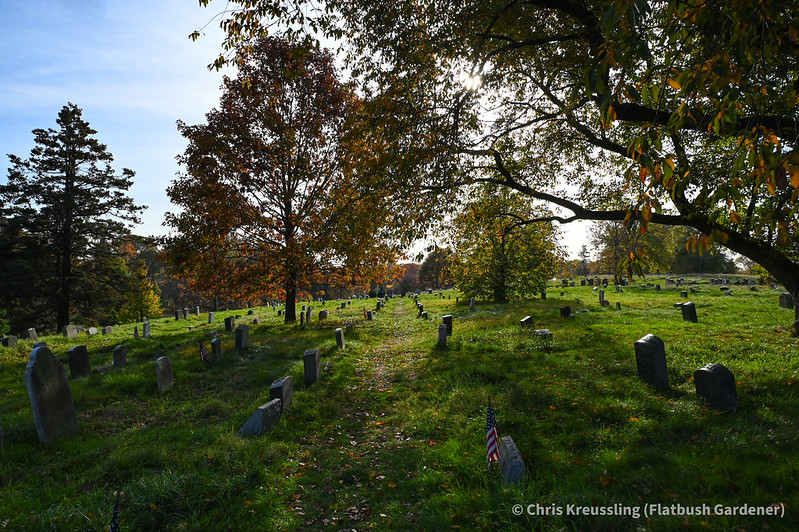
Green-Wood Cemetery, early November 2022
I write again for the solstice. The sun "stands still", as do I.

2022-11-30

Grief and Gardening: Extinct Plants of northern North America 2022

A Single Candle

As in past years, I'm limiting this list to northern North America for two reasons:

  1. Restricting this list geographically is in keeping with my specialization in plants native to northeastern North America.
  2. There are many more tropical plants, and plant extinctions, than I can manage.

In 2020, this paper:

Vascular plant extinction in the continental United States and Canada

caused me to expand my list from 6 to 59 species, including 7 extinct in the wild. The summary is terse, and grim:

2022-10-20

Eastern North America Native Groundcovers

These are some of the Eastern North American species suitable for groundcover, most of which I have grown in my gardens over the decades. Some of these prefer shade, some prefer sun. Most of these will spread by runners, stolons, and the like, as "true" groundcovers. Others are effective as groundcovers because of their habit and crown expansion over time.
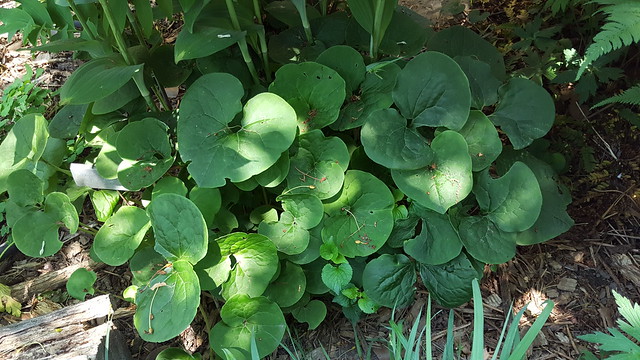
  • Asarum canadense, wild ginger
    Asarum canadense, wild ginger, growing in my urban backyard native plant garden and wildlife habitat, May 2016

2022-09-12

Grief and Gardening: Index

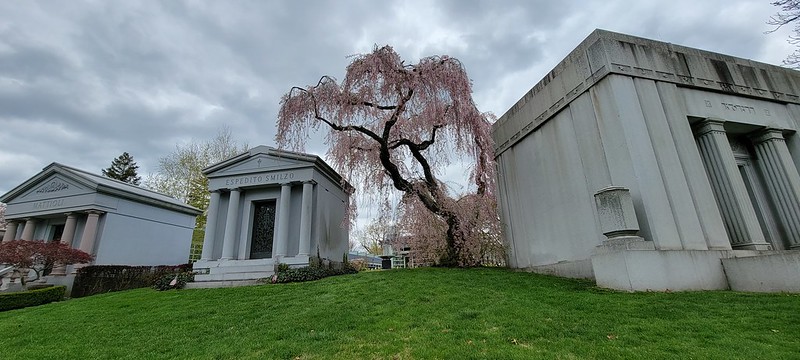
Green-Wood Cemetery, Brooklyn, NY, April 2021
Next Tuesday, September 20th, I will be the guest speaker for Green-Wood Cemetery's Death Cafe. Next week is also Climate Week; the topic is "Grief and Gardening", that title taken from the long-running series of blog posts here.

Listed below are my related blog posts, grouped by topic. For now, I'm omitting all the eulogies and remembrances for the deaths of family, friends, and pets.

Grief and Gardening: Ashes (Remembrance Day for Lost Species), published 2019-12-02, is one of my favorite writings on the subject of grief. It weaves together nearly all the topics below.

Biodiversity Loss

2022-05-02

Sunday, May 22: Habitat Gardening Workshop for NYC Wildflower Week

2022-05-13 UPDATE: A second session is now available for Sunday, May 22, 12 noon to 2pm! Registration links below now point to the new event.
2022-05-09 UPDATE: Due to the rainy, windy, cold weather yesterday, we will be scheduling another session of this workshop for later this week, most likely for the afternoon of Friday, May 13th. Will update here when confirmed!
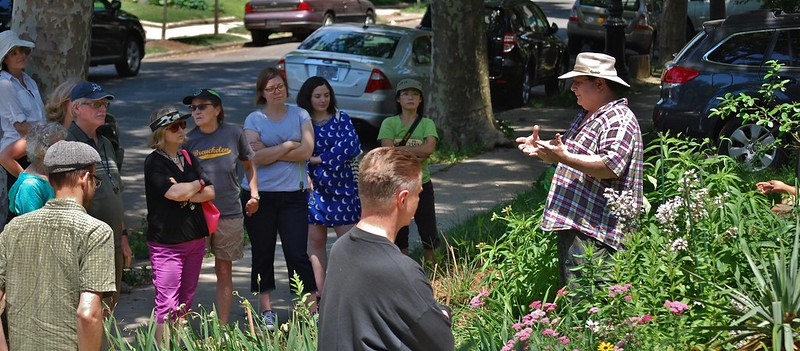
Me hosting the NYCWW Pollinator Week Safari in my Front Yard, June 2014. Photo: Alan Riback

Sunday, May 22nd 6th, I will be hosting and facilitating a workshop on gardening for habitat with native plants in my home garden. The workshop is from 12noon to 2pm. Space is limited, so please register at the Eventbrite link below.

Learn how to garden with native plants to create wildlife habitat, even in small urban gardens. In this interactive garden tour and workshop, Chris will use his garden to highlight the importance of native plants for sustaining urban wildlife, and how to create and maintain a garden for its ecological value. With nearly 200 NYC-native plant species, and over 400 documented insect visitors, you are sure to learn something new and find inspiration for improving habitat wherever you garden.

Presented by Chris Kreussling. Chris is an urban naturalist and advocate for urban habitat gardening with native plants. He has led numerous native plant and pollinator walks and workshops, for NYC Wildflower Week, Wave Hill, the High Line, and others. His garden is a registered habitat with the National Wildlife Federation, Xerces Pollinator Society, and other organizations. He’s documented this ongoing transformation on his gardening blog, Flatbush Gardener and on Twitter as @xrisfg.

- Eventbrite

Related Content

Insect Year in Review 2021, 2022-01-03
Hot Sheets Habitat, 2021-11-19
Documenting Insect-Plant Interactions, 2021-10-29
Presentation: Creating Urban Habitat, 2021-02-04
Home of the Wild, 2020-05-13
Pollinator Safari: Urban Insect Gardening with Native Plants, 2019-06-08
Charismatic Mesofauna, 2019-02-12
Pollinator Gardens, for Schools and Others, 2015-02-20
NYCWW Pollinator Safari of my Gardens, 2014-06-14

Links

Eventbrite registration page
NYC Wildflower Week

2022-04-25

City Nature Challenge 2022 - New York City

Botanizing along the Gowanus, May 2021

The annual City Nature Challenge (CNC) is this weekend, from Friday April 29 through Monday May 2. I put together a presentation on Slideshare with a brief overview of New York City's participation in CNC.

I'm one of the Brooklyn Borough Captains for the NYC Battle of the Boroughs, a friendly inter-borough competition among the boroughs to promote CNC participation across NYC. Following is a list of all the planned events and participating greenspaces in Brooklyn. You can also find this list on the Brooklyn CNC 2022 iNaturalist Project Journal.

2022-04-15

iNaturalist Workshops at GrowTogether, 4/22 & 4/23

Eristalis arbustorum (left) and and Syritta pipiens (right), thick-legged fly, on NOID Lamiaceae, 6&B Community Garden, East VIllage, Manhattan, July 2012

It's a busy season for me this Spring! NEXT WEEK is New York City NYC's GreenThumb community gardening program annual conference, known as GrowTogether:

Part 2 of the GreenThumb GrowTogether conference will be hosted in-person in community gardens in all five boroughs in celebration of Earth Week. Join us for workshops about growing food, healthy eating, native pollinators, flower arrangement, planting seeds, screen printing garden swag, volunteer projects, and more. All the activities are free and open to the public!

... The theme of this year’s GrowTogether is “Deeply Rooted: Growing Community Connections.” Community gardeners from across New York City have been gathering at the GrowTogether conference each spring since 1984 to celebrate the start of the garden season with a day of learning, networking, and reconnecting with friends. - Ibid.

- 38th Annual GreenThumb GrowTogether Conference Part 2 Conference Guide

As noted above, all GrowTogether workshops are open to the public. Please register, as some workshops have limited capacity.

This is my first time participating in GrowTogether. I'll be giving two different workshops on how to use iNaturalist, Friday in Brooklyn, and Saturday on Staten Island.

2022-03-17

Torrey Lecture, Wednesday March 30

2022-04-07: The recording is online on the Torrey Botanical Society YouTube channel.

I am proud to announce that I will be co-presenting, with Zihao Wang, a Lecture of the Torrey Botanical Society on Wednesday March 30 at 6pm. The title of the talk is "City Nature Challenge (CNC) 2022: For Plant-lovers and Botanists Alike."

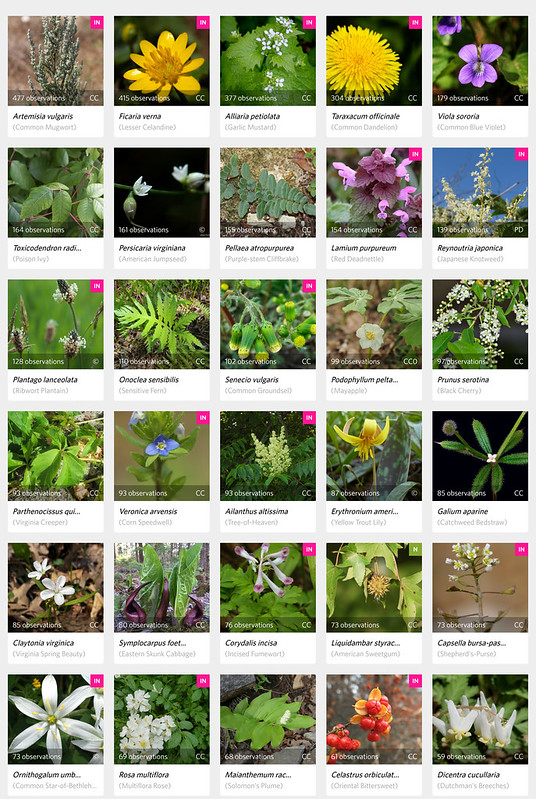
Screenshot of top 30 Species Observed during NYC's CNC 2021

Note that the information we present will be applicable to iNaturalist users and City Nature Challenge observers and identifiers anywhere in the world! So, whereever you are, please join us if you can.

Abstract

Unlike most other citizen science platforms, iNaturalist allows anyone to record their observations of any living thing anywhere in the world. As it approaches 100 million Observations worldwide, it has become increasingly important to botany and other biological sciences. City Nature Challenge, based on iNaturalist, engages community members in cities and urbanized areas around the world to make observations, and provides opportunities for taxonomic experts to identify them, all over the world. Last year over 400 cities participated, with over 50,000 people documenting over 45,000 species with over 1.2 million observations, the largest bioblitz in the world. In this Torrey Talk, two iNaturalist experts will show how you can participate in iNaturalist and this year’s upcoming City Nature Challenge.

Registration

Date: 2022-03-30
Time: 6pm EDT (GMT-04:00)
Duration: 1 hour
Registration: Zoom

The talk will be recorded and made available on the Torrey YouTube channel sometime after the event. Please subscribe to our channel and enable notifications so you get updated when we publish new recordings!

Related Content

Links

Torrey Botanical Society

2022-03-11

Native Plant Profile: Amelanchier

I could probably talk about Amelanchier until my voice gave out (at least an hour!). It's such a great multi-season plant in the garden, and brings so much value to wildlife, as well. It's also a great example of how native plants convey a "sense of place" that is not imparted by conventional, non-native plants in the garden.

Although the Genus is distributed across the Northern hemisphere, the greatest diversity is found in North America. As you can see from the BONAP distribution map, Amelanchier diversity is the greatest in the Northeast. New York State hosts 14 species, varieties, natural hybrids, and subspecies. And New York City is home to 6 of those.

2013 BONAP North American Plant Atlas. TaxonMaps - Amelanchier

Amelanchier in my garden

Amelanchier was one of the key plants I included in my backyard native plant garden design in 2009. To fit my design, I needed a tree form with a single trunk and broad canopy.