Showing posts with label Bees. Show all posts

2015-09-01

Bombus fervidus, golden northern bumblebee, yellow bumblebee

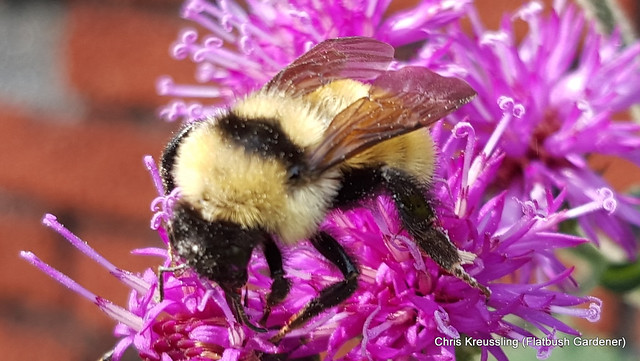
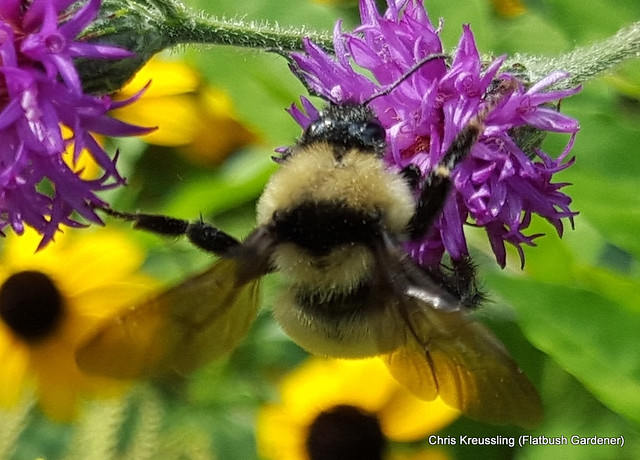
Sunday, while cutting up edited plants into my compost tumbler, I caught sight of something unusual out of the corner of my eye. It turned out to be Bombus fervidus, golden northern bumblebee, or simply, the yellow bumblebee.
Bombus fervidus, golden northern bumblebee, on Vernonia noveboracensis, New York ironweed, in my garden, August 2015

This is at least the 21st bee species I've found in my garden. And this brings to 20, or more, the number of new insect species I've identified in my garden this year alone.

Bombus fervidus, golden northern bumblebee

Related Content

Flickr photo set
All my bee photo albums

Links

BugGuide: Bombus fervidus, Golden Northern Bumble Bee
Discover Life: Bombus fervidus
Encyclopedia of Life: Bombus fervidus

2014-08-10

Megachile, Leaf-Cutter Bees

A leaf-cutter bee removes a segment from a leaf of Rhododendron viscosum, swamp azalea, in my urban backyard native plant garden and wildlife habitat (National Wildlife Federation Certified Wildlife Habitat #141,173). You can see other segments - both completed and interrupted - on the same and adjacent leaves.


Like carpenter bees, Leaf-cutters are solitary bees that outfit their nests in tunnels in wood. Unlike carpenter bees, they're unable to chew out their own tunnels, and so rely on existing ones. This year, I've observed a large leaf-cutter - yet to be identified - reusing a tunnel bored in previous years by the large Eastern carpenter bee, Xylocopa virginica.

They use the leaf segments to line the tunnels. The leaves of every native woody plant in my garden has many of these arcs cut from the leaves. The sizes of the arcs range widely, from dine-sized down to pencil-points, reflecting the different sizes of the bee species responsible.

Tiny arcs cut from the leaves of Wisteria frutescens in my backyard.


I speculate that different species of bees associate with different species of plants in my gardens. The thickness and texture of the leaves, their moisture content, and their chemical composition must all play a part. I've yet to locate any research on this; research, that is, that's not locked up behind a paywall by the scam that passes for most of scientific publishing.

Although I've observed the "damage" on leaves in my garden for years, this was the first time I witnessed the behavior. Even standing in the full sun, I got chills all over my body. I recognize now that the "bees with big green butts" I've seen flying around, but unable to observe closely, let alone capture in a photograph, have been leaf-cutter bees.

As a group, they're most easily identified by another difference: they carry pollen on the underside of their abdomen. A bee that has pollen, or fuzzy hairs, there will be a leaf-cutter bee.

An unidentified Megachile, leaf-cutter bee, I found in my garden.


Another behavior I observe among the leaf-cutters in my garden is that they tend to hold their abdomens above the line of their body, rather than below, as with other bees. Perhaps this is a behavioral adaptation to protect the pollen they collect. In any case, when I see a "bee with a perky butt," I know it's a leaf-cutter bee.

When they're not collecting leaves, they're collecting pollen. Having patches of different plant species that bloom at different times of the year is crucial to providing a continuous supply of food for both the adults and their young.

An individual bee will visit different plant species (yes, I follow them to see what they're doing). And different leaf-cutter species prefer different flowers. All the plants I've observed them visit share a common trait: they have tight clusters of flowers holding many small flowers; large, showy flowers hold no interest for the leaf-cutter bees.

Related Content

Links

BugGuide: Genus Megachile

2011-07-31

Gardening with the Hymenoptera (and yet not)

Contents


One of the great pleasures of gardening is observing the activity the garden invites. I can lay out the welcome mat, and set the table, but the guests decide whether or not the invitation is enticing enough to stop by for a drink, a meal, or to raise a family. While charismatic megafauna such as birds and mammals are entertaining, the most common and endlessly diverse visitors are insects.

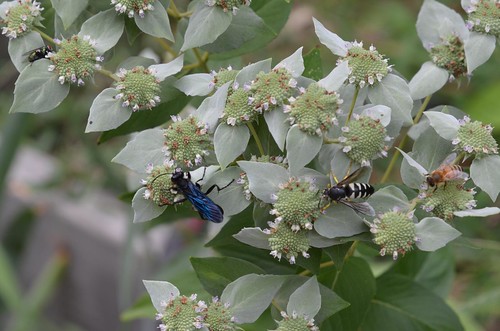
The Hymenoptera includes bees, wasps, and ants. Although my garden also provides amply for ants, we'll stick with the bees and wasps today. Following are some of the few portaits I've been able to capture of the many visitors to my gardens. The pollinator magnet, Pycnanthemum, Mountain-mint, in the Lamiaceae, provides the stage for many of these photos. I'm always amazed at the variety and abundance of insect activity it attracts when blooming.

Multiple pollinators on Pycnanthemum
Multiple Pollinators on Pycnanthemum

Bees

There are over 250 species of bees native to New York City alone. I'm still learning to identify just a handful of the dozens of species that frequent my garden.

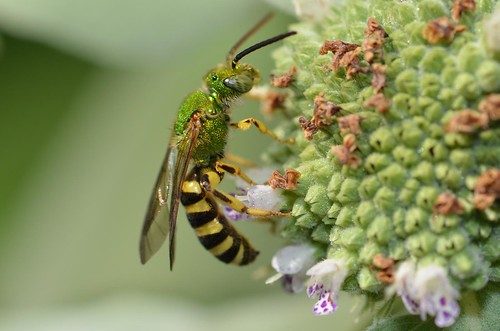
My current favorite is the bejeweled Agapostemon, Jade Bee
Agapostemon, Jade Bee, on Pycnanthemum

2010-04-26

Cellophane Bees Return

Cellophane Bee

Colletes thoracicus, Cellophane Bee, is a native species of solitary, ground-nesting bees. Solitary, because each nest is burrowed out by a single queen, who constructs several chambers in which to lay individual eggs. Solitary, yet communal: where they find the right conditions, the nests can be densely packed.Here's a short video showing the activity on Saturday morning.


This is the third year for what I've come to think of as "my little bees." I noticed the holes earlier last week, and saw all this activity last Saturday, as I was readying for the Plant Swap. This is the earliest in the year that I've noticed them.

Make Your Garden Bee-Friendly

These bees took up residence in a "neglected" spot of the garden, one of the benefits of being a lazy gardener/ecosystem engineer. Different species of bees have different requirements. Here are some things you can do to make your garden bee-friendly.

2009-11-04

Who Cares About Honeybees, Anyway?

2021-10-26: Scraped and back-dated from an Internet Archive copy of Garden Rant.

Originally published as a Guest Rant on Garden Rant on November 4, 2009. The original is no longer available on their Web site.
 

Subgenus *Agapostemon*, male, on NOID *Helianthus*, perennial sunflower, along my driveway, August 2009 
Colony Collapse Disorder (CCD) has been making the news rounds for a few years now. It's old, if still current, news. Dire outcomes from the loss of honeybees have been proffered. For example, PBS recently introduced an online "ask the expert" feature with this:
Since the winter of 2006, millions of bees have vanished, leaving behind empty hives and a damaged ecosystem. 

- Ask “Silence of the Bees” Expert Dr. Diana Cox-Foster, PBS Blog
Really? The ECOSYSTEM?! Did they not notice that honeybees aren't part of the ecosystem? 

Honeybees are livestock. They are animals which we manage for our uses. We provide them with housing and maintenance. We even move them from field to field, just as we let cows into different pastures for grazing.

Perhaps, if CCD can neither be prevented nor cured, disaster would come to pass. However, the underlying cause would not be the loss of the honeybees but our dependence on them as a consequence of unsustainable agricultural practices.

The old ways of farming include hedgerows, uncultivated areas between fields. The biodiversity of these patches provide substantial habitat for native pollinators, as well as other beneficial insects. When even these rough “unproductive” patches of land are cleared, we set the stage for the patterns that have come to dominate agriculture: more herbicides, more pesticides, more machinery. All of these also damage the soil food webs that support both soil fertility and agricultural ecosystems. Although  manufactured inputs provide temporary relief, they reduce the ecological functions of the land, requiring more and greater inputs to achieve the same effect. This is the definition of addiction, and it’s a clear sign that this way of doing business is unsustainable.

Why do we need to ship and truck pollinators around? There are plenty of native pollinators to do the job, where we haven't decimated their habitats. There are 4,000 species of bees alone in North America. 226 species are known in New York City. Many of them visit my gardens in Flatbush, Brooklyn; some have even taken up residence. Many native bees are ground-dwellers which need only some open ground in which to dig their nests. When every patch of ground is cultivated, plowed under or paved over, native pollinators disappear. Suddenly, we “need” honeybees for pollination.

I care about the honeybees. I like my honey and beeswax candles. I support efforts to legalize beekeeping in New York City. But not at the expense of the biodiversity that is all around us, even in the city, if only we care enough to look for it, value it, and nurture it.

Related Content

Cellophane Bees Return, 2009-05-02

Links

Ask “Silence of the Bees” Expert Dr. Diana Cox-Foster. [http://www.pbs.org/engage/blog/ask-%E2%80%9Csilence-bees%E2%80%9D-expert-dr-diana-cox-foster], PBS Blog 


Saving [Honey] Bees: What We Know Now [About CCD] http://roomfordebate.blogs.nytimes.com/2009/09/02/saving-bees-what-we-know-now/], NY Times, 2009-09-02

2009-08-16

Eristalis transversa, Transverse Flower Fly

This beautiful creature is not a bee. It's a fly of the Syrphidae, a family of flies renowned for bee mimics. This is Eristalis transversa, Transverse Flower Fly. I had noticed it in my garden for the first time this summer. yesterday was the first chance I had to capture some photos of it. Consider this a belated Garden Blogging Bloom Day post, but with a native pollinator as the focal point.

Eristalis transversa, Transverse Flower Fly

Eristalis transversa, Transverse Flower Fly

The flower it's visiting is Aster novae-angliae 'Chilly Winds', a selection of the native New England Aster from Seneca Hills Perennials in upstate New York. This plant has been a pollinator magnet in my backyard native plant garden for weeks. It's massive and overgrown and poorly placed, crowding out everything else around it. I'll have to find it another place for next year.


[bit.ly]

Related Content

Flickr photo set
My BugGuide images

Links

BugGuide page
Seneca Hills Perennials

2009-06-05

Bee Watchers Needed in NYC (and a rant)

The Great Pollinator Project, a joint effort of the Greenbelt Native Plant Center and the Center for Biodiversity and Conservation, is recruiting volunteers for 2009 to record and report observations of native bee species in New York City. They are conducting orientations over the next week from 6-8pm at the following locations:

Brooklyn: Monday, June 8th at Brooklyn Botanic Garden, 1000 Washington Avenue
Staten Island: Tuesday, June 9th at Greenbelt Nature Center, 700 Rockland Avenue
Bronx: Tuesday, June 9th at Van Cortlandt House Museum, Van Cortlandt Park
Queens: Wednesday, June 10th at Alley Pond Environmental Center (APEC) 228-06 Northern Blvd.
Manhattan: Tuesday, June 16th at Central Park, North Meadow Recreation Center (Off of 97th St. Transverse Road)

You can RSVP online, by emailing beewatchers@gmail.com, or by calling 718-370-9044.

I'll take this opportunity to rant a bit. Honeybees, which we manage both for their products - honey and beeswax - and their service as pollinators, are a single, non-native, species of bee. Colony Collapse Disorder (CCD) has been widely reported for several years and is well-embedded in the public consciousness. Meanwhile, the circumstances of the thousands of bee species native to North America go unreported.

Much has been made of agriculture's dependence on honeybees for pollination. Dire outcomes from the loss of honeybees - widespread crop failures, famine, even human extinction - have been proffered. Perhaps these things would come to pass. However, the underlying cause would not be the loss of honeybees but our dependence on them through unsustainable agricultural practices.

Honeybees are livestock. They are animals which we manage for our uses. We provide them with housing, maintenance, even move them from field to field as we let cows into different pastures for grazing.

Native pollinators will do the job, but only if we leave them a place to live. We clear land for orchards and fields, removing the hedgerows and other "messy" places that had been their home. The monocultures of agriculture are magnified in the deserts of diversity they create. Of course we need to ship domesticated pollinators around (burning fossil fuels in the process); we've eliminated the native pollinators by destroying their habitats. In the process, we've also driven out native predators of plant pests, thereby initating the addictive cycle of pesticides, fertilizers, more and more inputs needed just to tread water on land until our systems collapse around us.

If that should come to pass, just don't blame the bees.
One-third of our food depends on the services of a pollinator—bee or other insect, bird, or mammal. Bees are the most important pollinators in the Northeastern U.S., and there are more than 200 species of bees that live right here in New York City. We need to protect these local pollinators that help keep our parks and green spaces healthy and beautiful, and our farmers’ markets stocked with fresh produce.

In 2007, the Center for Biodiversity and Conservation and the Greenbelt Native Plant Center began the Great Pollinator Project (GPP) in collaboration with the Great Sunflower Project in San Francisco, CA. The goals of the GPP are:
1) identify which areas of New York City have good pollinator service (as determined by how quickly bees show up to pollinate flowers at various locations throughout the city);
2) increase understanding of bee distribution;
3) raise public awareness of native bees; and
4) improve park management and home gardening practices to benefit native bees.

If you are interested in our local pollinators, we need your help!

- The Great Pollinator Project
There are many ways to be a Bee Watcher:
  • Observe bee visitation at selected plants that will be distributed at our spring orientations. Conduct your observations in your own garden and submit your data online.
  • Become a Mobile Bee Watcher. Conduct your observations on flowers in your neighborhood or at selected bee gardens planted at various locations throughout New York City and submit your data online.
- Bee Watchers

Related Content

Bees, a Mockingbird, and Marriage Equality, 2009-05-22
Cellophane Bees Return, 2009-05-09
Colletes thoracicus (Colletidae), Cellophane Bees, 2008-05-26

Links

Great Pollinator Project
Greenbelt Native Plant Center
Center for Biodiversity and Conservation

2009-05-22

Bees, a Mockingbird, and Marriage Equality

2022-05-29: This is now the FOURTH time WNYC has broken the link. Fixed again. (What the *^!% is wrong with them?!)
2022-04-13: Updated - yet again - the link to the recording which WNYC broke for the third time.
2012-05-21: Updated - again - the links which WNYC broke - again.
2011-08-23: Updated to current links from the old ones which WNYC voided.

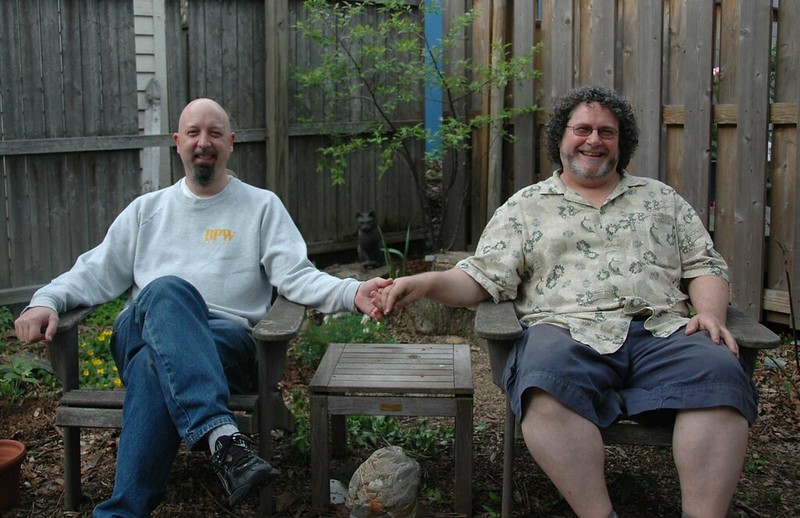
Domestic Bliss: Blog Widow (left) and me in the gardener's nook on the occasion of the interview. I had just transplanted the female Ilex verticillata in the background that morning.
Flatbush Gardener (right) and Blog Widow
Two weekends ago, Blog Widow and I were interviewed by WNYC's Kathleen Horan on the topic of marriage equality - marriage for all - in New York state. The piece aired this morning, and is available on the WNYC News Blog. We make our appearance about 4:55 into the segment.

Marriage Equality, Kathleen Horan, 2009-05-22

I didn't get to listen to it when it aired at 7:50am this morning. I thought it might be off-topic for the blog. But since most of my part of the aired conversation is about the garden, I figure it it's not much of a stretch. Please give it a listen, and let me know what you think in the comments below.

Related Content

Wildflowers in a Flatbush Backyard, 2009-05-11
Cellophane Bees Return, 2009-05-09

Links

Debating "Marriage Equality" , Kathleen Horan, WNYC

2009-05-09

Cellophane Bees Return

I'm no entomologist, but I think this is the same species, Colletes thoracicus (Colletidae), Cellophane Bees, that "bee guy" John Ascher identified from my photos last year. This is an individual from a colony that appeared this week in the same place it appeared last year about this time.

Colletes thoracicus (Colletidae), Cellophane Bees

We've had rain almost every day for a week. Yesterday I had the day off, and the weather also took a break, with sunny skies and temperatures in the 70s (F). Seems like perfect digging-in-the-ground conditions to me.

The area of activity is much larger this year than last. I wish I had a video camera. In the area of this photo, there were at least 30-40 bees flying around, but I can't pick them out from the photo at this scale and resolution.

Colony Area

Related Content

Colletes thoracicus (Colletidae), Cellophane Bees, 2008-05-26
Flickr photo set

Links

Wikipedia: Colletidae

2009-03-10

Sunday in the Garden

Sunday was warm, highs in the 60s (F). The Crocus were open. And the honeybees were swarming over them.

Honeybee on Crocus tommasinanus
Honeybee on Crocus tommasinianus

There are at least five (5) honeybees in this photo. Can you find them all?
Crocus tommasinianus

This is the third year for these little Crocus tommasinianus. They've grown into this small grove from just a handful of corms. Here's how they looked in March 2007:

Crocus tommasinianus and Eranthis hyemalis

The Eranthis in the above photo have not persisted. You can see how the Crocus have thrived.

Related Content

Other posts about the Front Garden

2008-06-03

Circus of the Spineless #33

Colletes thoracicus (Colletidae), Cellophane Bee

Circus of the Spineless #33 (COTS 33) is up on Seeds Aside.

I submitted my post and photographs of Cellophane Bees from last weekend. This is only my second contribution to COTS. My first was two years ago, in COTS #10.

I thought of sending in my post about Magicicada, but since I haven't actually encountered any, it seemed premature.

The next edition, COTS #34, will be posted at Gossamer Tapestry. Send your submissions to Doug: dtaron(at)gmail.com before June, 29.

Related Posts

Colletes thoracicus (Colletidae), Cellophane Bees, May
Coleomegilla usurps Coccinella as New York State Insect, June 23, 2006

Links

Circus of the Spineless #33, Seeds Aside
Circus of the Spineless

2008-05-26

Colletes thoracicus (Colletidae), Cellophane Bees

Update 2009.05.09: Cellophane Bees Return
Update 2008.05.28: Many thanks to John Ascher for the id!


Colletes thoracicus (Colletidae), Cellophane Bee

While spending most of the weekend gardening, I discovered that the garden is home to a small colony of mining cellophane bees. At first I thought they Andrenidae, mining bees, based on photos and this description on BugGuide.Net:
Many small, ground-nesting bees observed in areas of sandy soil are members of the family, Andrenidae. Characteristics of this family (of which there are approximately 3000 species) are: Small size, 20 mm, (or smaller) brown to black in color, and nesting in a burrow in areas of sparse vegetation, old meadows, dry road beds, sandy paths. Although the nests are built in close proximity of one another, the bees are solitary (each female capable of constructing a nest and reproducing). Many species are active in March and April when they collect pollen and nectar from early spring blooming flowers. The female bee digs a hole 2-3 inches deep excavating the soil and leaving a pile on the surface. She then digs a side tunnel that ends in a chamber (there are about 8 chambers per burrow). Each chamber is then filled with a small ball of pollen and nectar. An egg is laid on the top of each pollen ball and the female seals each brood chamber. The emerging larval bees feed on the pollen/nectar ball until they pupate.
- Family Andrenidae - Mining Bees, BugGuide.Net
I contacted Kevin Matteson, contact person for the Bee Watchers 2008 project here in NYC. I wasn't able to attend any of their orientation session last week, so I forwarded him a link to this post. He in turn forwarded the link to his "colleague at the museum." Thus turned out to be John Ascher, a BugGuide contributing editor, and all-around big bee guy, who identified the species in the first comment below. Considering I don't have a Ph.D. in Entomology, I don't feel so bad.
[Colletes] are virtually indistinguishable from some of the Andrenidae mining bees. Colletes are honey bee size, and have dramatic black and white banding on the abdomen. Some andrenids have similar markings, but are usually slightly smaller. Colletes tend to nest in dense aggregations, while andrenids are not usually as populous.
- Genus Colletes - Cellophane Bees, BugGuide.Net
I noticed the first entrance mound a couple of weeks ago, shortly after I put up the bat house. I saw a discoloration on the ground directly below the bat house, and thought it might be guano. On closer inspection, I thought it was an anthill.

This weekend, I was doing a lot of work near that corner of the house, and the presence of bees was more obvious, especially when I started digging up and dividing perennials (Hemerocallis and Hosta) from a bed I was preparing for a new sunny native plant border.

I also noticed that the bees were entering and leaving what I had taken to be ant hills. Here's the area where they're all nesting. There are six entrance holes visible in this photo. There are a couple more hidden beneath leaves. The area is less than a square foot.

Colletes thoracicus (Colletidae), Cellophane Bees in the garden

Here's a closer view of the three entrances to the left. Zoom in and check out the leftmost one. There's a little bee in there checking me out.

Colletes thoracicus (Colletidae), Cellophane Bees in the garden

When I saw all this activity around numerous holes, I thought I might have a hive. Since they're adjacent to the house, I was worried that they might move in. Before I did anything with them, I wanted to identify them to find out what they were.

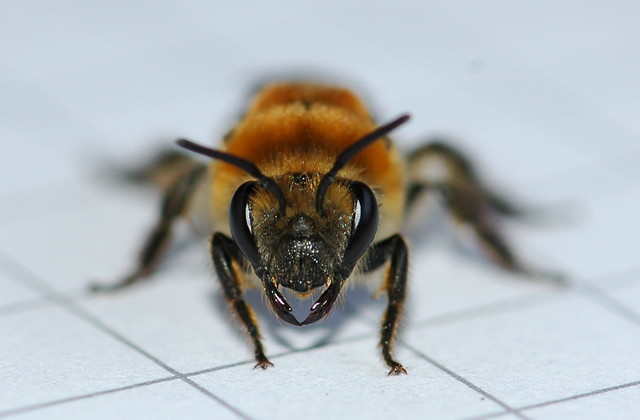
To photograph this individual, I captured it in a plastic jug and placed it in the refrigerator for a few hours. When I retrieved it, it was inert, and I first feared I had killed it. When I took it into the backyard, where temperatures were still in the 70s, thankfully it slowly revived. I placed it on a piece of graph paper from my notebook for scale. The squares are 1/4".

Here are two more views of the same individual. When I was done, I returned it back to the nesting area. Not realizing these are solitary bees, I thought it would return to the hive. It flew off, instead. I hope it returns and is able to find its own nest, again.

Colletes thoracicus (Colletidae), Cellophane Bee

Colletes thoracicus (Colletidae), Cellophane Bee

I want to take some more shots. I think I can get a shot of the wing venation without harming the individual. I'll be more careful to not keep the subject away from its nest for so long next time. Maybe only a half-hour of chilling is all I would need to get my shots.

I'm not satisfied with the depth of field (DOF) in any of these shots. My macro lens has a focal length of 105mm (digital, around 150mm equivalent 35mm), which compresses DOF. Using the flash helped a lot. A tripod would be better. I'll try some different options on my next attempts.

Links

Colletes thoracicus, Discover Life
Bee Watchers 2008
Family Andrenidae - Mining Bees, BugGuide.Net

2007-09-11

Canaries in the Coal Mine: Honeybees and Climate Change

NASA scientist Wayne Esaias believes that a beehive's seasonal cycle of weight gain and loss is a sensitive indicator of the impact of climate change on flowering plants. A hobbyist beekeeper, he has found signals of climate change in his records of the weight of his beehives, and wants to enlist other beekeepers to contribute their observations as well:
The 25-year NASA veteran has made a career studying patterns of plant growth in the world’s oceans and how they relate to climate and ecosystem change, first from ships, then from aircraft, and finally from satellites. But for the past year, he’s been preoccupied with his bee hives, which started as a family project around 1990 when his son was in the Boy Scouts. According to his honeybees, big changes are underway in Maryland forests. The most important event in the life of flowering plants and their pollinators—flowering itself—is happening much earlier in the year than it used to. - Buzzing About Climate Change
[The] 1-to-5-kilometer-radius area in which a hive’s worker bees forage is the same spatial scale that many ecological and climate models use to predict ecosystems’ responses to climate change. It also matches the spatial scale of satellite images of vegetation collected by NASA’s Terra and Aqua satellites. This similarity of scale means that all these ways of studying ecosystems could be integrated into a more sophisticated picture of how plant and animal communities will respond to climate change than any one method alone could provide. Esaias is particularly interested in comparing the hive data to satellite-based maps of vegetation “greenness,” a scale that remote-sensing scientists commonly use to map the health and density of Earth’s vegetation. Scientists have been making these types of maps for decades, and they have used them to document how warming temperatures in the Northern Hemisphere are causing vegetation to green up earlier in the spring than it did in the 1980s. Such maps are an excellent general indicator of seasonal changes in vegetation, says Esaias, but by themselves, they won’t tell you something as tangible as when plants are flowering. - Will Plants and Pollinators Get Out of Sync?
About half of the approximately 6 million honeybee colonies in the United States are kept by individual or family-scale beekeepers. Esaias’ vision is to develop a how-to guide, an automatic data recorder, and the computer and networking resources at Goddard Space Flight Center that would be needed to collect and preserve the data. Ideally, a hive data recorder would be hooked up to the Internet so that volunteers’ hive weights could appear on a Website hosted at Goddard. His goal is to get the cost per kit below $200 and then to get NASA funding to outfit a network of volunteers — HoneybeeNet — and analyze their data. “Ultimately, what we’d like to have is thousands of these across the country. Even if we can get the cost down to $200 a piece, that is still a lot of money to ask for until you have a test data set that proves it is valuable,” admits Esaias. He’s been working with local bee clubs in Maryland, rounding up some 20 volunteers who already have or are willing to purchase their own scales. He hopes that the data collected during the 2007 spring-summer season will be a prototype that will convince NASA to fund a pilot project.
Links: HoneybeeNet Colony Collapse Disorder (CCD) Heat Island Effect