Showing posts with label Gardening. Show all posts

2022-09-12

Grief and Gardening: Index

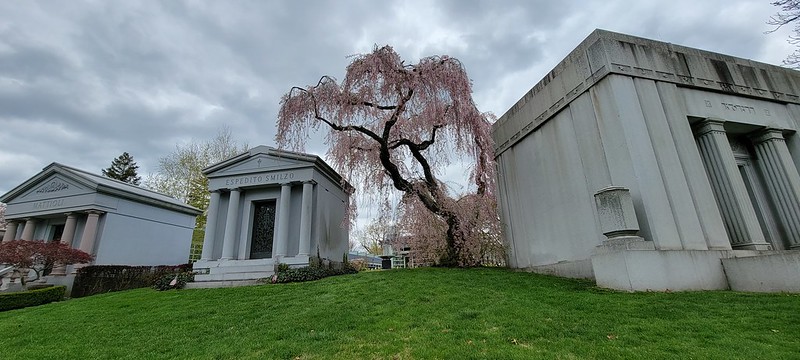
Green-Wood Cemetery, Brooklyn, NY, April 2021
Next Tuesday, September 20th, I will be the guest speaker for Green-Wood Cemetery's Death Cafe. Next week is also Climate Week; the topic is "Grief and Gardening", that title taken from the long-running series of blog posts here.

Listed below are my related blog posts, grouped by topic. For now, I'm omitting all the eulogies and remembrances for the deaths of family, friends, and pets.

Grief and Gardening: Ashes (Remembrance Day for Lost Species), published 2019-12-02, is one of my favorite writings on the subject of grief. It weaves together nearly all the topics below.

Biodiversity Loss

2022-05-02

Sunday, May 22: Habitat Gardening Workshop for NYC Wildflower Week

2022-05-13 UPDATE: A second session is now available for Sunday, May 22, 12 noon to 2pm! Registration links below now point to the new event.
2022-05-09 UPDATE: Due to the rainy, windy, cold weather yesterday, we will be scheduling another session of this workshop for later this week, most likely for the afternoon of Friday, May 13th. Will update here when confirmed!
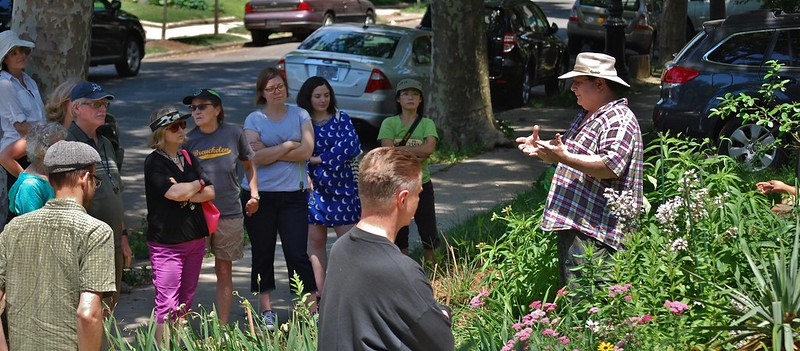
Me hosting the NYCWW Pollinator Week Safari in my Front Yard, June 2014. Photo: Alan Riback

Sunday, May 22nd 6th, I will be hosting and facilitating a workshop on gardening for habitat with native plants in my home garden. The workshop is from 12noon to 2pm. Space is limited, so please register at the Eventbrite link below.

Learn how to garden with native plants to create wildlife habitat, even in small urban gardens. In this interactive garden tour and workshop, Chris will use his garden to highlight the importance of native plants for sustaining urban wildlife, and how to create and maintain a garden for its ecological value. With nearly 200 NYC-native plant species, and over 400 documented insect visitors, you are sure to learn something new and find inspiration for improving habitat wherever you garden.

Presented by Chris Kreussling. Chris is an urban naturalist and advocate for urban habitat gardening with native plants. He has led numerous native plant and pollinator walks and workshops, for NYC Wildflower Week, Wave Hill, the High Line, and others. His garden is a registered habitat with the National Wildlife Federation, Xerces Pollinator Society, and other organizations. He’s documented this ongoing transformation on his gardening blog, Flatbush Gardener and on Twitter as @xrisfg.

- Eventbrite

Related Content

Insect Year in Review 2021, 2022-01-03
Hot Sheets Habitat, 2021-11-19
Documenting Insect-Plant Interactions, 2021-10-29
Presentation: Creating Urban Habitat, 2021-02-04
Home of the Wild, 2020-05-13
Pollinator Safari: Urban Insect Gardening with Native Plants, 2019-06-08
Charismatic Mesofauna, 2019-02-12
Pollinator Gardens, for Schools and Others, 2015-02-20
NYCWW Pollinator Safari of my Gardens, 2014-06-14

Links

Eventbrite registration page
NYC Wildflower Week

2016-05-28

Eastern Native Groundcovers

2022-10-20: Please refer to the new, updated list.
I started to reply to a Facebook post and quickly realized I had enough content for a blog post.
Hello from Long Island NY..looking for suggestion for ground cover that won't eat my plants. I would like somthing a bit tamer the vinca . The area is slightly damp..part sun/part shade. Any suggestions. See posted pics! Thanks!!
The accompanying photos show a mix of young trees, shrubs, and perennials in a nice non-lawn streetside garden. The photos show a lot of sun, with some shade. The shade will increase over time as the trees and shrubs fill in.

Another commenter suggested Lamium and Galium, neither of which I would describe as "tame." Either can take over an area in the right conditions.

These are some of the Eastern North American species I've grown and can recommend as groundcover. Some of these prefer shade, some prefer sun. Most of these will spread by runners, stolons, and the like, as "true" groundcovers. Others are effective as groundcovers because of their habit and crown expansion over time.

2015-05-09

Garden Deeper

I had a visceral (in a good way) reaction to Adrian Higgins' writeup of a visit, with Claudia West, to Shenk's Ferry Wildflower Preserve.

I think I'll adopt "ecological horticulturist" to describe my own approach to gardening. Whether you specialize in gardening with native plants, as I do, or prefer to grow plants from around the world, studying their native habitats is, in my experience, the best way to learn how to grow them in a garden.

That doesn't mean you have to recreate the conditions exactly. In many cases, this is impossible, anyway. The native Aquilegia canadensis, eastern red columbine, thrives in the crumbling mortar of my front steps; this location recreates some aspects of the face of a limestone cliff where I saw, decades ago, a huge colony of them in full bloom.
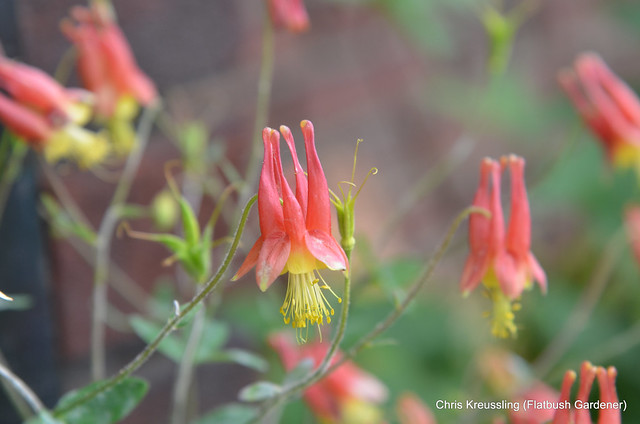
Aquilegia canadensis, Eastern Red Columbine, growing out of my front steps, April 2012

This is why I'm trying to go on more botanical walks and hikes. Like many, if not most, gardeners, I've never seen most of the plants I grow in the wild. I visited Hempstead Plains for the first time in August 2013.
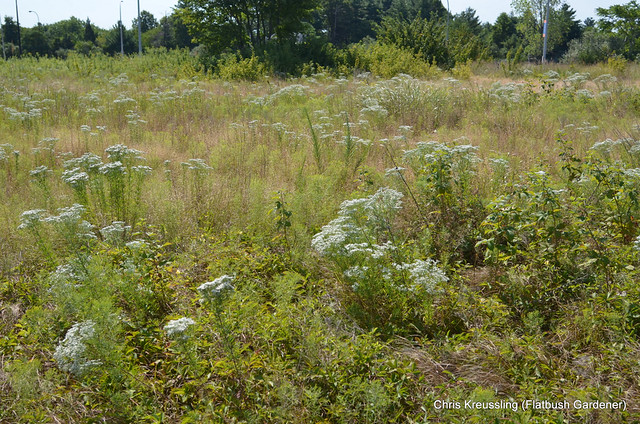
Hempstead Plains

That inspired me last year to remove most of the remaining lawn in the front yard and approach it as a meadow, instead.
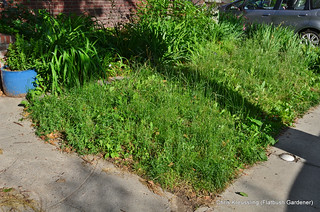
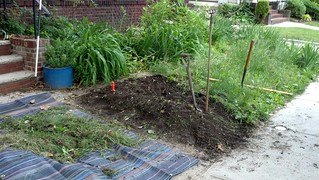
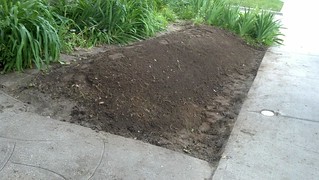
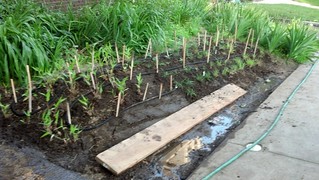
The Front Garden, before de-lawning, June 2014Weeding is Meditation: Removing the old "lawn" for the new short-grass "meadow" in the front yardFinal grading for the new front yard short-grass meadowThe berm, planted. Took 45 minutes, >2/min, including some rework for overly loose and linear spacing.


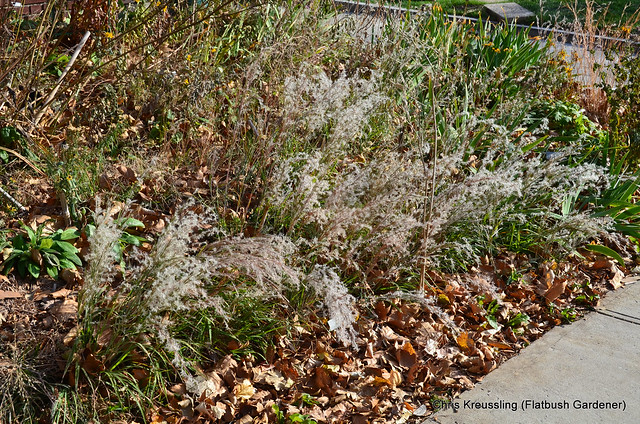
Schizachyrium scoparium, little bluestem (grass), in my front garden, November 2014

Rain gardens and rock gardens are both examples of creating gardens to grow plants requiring specific conditions, and to meet human needs. But we don't need to go to so much trouble. For all the "problem areas" in our gardens, there are plants that want nearly exactly those conditions. We need only think like a plant to see these as opportunities, and embrace the habitats waiting to emerge.

Related Content

Links

What you can learn from a walk through the woods (with Claudia West), Adrian Higgins, Washington Post Home & Garden

2015-04-18

April 2015: Native Plants Planting Plan

2015-04-26 Update: Finally finished planting everything.

Took me most of the day to figure out where all of the 63 plants I received this week are going. Better late then never.

Bog Planters

Plant in the bog planters. I've only seen Iris versicolor, but never grown it. The other species are new to me.
  • Geum rivale, water avens
  • Iris prismatica, slender blue flag
  • Iris versicolor, blue flag
  • Mimulus alatus, winged monkey-flower
  • Mimulus ringens, square-stemmed monkey-flower

2015-02-23

Invasive Plant Profile: Chelidonium majus, Celandine, Greater Celandine

Revised 2015-02-23: This was one of my earliest blog posts, first published in June 2006. I've overhauled it to 1) meet my current technical standards, and 2) improve the content based on the latest available information.


Chelidonium majus, Celandine or Greater Celandine, is a biennial (blooming the second year) herbaceous plant in the Papaveraceae, the Poppy family. It is native to Eurasia. It's the only species in the genus.

It's invasive outside its native range, and widespread across eastern North America. It emerges early in the Spring, before our native wildflowers emerge, and grows quickly to about 2 feet. That's one of the clues to identification. It's also one of the reasons why it's so disruptive. The rapid early growth crowds and shades out native Spring ephemerals.

2014-11-08

Shrubberies

Update 2014-11-23:
  • Completed Step #4 today, nearly injuring myself in the exertion. Did I mention that established grasses have deep and extensive roots?
  • Also completed Step #5, replacing the Panicum.
  • Added Step #9. I'd overlooked this shrub, and need to find a place where it can be featured, while still kept in bounds with the garden. I think where the Aronia once stood, a transplant I did in the Spring of this year.
Update 2014-11-10:
  • I'm taking photos as the work progresses. See Before and After below.
  • Reordered based on the progress I'm making. Because the Rhododendron is shallow-rooted, I decided to leave that until the last weekend before Thanksgiving, when I'll visit my sister and deliver her plants.

It's a long weekend for me. The weather favors gardening.

I've got seven shrubs - and one or two mature perennials - to plant, transplant, and move out. Here's the plan.

2014-06-14

Event: Saturday 6/21 NYCWW Pollinator Safari of my Gardens

On Saturday, June 21, in partnership with NYC Wildflower Week, in observation of Pollinator Week, I'm opening my gardens for a guided tour, what I'm calling a "Pollinator Safari." This is only the third time, and the first time in three years, I've opened my gardens for a tour.

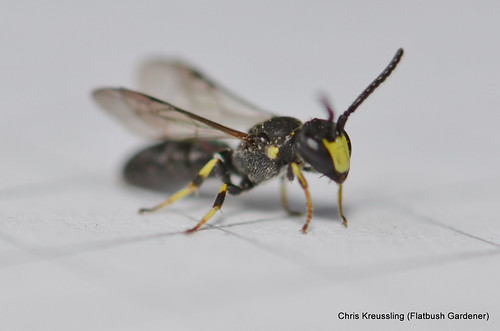
This Hylaeus modestus, Modest Masked Bee, 1/4" long, was visiting the blooms of Viburnum dentatum, Arrowwood, in my garden just two weeks ago. I've documented scores of insect pollinators in my gardens over the years, including bees, wasps, butterflies, moths, flies, and beetles.
Hylaeus modestus modestus, Modest Masked Bee sensu stricto

Here's the information from the Evite page, with a couple of extra links thrown in:
NYC Wildflower WeekPollinator Week in Flatbush, Brooklyn

Date & Time: Saturday, June 21 from 11:00 am - 12:30 pm (rain date Sunday, June 22)
Location: Stratford Road at Matthews Court in Flatbush, Brooklyn

Guides:
Event Description:
  • Since 2005, Chris has transformed a dusty, weedy backyard into a garden oasis. His gardens now incorporate over 80 species of native trees, shrubs, ferns, grasses and wildflowers. He's documented the process on his gardening blog, Flatbush Gardener. In honor of National Pollinator Week, Chris will give us a behind-the-scenes tour!
  • Our bee expert will help us identify some of the gardens' winged visitors, and review tips for creating an insect-friendly sustainable garden in urban settings.
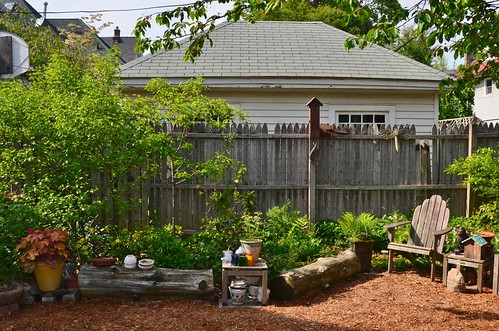
A view of my urban backyard native plant garden, as it looked in 2011, six years in.
The View North in my urban backyard native plant garden, May 2011
The same view as above, when we bought the house, in May 2005
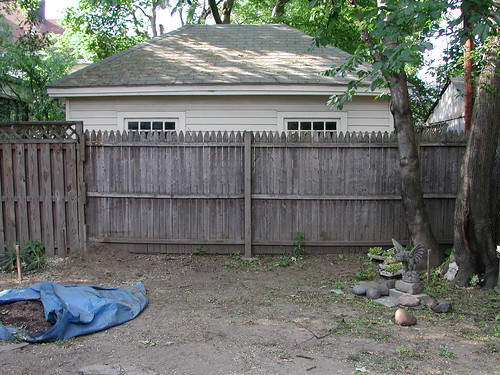
Backyard, view away from garage, May 2005

Related Content

On the blog
My Photography on Flickr

Links

NYC Wildflower Week
Pollinator Week

2013-08-03

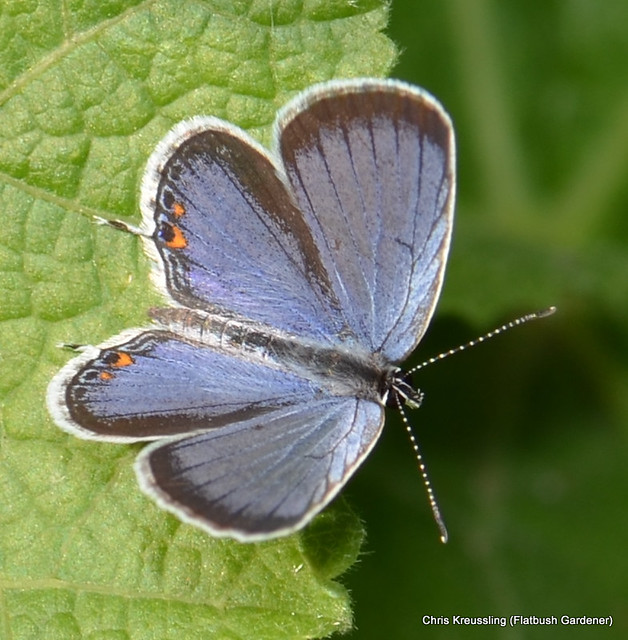
Cupido comyntas, Eastern Tailed-Blue

Cupido comyntas, Eastern Tailed-Blue.


A lifer butterfly for me. Very lucky to get a few good shots of it while it was resting, wings open, to take in some sun. They're small and fast.

2011-07-31

Gardening with the Hymenoptera (and yet not)

Contents


One of the great pleasures of gardening is observing the activity the garden invites. I can lay out the welcome mat, and set the table, but the guests decide whether or not the invitation is enticing enough to stop by for a drink, a meal, or to raise a family. While charismatic megafauna such as birds and mammals are entertaining, the most common and endlessly diverse visitors are insects.

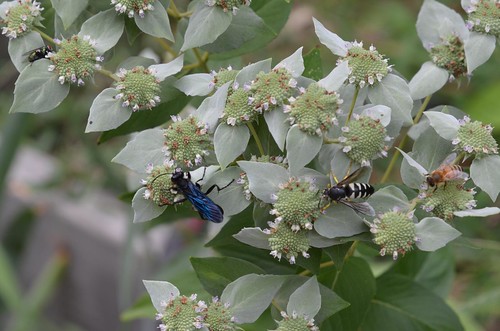
The Hymenoptera includes bees, wasps, and ants. Although my garden also provides amply for ants, we'll stick with the bees and wasps today. Following are some of the few portaits I've been able to capture of the many visitors to my gardens. The pollinator magnet, Pycnanthemum, Mountain-mint, in the Lamiaceae, provides the stage for many of these photos. I'm always amazed at the variety and abundance of insect activity it attracts when blooming.

Multiple pollinators on Pycnanthemum
Multiple Pollinators on Pycnanthemum

Bees

There are over 250 species of bees native to New York City alone. I'm still learning to identify just a handful of the dozens of species that frequent my garden.

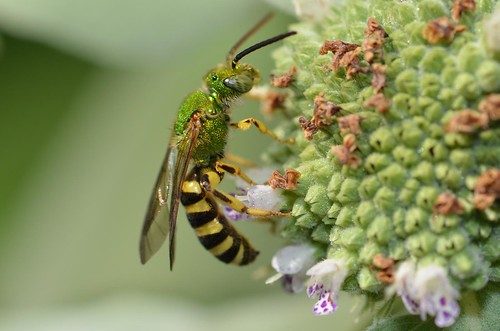
My current favorite is the bejeweled Agapostemon, Jade Bee
Agapostemon, Jade Bee, on Pycnanthemum

2011-03-14

Brooklyn Dirt #2, 3/16, Sycamore Bar and Flower Shop

The second night of the speaker event series Brooklyn Dirt: Monthly Talks on Urban Garden and Farming is this Wednesday, March 16. The topic is Garden Design.

Brooklyn Dirt, March 16, 2011


Prospect Farm and Sustainable Flatbush are proud to present Brooklyn Dirt: Monthly Talks on Urban Farming and Gardening.

Sycamore Bar and Flowershop
1118 Cortelyou Road
Brooklyn, NY, 11218

21 and over only

Directions: Q train to Cortelyou Road

Talk Two: Garden Design
With Speakers Tom Angotti with Jesse Alter (Hunter ) and Chris Kreussling (AKA Flatbush Gardener)
Talk One: Dirt and Soil
Wednesday, February 16, 2011, 7-9:30pm
With Speakers Jay Smith and Chris Kreussling (AKA Flatbush Gardener)

$5 suggested donation. Proceeds benefit Prospect Farm and the Urban Gardens and Farms Initiative of Sustainable Flatbush.

2011-02-06

Brooklyn Dirt, 2/16, Sycamore Bar and Flower Shop

I am honored and excited to be one of the inaugural speakers for a new event series: Brooklyn Dirt - Monthly Talks on Urban Garden and Farming. The topic of this first event is, appropriately, Dirt, aka Soil. If you have questions about soil, or dirt, let me know and Jay and I will try to cover the topic in our talk.

Brooklyn Dirt, February 16, 2011


Prospect Farm and Sustainable Flatbush are proud to present Brooklyn Dirt: Monthly Talks on Urban Farming and Gardening.

Sycamore Bar and Flowershop
1118 Cortelyou Road
Brooklyn, NY, 11218

21 and over only

Directions: Q train to Cortelyou Road

Talk One: Dirt and Soil
Wednesday, February 16, 2011, 7-9:30pm
With Speakers Jay Smith and Chris Kreussling (AKA Flatbush Gardener)

$5 suggested donation. Proceeds benefit Prospect Farm and the Urban Gardens and Farms Initiative of Sustainable Flatbush.

Event on Facebook

2010-09-11

Grief & Gardening: Nine Years

Let's get the usual question out of the way. This is where I was the morning of September 11, 2001.
Skytop and tower, Mohonk, New York, September 10, 2001
This is Skytop Tower at Mohonk Mountain House at sunset the previous night. Blog Widow and I had planned a week-long vacation upstate, starting at Mohonk. The morning of September 11, we hiked up to Skytop. A rustic retreat, Mohonk had no televisions or radios in the rooms. As we left the massive wooden structure to go out hiking, I noticed people huddled around the few televisions in some of the common rooms. I thought nothing of it at the time. I later realized we left just after the first attack.

2010-05-08

Native Plant Profile: Amelanchier x grandiflora

Jump to How to Plant a Tree.

Today I planted Amelanchier x grandiflora 'Autumn Brilliance', Apple Serviceberry, in my backyard native plant garden.
Mulched

I chose my backyard as my final class project for Urban Garden Design at the Brooklyn Botanic Garden last year. Serviceberry is one of the two key plants I specified for my planting scheme. Serviceberries are multi-season plants. They bloom in early Spring, before the flowering cherries. The berries ripen in mid-summer; they are edible and tasty, and attractive to birds. Fall color is excellent. Branching structure and bark provide winter interest.

Here are the initial sketch and final design for the project. The Amelanchier is the second smallest circle on the left (north) of the plan. In this design for an urban woodland garden, the Serviceberry plays the role of an understory tree. The larger circle on the right is Sassafras albidum, the canopy tree, which is proving even more difficult to source than the Amelanchier.

2010-04-26

Cellophane Bees Return

Cellophane Bee

Colletes thoracicus, Cellophane Bee, is a native species of solitary, ground-nesting bees. Solitary, because each nest is burrowed out by a single queen, who constructs several chambers in which to lay individual eggs. Solitary, yet communal: where they find the right conditions, the nests can be densely packed.Here's a short video showing the activity on Saturday morning.


This is the third year for what I've come to think of as "my little bees." I noticed the holes earlier last week, and saw all this activity last Saturday, as I was readying for the Plant Swap. This is the earliest in the year that I've noticed them.

Make Your Garden Bee-Friendly

These bees took up residence in a "neglected" spot of the garden, one of the benefits of being a lazy gardener/ecosystem engineer. Different species of bees have different requirements. Here are some things you can do to make your garden bee-friendly.

2010-04-04

The Fallen

The Fallen

Due to circumstance and inclination, my three decades of urban gardening have been devoted to mostly ornamental private gardens. I have dabbled in the occasional strawberry jar potted up with herbs (successful) and sweet corn in container (wretched). Nevertheless, most of my experience is with perennials and bulbs.

I label my plants. Rather, I label where I plant them. This is most helpful in the off seasons, to dissuade me from scanning some patch of deceivingly barren soil and imagining all the new plants I could acquire to populate it.

In the first garden, in the East Village, I carefully labeled all the little bulbs and plants with plastic labels. The white plastic contrasted strongly with the dark earth. This led one visitor to describe it as a "plant cemetery."

I've since graduated to aluminum labels. They are durable, erasable and reusable. Perhaps most important, less conspicuous. I've also gotten into the habit of scribing the provenance onto the back of the label: the year, and usually also the source from which I purchased the plant.

Nevertheless, they sometimes still serve as markers for those plants that have passed on. This is so common that gardeners have a euphemism for it: "adventurous." I am an adventurous gardener, in that I will plant things I've never grown before, perhaps never ever heard of before reading about it or spying it in some nursery and "rescuing" it.

Here then is a sampling of The Fallen, transcribed from markers I've found in different stashes, collecting dust with years-old seed packets, rusting pruners, and forgotten catalogs.

2010-03-17

In Observance of Irish Pride (St. Patrick's) Day

Updated 2011-03-17: Added links.

Irish Hunger Memorial

Yesterday, with the first good weather of the year, I visited the Irish Hunger Memorial in downtown Manhattan, two blocks from Ground Zero. I've been there before. It definitely had a wintery, wind-swept feel to it this visit. This year, I want to visit it a couple times during the seasons.

Some of the surrounding buildings are new, even in the past few years, since my first visit. The juxtaposition of modern, even stark, architecture with rustic elements is striking.

Here are my photos from that visit.

Slideshow

2009-10-14

Daffodil Project 2009

Update 2009.10.18: Kensington date of 10/18 was rained out. Rain date is 10/25.

The Daffodil Project 2009 distribution at the Greenmarket in Grand Army Plaza, outside Prospect Park, Saturday, October 10, 2009
Daffodil Project Distribution, Grand Army Plaza, October 2009
The Daffodil Project was originally created to commemorate September 11. ... The Daffodil Project is made possible in part by the generosity of a Dutch bulb supplier, Hans van Waardenburg of B&K Flowerbulbs, who has pledged to donate 500,000 daffodil bulbs to the project each year as long as there are volunteers willing to plant them. More than 20,000 volunteers have responded to his challenge so far. And thanks to their efforts, more than 3 million yellow daffodils [bloomed] in over 2,000 individual sites across the five boroughs in the spring of 2009.
- The Daffodil Project, New Yorkers for Parks
Here are some locations in Brooklyn where you can get your bulb on with the Daffodil Project this season.

2009-02-27

Brooklyn Last Frost Date and Spring Planting Calendar

  1. Go to the Spring Planting Calendar setup by Skippy's Vegetable Garden
  2. Enter the date 04/21/2009 as the "Last Spring Frost" date for Brooklyn.
  3. Click the [Generate ...] button.
  4. See how late you already are!
The hardest part of figuring out when to start seeds or set out plants is knowing when the "last frost date" is for your location. NOAA has a set of charts of frost and freeze dates on their Web site, one for each state, with a set of date for each of their measuring stations. Here's the explanation NOAA provides:
This product contains station freeze/frost probability tables for each state. Given are the dates of probable first and last occurrence ... and the probability of experiencing a given temperature, or less ... probabilities are given for three temperatures (36, 32, and 28 °f) at three probability levels (10, 50, and 90 percent).
The chart for New York state [PDF] lists four stations in New York City, including one on Avenue V in Brooklyn. Let's look at the Spring-relevant subsection of the New York state table for NOAA's Brooklyn station:
Threshold (F)90%50%10%
36Apr01Apr11Apr21
32Mar21Apr01Apr13
28Mar10Mar24Apr07
To get the "last frost date" for Brooklyn, I chose the most conservative - the safest - values: the highest of the three temperatures, 36F, and the 10% probability threshold. The date given is April 21. That means that there's only a 10% chance that the temperature will drop to 36F or lower on or after April 21, so that's the date I used for "Last Spring Frost" in the Spring Planting Calendar.

Links

Spring Planting Calendar Skippy's Vegetable Garden NOAA charts of frost and freeze dates

2008-05-27

Gardening Resources, Cornell University

Cornell University is the Land-Grant University for New York state. They operate New York state's Colleges of Veterinary Medicine and Agricultural and Life Sciences. They also operate the state's Cooperative Extension, including their NYC office.

Still, resources for home gardeners are hard to come by. Most of the information available through Cooperative Extensions focuses on issues and practices with economic importance. Cornell has addressed this with a Web portal for Gardening Resources.

Most, but not all, of the links on the portal home page lead to other pages on Cornell's Gardening or their school of Horticulture. A Web portal consolidates information and arranges it by theme regardless of its location or origins. This is especially helpful when the information has been developed independently over time. For example, on the sidebar of Cornell's Gardening Resources home page is a link to their Allstar Groundcovers section. The URL for the groundcovers section places it under Cornell's Entomology department, not the first place I would look for information about groundcovers.

Highlights

Here are a couple more examples of information available through Cornell's Gardening Resources portal:

Cornell University Links

Gardening Resources Portal
Department of Horticulture