
Showing posts with label Plants. Show all posts

2015-01-03

FAQ: Where do you get your plants?

[First in what I hope will be a series of Frequently Asked Questions, FAQs. If you have any questions for me, I invite you to leave a comment, or ping me on Twitter.]

Question: Where do you get your plants?

Answer (short)

I specialize in gardening with native plants. I get my plants from a variety of sources, including mail-order nurseries, local and regional nurseries, annual plant sales, and neighborhood plant exchanges. My Native Plants page has a list of Retail Sources of Native Plants in and around New York City, extending to New England and the Mid-Atlantic.

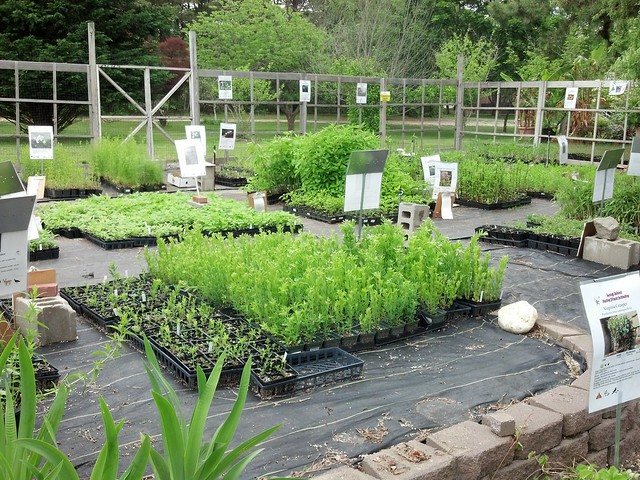
Grasses and Sedges at Rarefind Nursery in Jackson, New Jersey
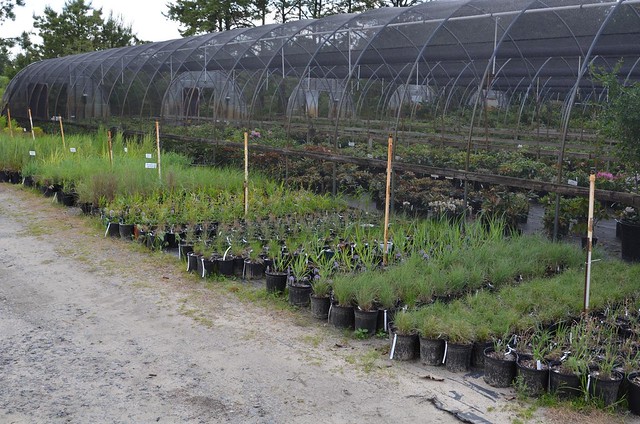
Grasses and Sedges, Rarefind Nursery

Catskill Native Nursery, Kerhonkson, NY
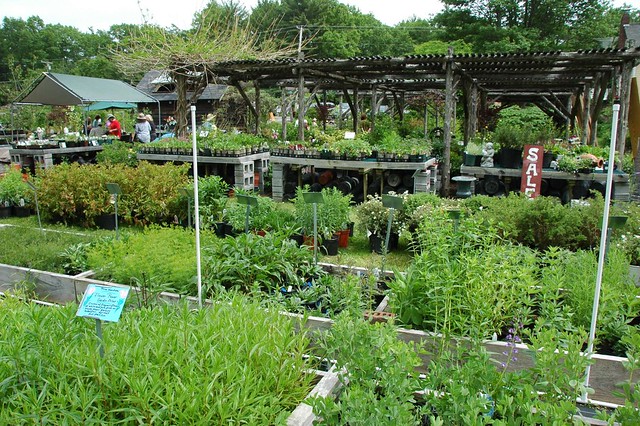

Answer (longer)

I've been gardening in New York City for over three decades, since 1981 or thereabouts in the East Village, since 1992 in Brooklyn. Each garden provided its own challenges, and lessons. The plants I seek out, and where I get them, has changed a lot over time.

The first 20 years: Shade, Concrete, and Invasives

The first garden, in the East Village, was surrounded by adjacent buildings and overtopped by two large Ailanthus altissima trees (the "tree that grew in Brooklyn"). There I learned, by necessity, about gardening in shade. Garden #2, in Park Slope, was nearly all concrete; there I learned to garden in containers. Garden #3, also in Park Slope, had been somewhat neglected; weeds and invasive plants, including Fallopia japonica, Japanese Knotweed, were the lessons there.

I've always included native plants in my gardens. In the East Village garden, I planted a small wildflower area that was, perhaps, my favorite spot. I added a small wildflower plot to the 3rd garden, as well. Out of necessity, most of these were cultivars, the only "native plants" commercially available at the time. I divided many of them and brought them to my current garden.

The 4th Garden

This Spring will be 10 years since we closed on our current home, and I started work on my fourth garden in New York City. Here the lessons have been about rehabilitation, and healing the land, if only in my small pocket of it.

The backyard was the initial focus of my efforts. My goal here was to recreate a shady woodland garden, populated with native woodland plants. Four years in, it was my design subject for the Urban Garden Design class I took at Brooklyn Botanic Garden.
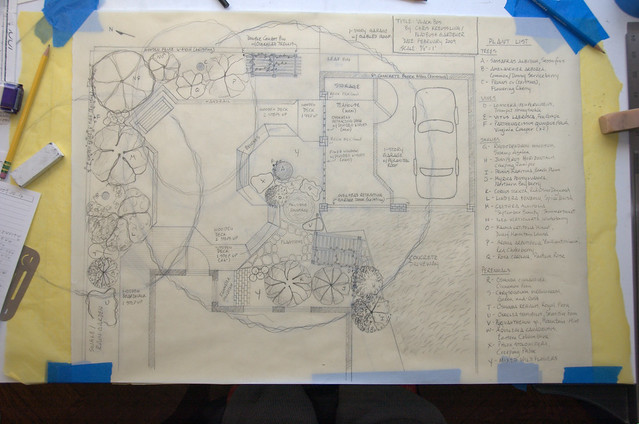
Final rendering, backyard garden design

10 years ago, the backyard was a wasteland of dust and scraggly grass, shaded by multiple Norway maples.
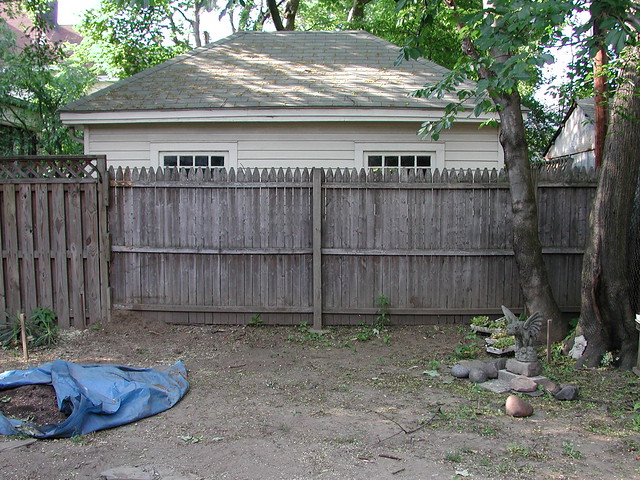
Backyard, view away from garage, May 2005

The first month, I removed four trees from this small space. Over time, the remaining three trees failed and had to be removed. After 10 years, I'm still working on building up the soil to meet the needs of more specialized woodland plants. But I've been largely successful in rehabilitating this space.
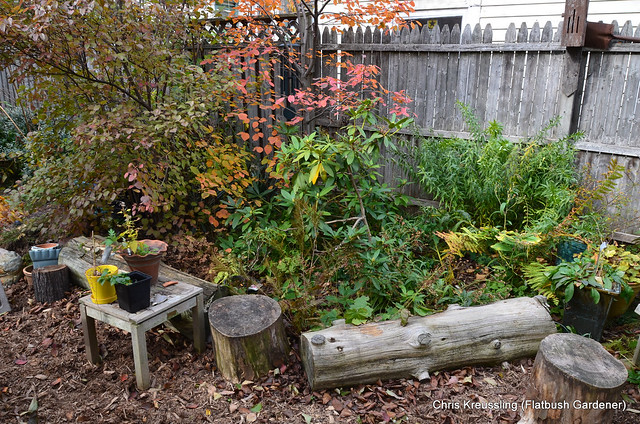
The shrub border, pre-transplant, November 2014

Similarly, the front yard was, at best, barren: lawn and a few canonical evergreen shrubs.
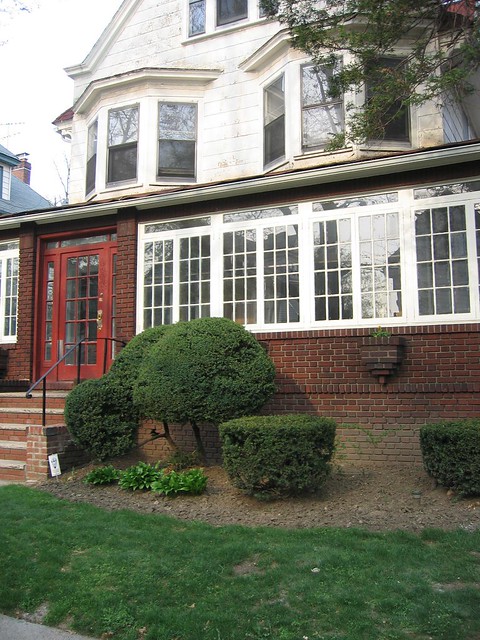
Front Garden, April 2005

Our house was built in 1900. In keeping with the historical nature of our home, and the neighborhood, initially I focused on heirloom plants in the front garden.
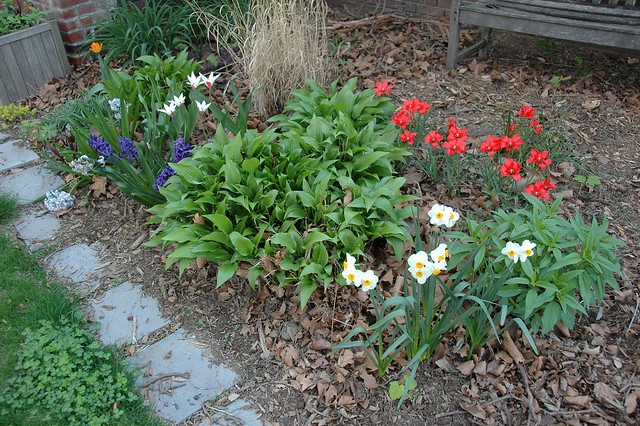
The Front Garden

As my knowledge of and experience with gardening with native plants grew, I expanded the scope of their planting to include all areas around the house. The loss of our neighbor's street tree a few years ago to Hurricane Irene opened up - literally - the opportunity to grow more sun-loving species in the front yard. I started taking out the front lawn two years ago, gradually replacing it with a mixed wildflower meadow. The original lawn has been reduced to a less than a third of its original extent.
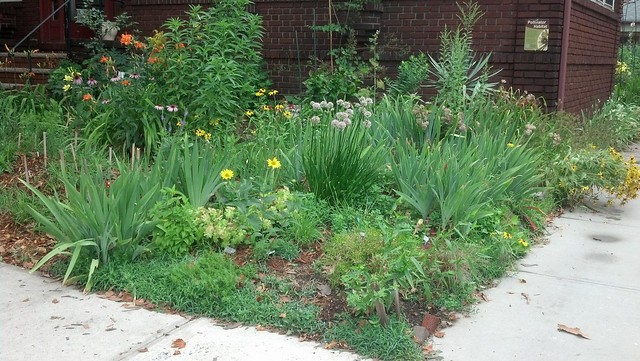
Morning Glory: The Front Garden this morning

Most recently, I've narrowed my plant acquisitions further. My most treasured plants in my gardens are local ecotypes, those that have been propagated - responsibly - from local wild populations. There are two regional plant sales where these are available, both organized by regional preservation groups: the Long Island Native Plant Initiative, and the Pinelands Preservation Alliance. These are currently my preferred sources for plants.
I have arrived! LINPI Plant Sale

It's my hope that more retail sources for local ecotypes will become available to urban gardeners. I recommend that gardeners who want to explore gardening with native plants choose straight species, not cultivars, from local growers, who are more likely to be growing plants propagated originally from local stock.

Related Content

Tags: Nurseries, Sources, Native Plants

Flickr photo sets:
The Front Garden
The Backyard

Catskill Native Nursery, Kerhonkson, NY
Rarefind Nursery, Jackson, NJ

Links

Long Island Native Plant Initiative (LINPI) Plant Sale
Pinelands Preservation Alliance Plant Sale

2011-04-03

Dividing Ornamental Grasses

As we approach the Second Annual Great Flatbush Plant Swap, I'm hoping to post some tips on how to divide perennials to bring to the event. Now is the time to do it, as foliage has just emerged, plants are actively growing, and most will recover quickly from any perceived insult of being lifted out of the ground and ripped into pieces.

I have to do with this with perennials in my gardens, so I'll use them as examples. Today I divided one of my larger grasses.

Second Annual Great Flatbush Plant Swap

Do you have extra seed-starts? Leftovers from dividing perennials? No place for that shrub you just dug out? Bring them to the Second Annual Great Flatbush Plant Swap on Saturday, April 16. No plants? No problem: everyone can bring home a plant, even if you have none of your own to swap. And it's a great way to meet other local gardeners, whether you're a beginner or a pro.

Plant Swap 2011

Sponsored by Sustainable Flatbush and the Flatbush Food Coop, the First Annual was, coincidentally, just last year. It was a great success, especially for an inaugural event: we distributed over 330 plants. Let's see if we can distribute even more this year!

When: Saturday, April 16, noon to 3pm
Where: Flatbush Food Coop, 1415 Cortelyou Road, at Marlborough Road

[goo.gl]

Related Content

The First Annual Great Flatbush Plant Swap, 2010

Links

Flatbush Plant Swap, April 16th, Sustainable Flatbush
Flatbush Food Coop

2010-04-29

NYC Wildflower Week, 5/1-5/9

The Native Flora Garden at the Brooklyn Botanic Garden, May 2009. This was the first garden constructed after BBG was established on the site of a municipal ash dump 100 years ago, and the first public garden devoted to native plants. Next Wednesday's tour of this garden with Uli Lorimer, curator of BBG's Native Flora Garden and an instructor in their Certificate in Horticulture program, is one of over 45 FREE events in all - available during NYC Wildflower Week.
Native Flora Garden

NYC Wildflower Week kicks off Saturday 5/1. This is the third year for the event, and it's bigger and better than ever. There are events all over the city, including tours of locations otherwise closed to the public. I'm looking forward to visiting, for the first time, the Greenbelt Native Plant Center on Staten Island, "the only municipal native plant nursery in the country."

You can get all the details at the official, extensive, NYCWW Web site, or at the Parks Department event page:
From Friday, May 1, to Saturday, May 9, we're celebrating the hundreds of native flowers, trees, shrubs and grasses in the Big Apple. Take advantage of the spring weather, and come out for a week of environmental learning, with free activities, walks, and talks galore.
I'm proud that this year, for the first time, I've been invited to participate in an official capacity. This Saturday morning, May 1, I'll be on-hand at the information booth at Union Square to help answer questions and provide information about native plants.

2010-04-08

The Plight of NYC's Native Flora

Local ecotypes - propagated from local sources by the Staten Island Greenbelt - for sale by Oak Grove Farms (now Nature's Healing Farm) at the Union Square Greenmarket during the first annual NYC Wildflower Week in 2008. I bought one of each; two years later, all are thriving in my backyard native plant garden.
Native Plants at Oak Grove Farms

Earlier this week, the Brooklyn Botanic Garden issued a press release summarizing findings from 20 years of research through their New York Metropolitan Flora Project (NYMF). The results are not surprising, but disheartening nevertheless:
At least 50 varieties of native plants are locally extinct or nearing elimination, say project scientists. Nuttall’s mudflower (Micranthemum micranthemoides), last collected from the region in 1918, is likely extinct throughout its former range. Scarlet Indian paintbrush (Castilleja coccinea), pennywort (Obolaria virginica), sidebells wintergreen (Orthilia secunda), and sundial lupine (Lupinus perennis) are among the wildflower species to have seriously declined in the region. Black crowberry (Empetrum nigrum) is locally extinct, without a trace of a population remaining today in the New York City metropolitan area.
- Some Plants Native to NYC Area Have Become Locally Extinct As New Flora Has Moved In, Finds Brooklyn Botanic Garden, Press Release, 2010-04-05
The story has been widely covered in blogs and other media, including New York Times Science. I've included the complete press release below for reference.

I first wrote about NYMF in June of 2006, shortly after I launched this blog, four years ago next month. I've written about native plants countless times (see: , ). I have a lifelong interest in the nature around me, especially that which is right around me, where I live. Learning about and understanding the ecosystems where I live is part of finding my place in the world. I come to feel this connection deeply. Without it, my life is impoverished, and I am lost.

The greatest threat to native plants, and the ecosystems they support, is habitat loss. The second is competition and displacement, and further habitat loss, from invasive species, whether they be insects, infectious organisms, or other plants. Roughly half of invasive plant species were deliberately introduced, through agriculture, for civil engineering purposes such as erosion control, and for horticultural purposes.

2010-04-04

The Fallen

The Fallen

Due to circumstance and inclination, my three decades of urban gardening have been devoted to mostly ornamental private gardens. I have dabbled in the occasional strawberry jar potted up with herbs (successful) and sweet corn in container (wretched). Nevertheless, most of my experience is with perennials and bulbs.

I label my plants. Rather, I label where I plant them. This is most helpful in the off seasons, to dissuade me from scanning some patch of deceivingly barren soil and imagining all the new plants I could acquire to populate it.

In the first garden, in the East Village, I carefully labeled all the little bulbs and plants with plastic labels. The white plastic contrasted strongly with the dark earth. This led one visitor to describe it as a "plant cemetery."

I've since graduated to aluminum labels. They are durable, erasable and reusable. Perhaps most important, less conspicuous. I've also gotten into the habit of scribing the provenance onto the back of the label: the year, and usually also the source from which I purchased the plant.

Nevertheless, they sometimes still serve as markers for those plants that have passed on. This is so common that gardeners have a euphemism for it: "adventurous." I am an adventurous gardener, in that I will plant things I've never grown before, perhaps never ever heard of before reading about it or spying it in some nursery and "rescuing" it.

Here then is a sampling of The Fallen, transcribed from markers I've found in different stashes, collecting dust with years-old seed packets, rusting pruners, and forgotten catalogs.

2009-08-24

Study Guide for BBG Plant ID Class

Clerodendrum bungei Steud., Rose Glory Bower
Clerodendrum bungei

This Wednesday I take the final for the Brooklyn Botanic Garden's Herbaceous Landscape Plant Identification class. [Spelling counts! So please let me know of any typos.] Thursday, I start Urban Garden Maintenance, the last of the eight classes I need for my Certificate in Urban Horticulture from BBG. I started the program in Winter 2008. This is the home stretch; I can't believe I'm almost done with it.

Unlike the "woodies" class, I already knew most of the plants introduced in the class over the past five weeks. Either I've grown them myself sometime over my 30 years of gardening in NYC, or I've researched and studied them. However, there have been several, such as the interesting Clerodendrum above, which I've never even heard of, or never knew the names of.

This post is the index to my photographic study guide. Plant names are listed by week, in alphabetical order by botanical name within each week. Botanical names are given, corrected for typos, as they were introduced in the class; that's what we'll be tested on for the final this Wednesday evening. Plant names are linked to my Flickr Set, where I have one. You can also browse my Flickr Collection for this class, where all the plants are listed by botanical name.

Week 1, 2009.07.22

Callirhoe involucrata, Purple Poppy-Mallow
Callirhoe involucrata, Poppy Mallow

Observed:
Omitted (these will not be included on the final):
  • Aquilegia canadensis, Columbine. This grows as a Spring ephemeral in our region; none were available to observe at this late date.
  • Geranium macrorrhizum, Bigroot Geranium. Omitted primarily for time constraints; also, it was out of bloom by this time of the year. Too bad, since it's a handsome plant, and there are lots of them around the grounds of BBG.

Week 2, 2009-07-29

We got 11 plants this week to make up for being two short the previous week.

Week 3, 2009-08-05

Week 4, 2009-08-12

This was the only themed week of the class, consisting solely of grasses, ferns and fern allies.

Pennisetum alopecuroides, Fountain Grass

Week 5, 2009-08-19

The last class before the in-class final.

Angelica gigas, Purple Angelica
Angelica gigas

2009-05-15

Endangered Plants in New York State

In observance of Endangered Species Day, here is a list of just some of the plants listed as endangered in New York state. Note that plants endangered in one state may not be listed in another.
  • Aconitum noveboracense, Northern wild Monkshood
  • Agalinis acuta, sandplain Gerardia
  • Amaranthus pumilus, seabeach Amaranth
  • Asplenium scolopendrium var. americanum, Hart's-tongue fern
  • Helonias bullata swamp Pink
  • Isotria medeoloides,small whorled Pogonia
  • Platanthera leucophaea, eastern prairie fringed Orchid
  • Schwalbea americana, American Chaffseed
  • Scirpus ancistrochaetus, Northeastern Bulrush
  • Sedum integrifolium ssp. leedyi, Leedy's roseroot
  • Solidago houghtonii, Houghton's goldenrod

Links

Department of Environmental Conservation, New York State:

2009-05-14

The Native Flora Garden

See also The Osborne Garden and The Bluebell Wood.


For the past four years I've been cultivating my backyard native plant garden. I've been adding compost and mulching with leaves and shredded Christmas trees, as much as I can get of all of it. I'm not yet able to grow The Precious (below), but I'm learning in Soil Management class that what I've been doing is just what's needed to develop the humusy, woodland soil it requires. Someday, I'll have some in my garden (obtained, of course, only from a conservation-oriented source such as the Vermont Ladyslipper Company). Meanwhile I can enjoy them in BBG's Native Flora Garden.

Cypripedium calceolus var. pubescens, Yellow Lady-Slipper
Cypripedium calceolus var. pubescens

I find the native Lady-Slipper orchids achingly beautiful. They seem more to float than to be held up by their slender stems. Maybe they would seem less fantastic if they were more common, spreading like dandelions, and less specialized in their environmental requirements. Maybe, but not by much.

There are other beauties in bloom right now. The early Spring wildflowers have been replaced by the regime of those which bloom in late Spring, and even early Summer. Geranium maculatum is one example of something I associate more with Summer than Spring. It is, in some settings I've seen, a common wildflower. But I covet it for my own garden nonetheless.

Geranium maculatum
Geranium maculatum
Geranium maculatum

Some of the Spring ephemerals are already entering senescence. Here's Dicentra cucullaria Dutchman's Breeches, as it appeared Tuesday afternoon in one part of the Garden. Contrast that with how it appeared just three weeks ago in a different location.

Dicentra cucullaria, Tuesday afternoon
Ephemerizing Dicentra cucullaria

Dicentra cucullaria, three weeks earlier
Dicentra cucullaria, Dutchman's Breeches
Spring ephemeral describes a life habit of perennial woodland wildflowers which develop aerial parts (i.e. stems, leaves, and flowers) of the plant early each spring and then quickly bloom, go to seed and then quickly die back to its underground parts (i.e. roots, rhizomes, and bulbs) for the remainder of the year. This strategy is very common in herbaceous communities of deciduous forests as it allows small herbaceous plants to take advantage of the high amount of sunlight reaching the forest floor prior to the leaf-out of woody plants.
- Wikipedia: Ephemeral plant
It's interesting that Wikipedia lists Dicentra eximia among the Spring ephemerals. It's still going strong at BBG. My experience is that it blooms for months, and lasts at least through the summer, barring drought. This is one of the things that makes it an excellent performer in the garden.

Tuesday afternoon, near the Bog habitat
Dicentra eximia

Interspersed with Dodecathon meadia in the Serpentine Rock habitat
Serpentine Rock Area

Three weeks ago
Dicentra eximia, Eastern Bleeding-Heart

The march of the Rhododendron in the Osborne Garden continues into the Native Flora Garden, more evidence that early Summer is replacing late Spring.

Native Flora Garden

Rhododendron prinophyllum, Rosebud Azalea
Rhododendron prinophyllum

Rhododendron periclymenoides, Pinkster Azalea

Two purple beauties from the Pine Barrens habitat, something which I would only be able to recreate in container in my garden.

Viola brittoniana, Coast Violet

Lupinus perennis, Sundial Lupine

[bit.ly]

Related Content

Native Flora Garden, Brooklyn Botanic Garden, 2009-04-27
Native Flora Garden, BBG, 2008-04-18

Photos from Tuesday (Flickr photo set)
All my photos (Flickr collection)
More on native plants
Wildflower Week in NYC, 5/1 through 5/9, 2009-04-29
Growing a Native Plant Garden in a Flatbush Backyard, 2007-08-06
Resources: Native Alternatives to Invasive Plants, 2007-05-22
Native Plant profile: Dicentra eximia, Bleeding-heart, 2006-05-22
Notes from a visit to the Brooklyn Botanic Garden, Late July 2005

Links

Native Flora Garden, Brooklyn Botanic Garden

2009-05-11

Wildflowers in a Flatbush Backyard

Last week was NYC Wildflower Week. Appropriately, here are some wildflowers blooming over the past week in my backyard native plant garden.

Wildflowers blooming near the gardener's nook in my backyard for last May's Garden Blogging Bloom Day.
Part of the Native Plant Garden
  • Aquilegia canadensis, Eastern Columbine
  • Chrysogonum virginianum 'Allen Bush', Green-and-Gold
  • Dicentra eximia 'Aurora', White-flowering Eastern Bleeding-Heart, Turkey Corn
  • Iris cristata, Crested Iris
  • Phlox stolonifera
  • Viola striata
  • Zizia aurea, Golden Alexanders
  • Brunnera macrophylla, Large-leaf Brunnera, Siberian Bugloss

Aquilegia canadensis, Eastern Red Columbine

Somehow, I have no photos of this from my garden in Flickr. Yet it's been a favorite of mine for decades.

Native range is eastern North America. Widespread in New York state. Native to all five boroughs of NYC.

Aquilegia canadensis, Eastern Red Columbine, 2006-05-31

MOBOT
PLANTS

Chrysogonum virginianum 'Allen Bush', Green-and-Gold

Chrysogonum virginianum

A great groundcover for partial shade. Several cultivars are available. To my eye, all vary only slightly from the species, though I haven't grown them side-by-side.

Individual flowers look like shaggy sunflowers.

Chrysogonum virginianum

Native range is Mid-Atlantic and Southeastern United States. Native to only one New York upstate county. Not native to NYC.

MOBOT
PLANTS

Dicentra eximia 'Aurora', Eastern Bleeding-Heart, Turkey Corn

Dicentra eximia 'Aurora'

A white-flowering cultivar of the native Eastern Bleeding Heart. Not every white-flowering form of a plant is successful. This is one that is equally lovely as the species, bringing its own graces to the structure of the inflorescence and individual flowers. Also a good choice for the shady white garden.

This plant is maybe three years old now. Not only has the original plant spread in size each year, this Spring I've noticed little seedlings cropping up around the mother plant. I'll be curious to see how these develop, and what the flower color wil be in the children.

Dicentra eximia, Bleeding-heart, 2006-05-22
Dicentra eximia, Eastern bleeding-heart (Flickr photo set)

MOBOT
PLANTS

Iris cristata, Crested Iris

Iris cristata

Really beautiful, if a bit of a finicky grower. It seems to be at its best when grown on a slight slope with ample mulch. The stems trail through the mulch, the fans oriented down-slope. Sulks during the summer. Needs consistent moisture during the hot summer months and good drainage during the winter or it will disappear. Where it's happy, it makes a great groundcover.

Native to Mid-Atlantic and interior Eastern United States, but not New York.

MOBOT
PLANTS

Phlox stolonifera, Creeping Phlox

Phlox stolonifera

One of the best wildflower ground covers you can grow in the garden. In the trade, you're more likely to find cultivars selected for flower color - such as 'Bruce's White' and 'Sherwood Purple' - rather than the unqualified species. They all seem equally fine to me. (Mine is also a cultivar, but its name escapes me at the moment.) The flowers are usually fragrant, reminiscent of grape jelly.

Native range is most of Eastern United States, but only found in two upstate New York counties, not NYC.

MOBOT
PLANTS

Viola striata, Pale Violet, Striped Cream Violet

Viola striata

The "oldest" plant in this post, this population came from my second city garden on 5th Street in Park Slope. The original plants were given to me 8-10 years ago by a gay couple who lived across the street. They have a beautiful shady backyard garden growing many wildflowers collected from their home in upstate New York.

Native to Eastern North America. Native to several counties in New York, but not NYC.

MOBOT
PLANTS

Zizia aurea, Golden Alexanders

Zizea aurea

This plant is a recent discovery for me. I had never heard of it before picking it up from Gowanus Nursery last Spring. Now I see it all over the place, and it's a fine groundcover. You can't see it in this photo, but the foliage is also handsome.

Native to NYC, but not Brooklyn.

MOBOT
PLANTS

Brunnera macrophylla, Large-leaf Brunnera, Siberian Bugloss

Brunnera macrophylla

Okay, Brunnera is not a native wildflower on this continent - it's native range is Eastern Europe - but it is blooming in the backyard and it's so pretty I had to take a picture of it. This plant is a refugee from the sideyard of Frank, a neighbor, professional gardener and fellow garden blogger at New York City Garden.

MOBOT
PLANTS

[bit.ly]

Related Content

Growing a Native Plant Garden in a Flatbush Backyard, August 6, 2007

2009-05-01

Plant Sales this week in Brooklyn

Cobble Hill, May 2

Cobble Hill Tree Fund Plant Sale
Cobble Hill Park (at Clinton and Congress Streets)
Saturday, May 2. 10:30 a.m.-3 p.m. Rain date is Sunday, May 3.

Boerum Hill, May 2 & 3

Hoyt Street Association Annual Plant Sale
110 Hoyt Street (near Pacific Street)
Saturday, May 2 10 a.m.-6 p.m.
Sunday May 3. 11 a.m.-5 p.m.

Park Slope, May 2

PS 107 (Park Slope) Plant Sale
PS 107, 1301 8th Avenue (between 13th and 14th Streets)
Saturday, May 2 (rain date May 3). 10 am to 4 pm

Bay Ridge, May 3

Narrows Botanical Gardens Sneak Preview Sale
Narrows Botanical Gardens, 69th Street entrance
Sunday, May 3. 11:00 a.m. to 2:00 p.m.

Brooklyn Botanic Garden, May 5-7

Brooklyn Botanic Garden, Cherry Esplanade
Brooklyn Botanic Garden 2009 Plant Sale
Wednesday, May 6 | 9 a.m.–7 p.m.
Thursday, May 7 | 9 a.m.–Noon
Members-Only Preview Sale
Tuesday, May 5, 2009. 4:30–8:30 p.m. (Admission with BBG membership card only.)

Park Slope, May 9

615 Green Garden, 6th Avenue and 15th Street
6/15 Green Annual Spring Festival and Plant Sale
Saturday, May 9, 10am-3pm

Park Slope, May 10

Brooklyn Bear's Pacific Street Garden, Pacific Street and Flatbush Avenue
Brooklyn Bears Mother's Day Plant Sale
Saturday and Sunday, May 10 & 11 from 10am to 4pm

[bit.ly]

2009-04-29

Wildflower Week in NYC, 5/1 through 5/9

Mertensia virginica, Virginia Bluebells blooming yesterday afternoon in the Native Flora Garden at the Brooklyn Botanic Garden.
Mertensia virginica, Virginia Bluebells

This Friday, May 1, through next Saturday, May 9, is the Second Annual New York City Wildflower Week (WFW):
The 2nd annual NYC Wildflower Week celebrates all things green and wild in the Big Apple—the hundreds of native flowers, trees, shrubs and grasses that are found in the five boroughs. It gives New Yorkers numerous ways to connect with and be inspired by their local environment. Free activities throughout the city include: botanical walks, garden tours, ecology lectures, children’s events, planting opportunities, cooking classes, and food tastings at top restaurants. It is the largest celebration of National Wildflower Week, an initiative begun by Lady Bird Johnson.
Events are two numerous to list here. Please see the WFW calendar for a complete listing of and details on all events. They cover all five boroughs. See below for events in Brooklyn, which are also listed in the Flatbush Gardener calendar in the sidebar.

Aquilegia canadensis, Eastern Columbine blooming in the Union Square Native Plant Garden in May 2008.
Aquilegia canadensis, Eastern Columbine, Native Plant Garden, Union Square

Sunday, May 3, 11am: Native Plants of the Marsh of Marine Park

Guide: Ranger Allison McCarthy (allison.mccarthy@parks.nyc.gov)
Location: Meet outside Salt Marsh Nature Center, 3302 Avenue U
For more information, call 311 and ask for the Brooklyn Urban Park Rangers.
Description: Join the Urban Park Rangers for a hike through the salt marsh and learn about New York City’s beautiful native flora that flourish in the wetlands of Brooklyn. Dress for the weather, bring comfortable walking shoes and water, hat. You may also like to have a camera, hand lens, field guides, water, bug spray.

Sunday, May 3, 3:00pm: Prospect Park

Guide: Anne Wong, Director of Landscape Management (awong@prospectpark.org)
Location: Meet at Prospect Park Audubon Center
Description: Tour recent restorations in the woodlands and along the waterways in Prospect Park. The walk will focus on native plantings as well as invasive plant problems.

Dodecathon meadia, Eastern Shooting-Star, yesterday afternoon, Native Flora Garden, Brooklyn Botanic Garden.
Dodecathon meadia, Eastern Shooting-Star

Wednesday, May 6, 11am: Brooklyn Botanic Garden Native Flora Garden,

Location: Meet at the front entrance of the Native Flora Garden (by the wooden gates, across from the Lilac Collection)
Guide: Ulrich Lorimer, Curator of BBG's Native Flora Garden
Description: Highlights will include many spring ephemerals such as trillium species (Trillium spp.), mayapple (Podophyllum peltatum) and violets (Viola spp.). Native azaleas will also be in bloom including the flame, pinxterbloom and sweet azaleas (Rhododendron spp.). A multitude of fern species will be emerging as well as aquatics such as golden club (Orontium aquaticum) and blue flag iris (Iris versicolor).

Lilium canadense, Canada Lily, July 2006, Native Flora Garden, Brooklyn Botanic Garden.
Lilium canadense, Canada Lily

Thursday, May 7, 3:30-5:00pm: Brooklyn Bridge Park

Location: Meet at corner of Main Street and Plymouth Street in DUMBO
Description: This program is presented by the Brooklyn Bridge Park Conservancy with guest speaker and native plant specialist Sara Stopek. It features a guided tour of native plants and wildflowers in Brooklyn Bridge Park. The tour is followed by a native wildflower planting project by students from Science Skills High School.
To sign up please contact: Kara Gilmour, Education and Stewardship Coordinator, email: kgilmour@bbpc.net, or call 718-802-0603 x18

Berries of Phytolacca americana, Pokeweed, in my backyard native plant garden in Flatbush, Brooklyn, in October 2007.
Berries, Phytolacca americana, Pokeweed

[bit.ly]

Related Content

My photos of BBG's Native Flora Garden (Flickr Collection)

Links

New York City Wildflower Week (WFW)
Native Flora Garden, Brooklyn Botanic Garden
Brooklyn Bridge Park Conservancy

2009-04-27

Native Flora Garden, Brooklyn Botanic Garden

Last Friday, I had the opportunity to visit the Brooklyn Botanic Garden. The Native Flora Garden was how I hoped it would be. Some of my favorite native woodland wildflowers were in bloom.

That was before our weekend heat wave and record high temperatures. Starting this week, I'll be returning on Tuesday afternoons, when I take my Soil Management course toward my Certificate in Horticulture at BBG. The instructor is Uli Lorimer, who is also the curator of the Native Flora Garden.

Slideshow


Selected Photos

The view just inside the southern entrance to the garden.
Native Flora Garden

There is a large drift of Viola sororia forma priceana, Confederate Violet, just inside the southern entrance to this garden. I would not mind this growing as a "weed" in my garden in place of the common purple violets I'm constantly digging out.
Viola sororia forma priceana, Confederate Violet

Dicentra eximia, Eastern Bleeding-Heart, grows inside and outside the entrance, and throughout the garden. I have a white-flowering form in my backyard garden which is just starting to bloom.
Dicentra eximia, Eastern Bleeding-Heart

D. cucullaria, Dutchman's Breeches, blooms nearby with similar wands of dangling flowers and lovely ferny foliage.
Dicentra cucullaria, Dutchman's Breeches

Erythronium americanum, Trout-Lily (yellow) and Trillium grandiflorum (white). When I visited, the Trout-Lily were blooming in fields of thousands all over the Native Flora Garden.
Erythronium americanum and Trillium grandiflorum

T. erectum, Purple Trillium, was bashful despite its specific epithet.
Label, Trillium erectum, Pruple Trillium

From repeated visits, I'm coming to appreciate the subtle charms of Uvularia sessilifolia, Wild Oats. This is one of the few upright flowers I found, just emerging from the bud; as the flowers mature, the peduncle extends, and the flowers dangle below like narrow bells.
Uvularia sessilifolia, Wild Oats

Caltha palustris, Marsh Marigold, growing in the Bog habitat.
DSC_7627_217

[bit.ly]

Related Content

Flickr Set