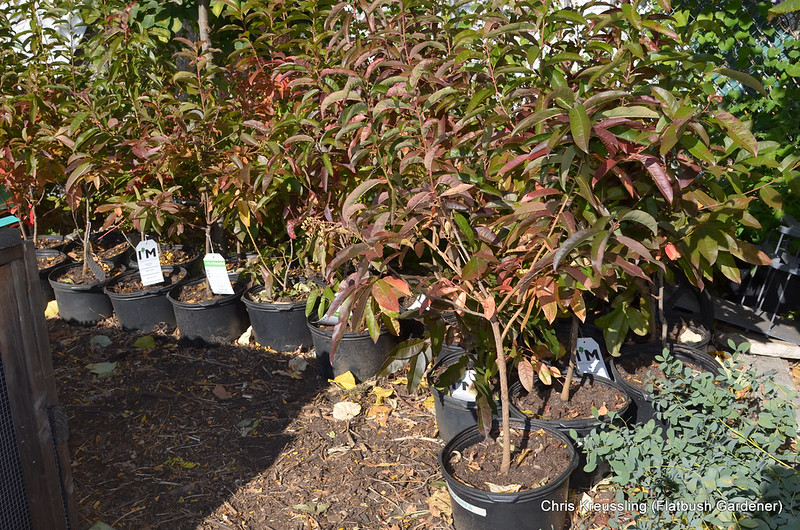
Local ecotypes - propagated from local sources by the
Staten Island Greenbelt - for sale by Oak Grove Farms (now
Nature's Healing Farm) at the Union Square Greenmarket during the first annual
NYC Wildflower Week in 2008. I bought one of each; two years later, all are thriving in my backyard native plant garden.

Earlier this week, the Brooklyn Botanic Garden issued a press release summarizing findings from 20 years of research through their
New York Metropolitan Flora Project (NYMF). The results are not surprising, but disheartening nevertheless:
At least 50 varieties of native plants are locally extinct or nearing elimination, say project scientists. Nuttall’s mudflower (Micranthemum micranthemoides), last collected from the region in 1918, is likely extinct throughout its former range. Scarlet Indian paintbrush (Castilleja coccinea), pennywort (Obolaria virginica), sidebells wintergreen (Orthilia secunda), and sundial lupine (Lupinus perennis) are among the wildflower species to have seriously declined in the region. Black crowberry (Empetrum nigrum) is locally extinct, without a trace of a population remaining today in the New York City metropolitan area.
- Some Plants Native to NYC Area Have Become Locally Extinct As New Flora Has Moved In, Finds Brooklyn Botanic Garden, Press Release, 2010-04-05
The story has been widely covered in blogs and other media, including
New York Times Science. I've included the complete press release below for reference.
I
first wrote about NYMF in June of 2006, shortly after I launched this blog, four years ago next month. I've written about native plants countless times (see:
Native Plant Profiles,
Natives). I have a lifelong interest in the nature around me, especially that which is
right around me, where I live. Learning about and understanding the ecosystems where I live is part of finding my place in the world. I come to feel this connection deeply. Without it, my life is impoverished, and I am lost.
The greatest threat to native plants, and the ecosystems they support, is habitat loss. The second is competition and displacement, and further habitat loss, from invasive species, whether they be insects, infectious organisms, or other plants. Roughly half of invasive plant species were deliberately introduced, through agriculture, for civil engineering purposes such as erosion control, and for horticultural purposes.