Showing posts with label Insects. Show all posts

2023-03-15

U.S. Firefly Atlas

The Xerces Society, in collaboration with the IUCN SSC Firefly Specialist Group and New Mexico BioPark Society, has launched the Firefly Atlas project:

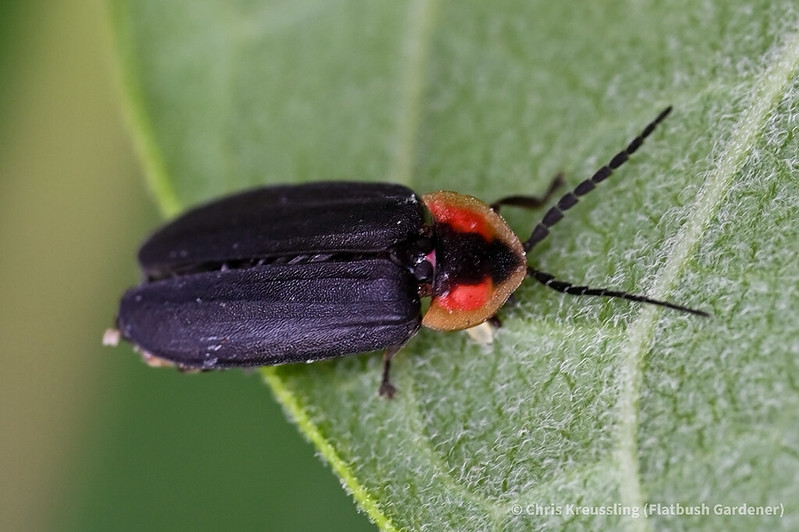
Lucidota atra, black firefly, found on milkweed along my driveway, 2022-07-05
The Firefly Atlas is a collaborative effort to better understand and conserve the diversity of fireflies in North America. Launched in 2022, the project aims to advance our collective understanding of firefly species’ distributions, phenology, and habitat associations, as well as to identify threats to their populations.

Although the Atlas tracks all species described from the US and Canada, we are currently prioritizing efforts for a subset of 13 threatened and data deficient species found in three focal regions of the US: the Mid-Atlantic, Southeast, and Southwest. These priority regions were chosen based upon having a high number of threatened species and/or a high number of data deficient species. - What is the Firefly Atlas?

2022-01-03

Insect Year in Review 2021

Observing the diversity of life that coexists in one place is one of the rewards of visiting the same natural area over a long period of time. My garden not only offers myself and passersby such an observatory. It's also a laboratory in which I can research how insects engage with their environment - both biotic and abiotic - and imagine, design, and create habitat to better provide for their needs.

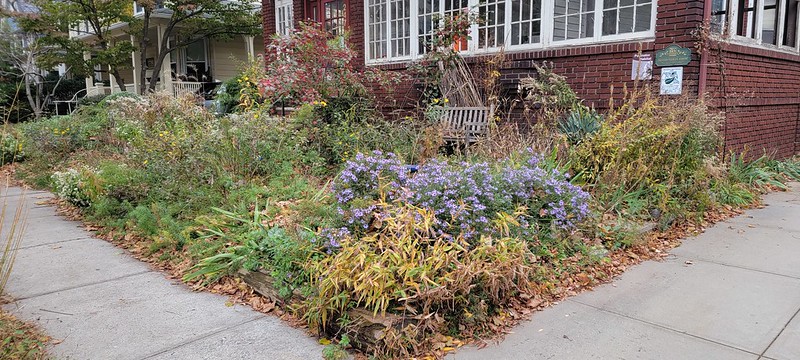
The Front Garden, November 2021

I use iNaturalist to document the diversity of life in my garden. Although I only posted my first iNaturalist Observation in 2017, my garden Observations now span more than a decade. As of this year, I've documented over 400 insect species making use of my garden.

iNaturalist Observations · Flatbush Gardener - Top 25 Species - 2021-12-31

This biodiversity, and my documentation of it, is intentional. And although all of this is by design, all I can do is uncover the latent urban biodiversity in and around my garden. Each new species I find is a surprise to me.

2021-11-19

Hot Sheets Habitat

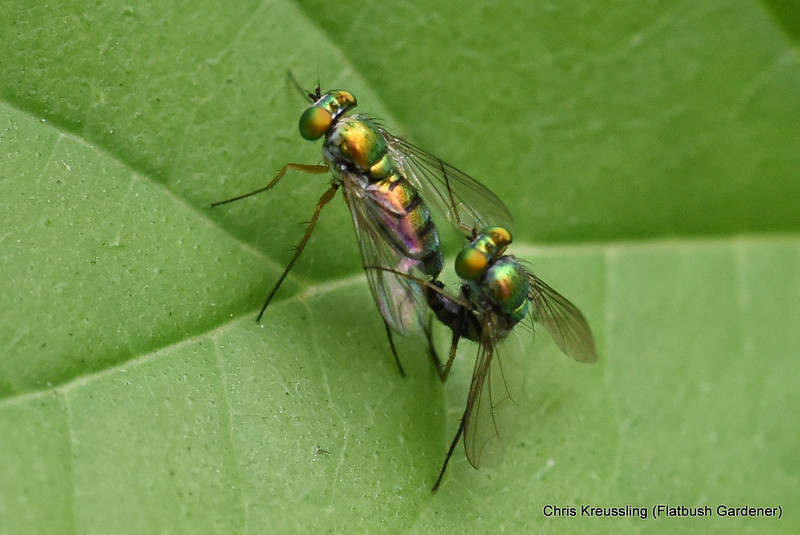
A mating pair of NOID Dolichopodidae, long-legged flies, in my backyard, September 2018

My garden is registered as both a National Wildlife Federation Backyard Wildlife Habitat and Xerces Society Pollinator Habitat. The insects have certainly gotten the message. During 2021, I've been able to document 14 different species of insects mating in my garden.
  1. Acanthoscelidius acephalus, minute seed weevil
  2. Epitrix fuscula
  3. Harmonia axyridis, multi-colored lady beetle (introduced)
  4. Eumerus
  5. Orthonevra nitida, wavy mucksucker
  6. Syritta pipiens, compost fly (introduced)
  7. Toxomerus geminatus, Eastern calligrapher fly
  8. Toxomerus marginatus, margined calligrapher fly
  9. Xenox tigrinus, tiger bee fly
  10. Jalysus, stilt bug
  11. Lygaeus kalmii ssp. angustomarginatus, Eastern small milkweed bug
  12. Hylaeus modestus, modest masked bee
  13. Xylocopa virginica, large Eastern carpenter bee
  14. Danaus plexxipus, monarch butterfly

2019-02-12

Charismatic Mesofauna

Over the weekend I was inspired to write a little tweet storm. I thought it would make a good blog post.

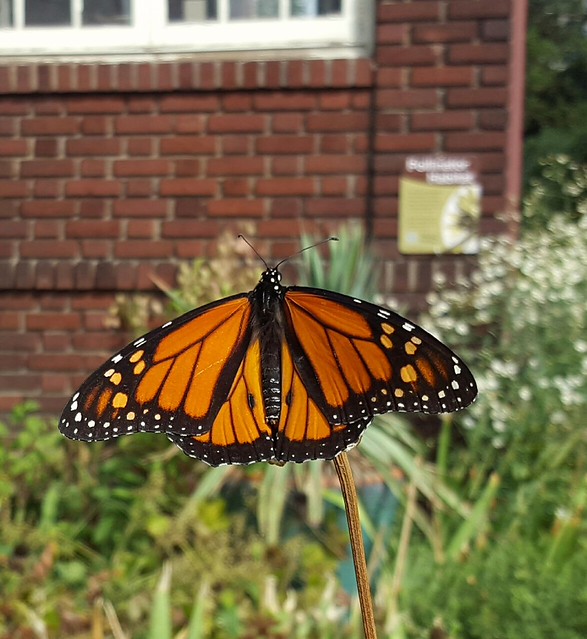
Danaus plexippus, monarch butterfly (male), with @XercesSociety Pollinator Habitat sign behind, in my front yard, September 2016

It started with a blog post by entomologist Eric Eaton, who goes by @BugEric on his blog, Twitter and other social media. Benjamin Vogt, a native plants evangelist (my word, bestowed with respect) tweeted a link, which is how it came to my attention.
The Monarch is the Giant Panda of invertebrates. It has a lobby built of organizations that stand to lose money unless they can manufacture repeated crises. Well-intentioned as they are, they are siphoning funding away from efforts to conserve other invertebrate species that are at far greater risk. The Monarch is not going extinct
- Bug Eric: Stop Saying the Monarch is a "Gateway Species" for an Appreciation of Other Insects

2016-06-24

Coccinella novemnotata, nine-spotted lady beetle, aka "C9"

New York State Gardeners: You can help re-introduce our state insect! See Links below.

A decade ago, shortly after I launched this blog, I wrote the following:
[Coccinella] novemnotata was once common. How did New York State get to have a once-native-but-no-longer-resident state insect?
Not just common; C. novemnotata, or C9 for short, was once the most common lady beetle in the eastern U.S.

2015-09-01

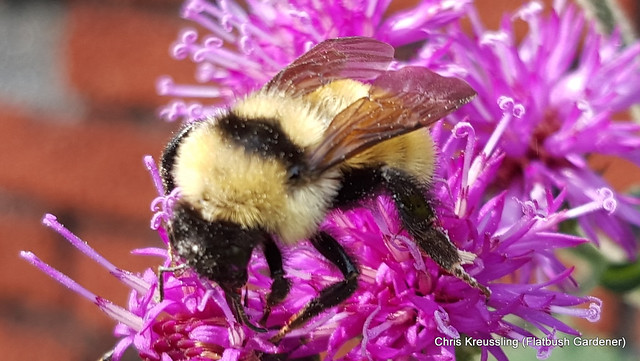
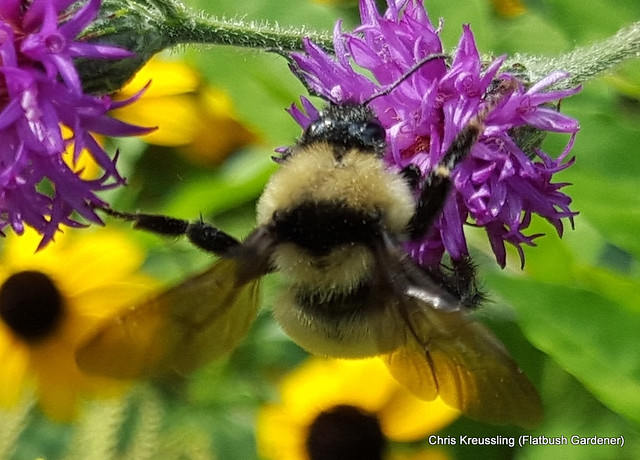
Bombus fervidus, golden northern bumblebee, yellow bumblebee

Sunday, while cutting up edited plants into my compost tumbler, I caught sight of something unusual out of the corner of my eye. It turned out to be Bombus fervidus, golden northern bumblebee, or simply, the yellow bumblebee.
Bombus fervidus, golden northern bumblebee, on Vernonia noveboracensis, New York ironweed, in my garden, August 2015

This is at least the 21st bee species I've found in my garden. And this brings to 20, or more, the number of new insect species I've identified in my garden this year alone.

Bombus fervidus, golden northern bumblebee

Related Content

Flickr photo set
All my bee photo albums

Links

BugGuide: Bombus fervidus, Golden Northern Bumble Bee
Discover Life: Bombus fervidus
Encyclopedia of Life: Bombus fervidus

2015-07-07

Garden Insect Species Records 2015

2015-09-19: Added Homeosoma, observed 10 days ago and just identified, bringing the total to 23.
2015-09-13: Two more Hymenoptera species identified from the last weekend in August: Bombus fervidus, golden northern bumblebee, and Gnamptopelta osidianator, an Ichneumon wasp. And a new Diptera species identified today: Hermetia illucens. That brings the number of species to 22.
2015-07-12: Added two I'd forgotten about: Orius insidiosus, and Anthrenus verbasci. That brings the number of species to 19.

These are the insect species I've discovered or identified in my garden for the first time this year.

Hymenoptera - Bees

  • Bombus fervidus, golden northern bumblebee, yellow bumblebee, 2015-08-30
  • Ceratina calcarata, spurred ceratina, small carpenter bee
  • Cerceris, two different species, not identified down to species.
  • Nomada, cuckoo bee
  • Osmia pumila, mason bee
  • Stelis louisae, Megachilid bee, cleptoparasite of Megachile campanuelae and perhaps related bees

    Stelis louisae (ID correction welcomed) on Heliopsis helianthoides, smooth oxeye, false sunflower, in the front garden, July 2015

2015-07-01

Pyrrhalta viburni, viburnum leaf beetle (VLB)

Pyrrhalta viburni, the viburnum leaf beetle, or VLB for short, is native to Europe. It was first discovered in North America barely two decades ago, in Maine in 1994. Both larvae and adults eat leaves. Our native Viburnum species are extremely vulnerable; they aren't adapted to this species of leaf beetle. With ample food supply, and no native predators to control its spread, VLB has rapidly expanded its range since.
The viburnum leaf beetle, Pyrrhalta viburni (Paykull), is an invasive, non-native beetle that first appeared in New York along Lake Ontario in 1996, and has steadily spread across the state and down the Hudson Valley. It is a voracious eater that can defoliate viburnum shrubs entirely. Plants may die after two or three years of heavy infestation, particularly when larvae strip plants after hatching out in spring followed by heavy adult feeding later in summer.
- Viburnum leaf beetle invading NYC?, Cornell Horticulture Blog, May 2009
It's been in New York City less than a decade. In Brooklyn, I first observed the damage on Viburnum dentatum, arrowwood, at the Brooklyn Botanic Garden in May 2012. Last year, I found it in Prospect Park; by May, arrowwoods there were shredded.
Pyrrhalta viburni, Viburnum leaf beetle, on Viburnum dentatum, arrowwood, Prospect Park, Brooklyn, May 2014

2013-08-03

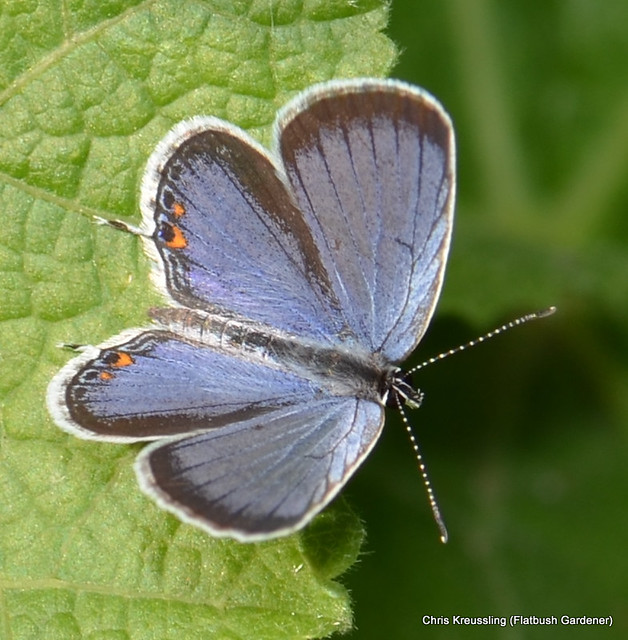
Cupido comyntas, Eastern Tailed-Blue

Cupido comyntas, Eastern Tailed-Blue.


A lifer butterfly for me. Very lucky to get a few good shots of it while it was resting, wings open, to take in some sun. They're small and fast.

2013-05-28

Magicicada Brood II

UPDATED: Expanded and organized into topics.

Contents

Magicicada in Staten Island's Clove Lakes Park

Yesterday, Matthew Wills and I traveled to Staten Island in search of Magicicada, the periodical cicada, specifically, Brood II. We both had examined the online reports and articles; although the south shore of Staten Island is their stronghold, Cloves Lake Park - not that far from the ferry terminal - kept turning up as one of the places they'd been sighted. As a bonus, I had the car, and this park was closest to the Verrazano narrows bridge.

2012-09-09

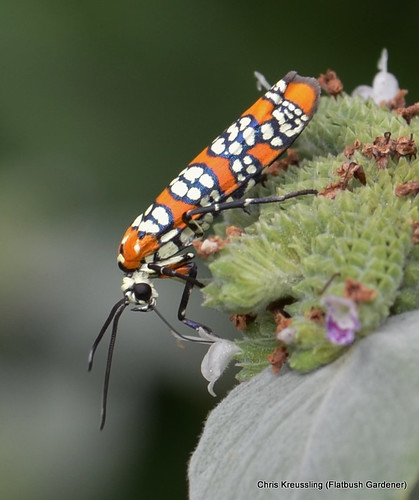
Atteva aurea, Ailanthus Webworm Moth

Atteva aurea, Ailanthus Webworm Moth, on Pycnanthemum, Mountain-Mint, in my garden last weekend. The intense colors are believed to be aposematic, a warning coloration to deter predators, probably because they would be distasteful.
Atteva aurea, Ailanthus Webworm Moth, on Pycnanthemum, Mountain-Mint

The larvae - caterpillars - feed in communal aggregations, like tent caterpillars. Around the globe, caterpillars in the genus Atteva are known to feed on plants from at least a half-dozen plant families. But they favor plants in the Simaroubaceae, the Quassia Family.

2012-08-13

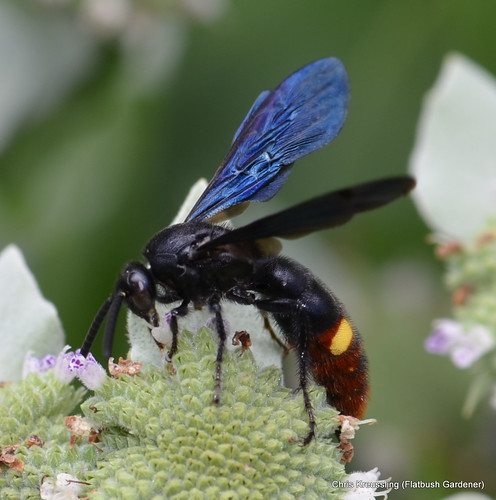
Scolia dubia, Blue-Winged Digger Wasp

Scolia dubia, Blue-winged Digger Wasp, on Pycnanthemum, Mountain-Mint, in my garden.
Scolia dubia, Blue-winged Digger Wasp, on Pycnanthemum, Mountain-Mint

Another little jewel of a wasp that is new to me this year. I've been seeing it on the Pycnanthemum, but was unable to get decent photos of it until yesterday. I've also seen it on the Clethra alnifolia, Summersweet in my garden, which just started blooming in the past week.

2011-07-31

Gardening with the Hymenoptera (and yet not)

Contents


One of the great pleasures of gardening is observing the activity the garden invites. I can lay out the welcome mat, and set the table, but the guests decide whether or not the invitation is enticing enough to stop by for a drink, a meal, or to raise a family. While charismatic megafauna such as birds and mammals are entertaining, the most common and endlessly diverse visitors are insects.

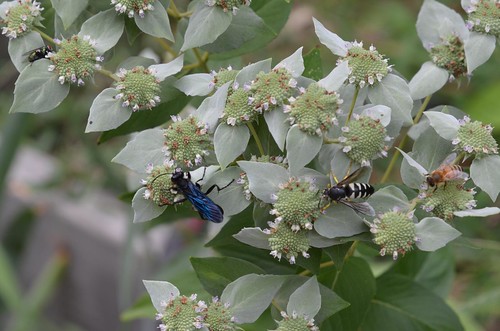
The Hymenoptera includes bees, wasps, and ants. Although my garden also provides amply for ants, we'll stick with the bees and wasps today. Following are some of the few portaits I've been able to capture of the many visitors to my gardens. The pollinator magnet, Pycnanthemum, Mountain-mint, in the Lamiaceae, provides the stage for many of these photos. I'm always amazed at the variety and abundance of insect activity it attracts when blooming.

Multiple pollinators on Pycnanthemum
Multiple Pollinators on Pycnanthemum

Bees

There are over 250 species of bees native to New York City alone. I'm still learning to identify just a handful of the dozens of species that frequent my garden.

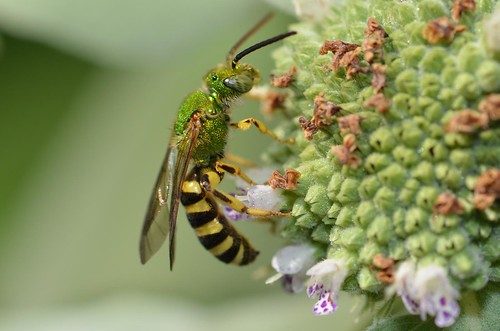
My current favorite is the bejeweled Agapostemon, Jade Bee
Agapostemon, Jade Bee, on Pycnanthemum

2011-06-11

Gardening with the Lepidoptera

Tomorrow, Sunday, June 12, my garden will be opened for its second tour of the season: the Victorian Flatbush House (and Garden!) Tour, to benefit the Flatbush Development Corporation (FDC). Earlier this week, I wrote about the transformation of the garden over the six past years, since we bought our home. Today, I'm providing details about one part of that transformation, one which is easy to replicate on a small scale, even in a tree bed or on a balcony.

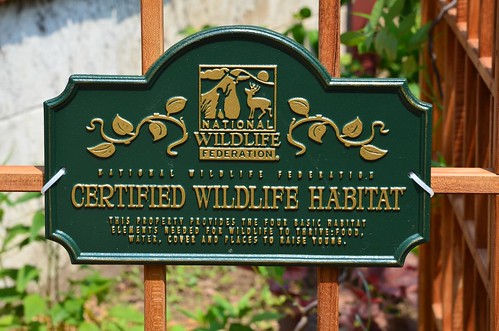
After readying my backyard native plant garden for its debut tour for NYC Wildflower Week in May, I decided to complete the requirements to register my garden as a Certified Wildlife Habitat (#141,173) with the National Wildlife Federation. With over 80 species of native plants, I easily met three of the four requirements: shelter, food, and places to raise young. All I lacked was water, a requirement satisfied by placing some birdbaths and a terra-cotta cistern.

On Friday, May 27, I mounted the plaque on the entrance arbor.
Certified Wildlife Habitat sign

The morning after I put out this welcome mat, I saw butterflies visiting a vine in the garden. I was puzzled, since the plant wasn't blooming yet. Closer observation revealed that they were laying eggs on the vine.

2010-04-26

Cellophane Bees Return

Cellophane Bee

Colletes thoracicus, Cellophane Bee, is a native species of solitary, ground-nesting bees. Solitary, because each nest is burrowed out by a single queen, who constructs several chambers in which to lay individual eggs. Solitary, yet communal: where they find the right conditions, the nests can be densely packed.Here's a short video showing the activity on Saturday morning.


This is the third year for what I've come to think of as "my little bees." I noticed the holes earlier last week, and saw all this activity last Saturday, as I was readying for the Plant Swap. This is the earliest in the year that I've noticed them.

Make Your Garden Bee-Friendly

These bees took up residence in a "neglected" spot of the garden, one of the benefits of being a lazy gardener/ecosystem engineer. Different species of bees have different requirements. Here are some things you can do to make your garden bee-friendly.

2009-08-18

Sphecius speciosus, Eastern Cicada Killer

Although I've lived in Brooklyn since 1992, I didn't encounter Sphecius speciosus, the Eastern Cicada Killer, until we moved to Flatbush in 2005. It was summer, and I was working outside in the garden. Suddenly, here was the biggest wasp I had ever seen, large and loud, buzzing around my driveway and digging into the lawn next to it. I freaked out. I hosed out the burrow and destroyed the nest.

I regret having done that. I attribute my over-reaction partially to the stresses of being a first-time homeowner. I now find them beautiful. I consider myself lucky that we live in an urban area where these specialists can thrive. Besides, they are much too busy during their short adult lives to bother with people.

Sphecius speciosus, Eastern Cicada Killer, with prey, just inside the Eastern Parkway entrance of the Osborne Garden at Brooklyn Botanic Garden, August 2009
Sphecius speciosus, Eastern Cicada Killer

They have a fascinating, if gruesome by human standards, life history. It could easily be the inspiration for the xenomorph of the Alien movie series.

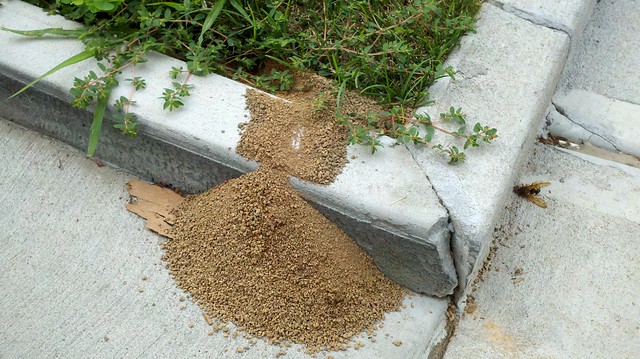
After mating, the female digs out a deep tunnel leading to a multi-chambered nest. They're impressive excavators. This debris pile appeared overnight alongside our driveway and sidewalk in August of 2012. The concrete curb is 3" high.
Burrow of Sphecius speciosus, Eastern Cicada Killer

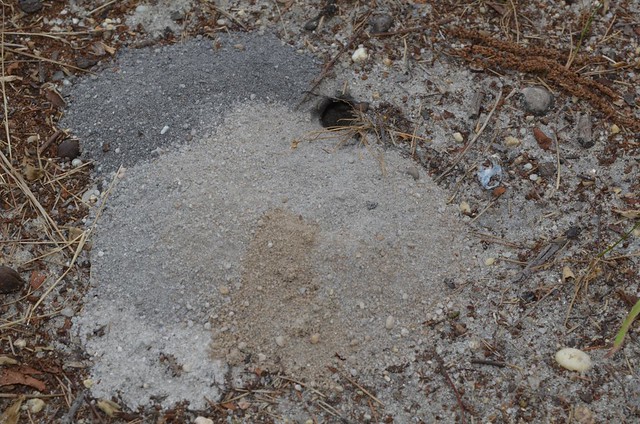
Here's the entrance to a nest in Cattus Island Park in Toms River, in the coastal pine barrens of New Jersey, in August of 2011. Note there are 4 different colors of sand, showing the different layers, and depths, the female reached.
Nest, Sphecius speciosus, Eastern Cicada Killer

The female then hunts for and captures an adult cicada, paralyzing it with its sting without killing it. It returns with the cicada to its burrow, dragging it into one of the chambers of the nest. It lays a single egg on the cicada. It repeats this process several times. The female dies soon after egg-laying.

Sphecius speciosus, Eastern Cicada Killer, with prey, at the Flatbush CommUNITY Garden, July 2008
Spechius speciosus, Eastern Cicada Killer

When the egg hatches, the larva feeds on the still-living cicada. When the cicada hs been completely consumed, the larva spins a cocoon and overwinters as a pre-pupa. In Spring it emerges from the cocoon as a pupa, eventually metamorphosizing and emerging as adults, male and female, for mating and renewing the cycle.

Dog-day Cicada (annual Cicada) in Prospect Park, July 2008
Dog-day Cicada

Cicada killers are solitary wasps. Males emerge from pupal cases in mid-July to early August, a few weeks before the females. The males tunnel out of the ground, leaving telltale holes, and select a territory that they actively defend. Females mate soon after emerging, and then begin digging burrows in the ground using their mandibles and legs. The burrows can be several feet deep with numerous branches.

Once construction is complete, the female searches in trees and shrubs. Upon capturing a cicada, the female stings it injecting venom. Then, she carries the cicada back to the burrow, where she lays an egg on its living, but paralyzed body. Within two weeks, the egg hatches into a larva, eats the cicada, and develops into a pre-pupa, the stage at which it will spend the winter. Cicada killers are active in late summer, the same time that cicadas are present. By September, most adults have died.

Although visually alarming, these wasps pose little threat. Females are not aggressive and rarely sting, unless excessively provoked. Males often display territorial behavior and will dive-bomb people’s heads; however, they have no sting and pose no real threat.

- Cicada Killer, Master Beekeeper Program, Cornell University
Felis catus ssp. cicadakilleratus 'Ripley' on my back porch, August 2009
Ripley with Cicada


I was prompted to write this in response to a message sent out on the Flatbush Family Network:
We seem to have an underground yellow jacket nest on our front walkway with a "Queen" that is about 2.5 inches long.....a little frightening to me but will absolutely scare the wits out of my kids- she looks like she can carry her own luggage! Anyone know an exterminator that can come and get rid of this Quick!?

Thanks, Lori
[bit.ly]

Related Content

Dog-Day Cicadas, 2008-07-11
Flickr photo set

Links

BugGuide

Wikipedia

University of Kentucky Entomology
Ohio State University Extension

2009-08-16

Eristalis transversa, Transverse Flower Fly

This beautiful creature is not a bee. It's a fly of the Syrphidae, a family of flies renowned for bee mimics. This is Eristalis transversa, Transverse Flower Fly. I had noticed it in my garden for the first time this summer. yesterday was the first chance I had to capture some photos of it. Consider this a belated Garden Blogging Bloom Day post, but with a native pollinator as the focal point.

Eristalis transversa, Transverse Flower Fly

Eristalis transversa, Transverse Flower Fly

The flower it's visiting is Aster novae-angliae 'Chilly Winds', a selection of the native New England Aster from Seneca Hills Perennials in upstate New York. This plant has been a pollinator magnet in my backyard native plant garden for weeks. It's massive and overgrown and poorly placed, crowding out everything else around it. I'll have to find it another place for next year.


[bit.ly]

Related Content

Flickr photo set
My BugGuide images

Links

BugGuide page
Seneca Hills Perennials

2009-07-12

Monobia quadridens, Mason Wasp

Monobia quadridens, Mason Wasp, male (I think), on Aster novae-angliae 'Chilly Winds' in my backyard native plant garden this afternoon.
Monobia quadridens, Mason Wasp

Today was my first full day home since last Monday, and I was sick for nearly a week leading up to that. So I took advantage of the beautiful weather in NYC and got out into the garden. The weeds had gotten away from me, and I spent most of my time dealing with them, at least a little bit.

I then turned my attention to the center of activity in the backyard: the massive specimen of New England Aster that just started to bloom in my absence. It's a selection of the species I ordered from Seneca Hill Perennials, which specializes in New York native plants, a couple years back. It didn't do much at first. In the full sun it's enjoyed since I had to take down the last of the weedy maples last year, it has grown to shrublike proportions - 5' wide and high - mocking the meager 1-2' spacing I provided between it and the plants around it. Today's pollinator activity concentrated on just the handful of open flowers. It has hundreds of buds. When it's in full bloom, the activity will be audible.

I was watching for bees, and there were a lot of different species visiting. This wasp was the most striking visitor. It's Monobia quadridens, the Mason Wasp. From the antennae, I think it's a male. Thanks to tangledbranches for the ID!

Judging from the photos on its BugGuide page alone, this is a common species with a wide distribution. It's native to eastern North America. From a gardener's perspective, this is a beneficial insect. It provisions its young with caterpillars in nests burrowed into the ground or bored into wood; it's also known as a Carpenter Wasp. I've never noticed it before. I hope to see more of it as the Aster comes into full bloom.

Monobia quadridens, Mason Wasp Monobia quadridens, Mason Wasp Monobia quadridens, Mason Wasp
[http://bit.ly/imbbO]

Related Content

Links

BugGuide page

2009-06-05

Bee Watchers Needed in NYC (and a rant)

The Great Pollinator Project, a joint effort of the Greenbelt Native Plant Center and the Center for Biodiversity and Conservation, is recruiting volunteers for 2009 to record and report observations of native bee species in New York City. They are conducting orientations over the next week from 6-8pm at the following locations:

Brooklyn: Monday, June 8th at Brooklyn Botanic Garden, 1000 Washington Avenue
Staten Island: Tuesday, June 9th at Greenbelt Nature Center, 700 Rockland Avenue
Bronx: Tuesday, June 9th at Van Cortlandt House Museum, Van Cortlandt Park
Queens: Wednesday, June 10th at Alley Pond Environmental Center (APEC) 228-06 Northern Blvd.
Manhattan: Tuesday, June 16th at Central Park, North Meadow Recreation Center (Off of 97th St. Transverse Road)

You can RSVP online, by emailing beewatchers@gmail.com, or by calling 718-370-9044.

I'll take this opportunity to rant a bit. Honeybees, which we manage both for their products - honey and beeswax - and their service as pollinators, are a single, non-native, species of bee. Colony Collapse Disorder (CCD) has been widely reported for several years and is well-embedded in the public consciousness. Meanwhile, the circumstances of the thousands of bee species native to North America go unreported.

Much has been made of agriculture's dependence on honeybees for pollination. Dire outcomes from the loss of honeybees - widespread crop failures, famine, even human extinction - have been proffered. Perhaps these things would come to pass. However, the underlying cause would not be the loss of honeybees but our dependence on them through unsustainable agricultural practices.

Honeybees are livestock. They are animals which we manage for our uses. We provide them with housing, maintenance, even move them from field to field as we let cows into different pastures for grazing.

Native pollinators will do the job, but only if we leave them a place to live. We clear land for orchards and fields, removing the hedgerows and other "messy" places that had been their home. The monocultures of agriculture are magnified in the deserts of diversity they create. Of course we need to ship domesticated pollinators around (burning fossil fuels in the process); we've eliminated the native pollinators by destroying their habitats. In the process, we've also driven out native predators of plant pests, thereby initating the addictive cycle of pesticides, fertilizers, more and more inputs needed just to tread water on land until our systems collapse around us.

If that should come to pass, just don't blame the bees.
One-third of our food depends on the services of a pollinator—bee or other insect, bird, or mammal. Bees are the most important pollinators in the Northeastern U.S., and there are more than 200 species of bees that live right here in New York City. We need to protect these local pollinators that help keep our parks and green spaces healthy and beautiful, and our farmers’ markets stocked with fresh produce.

In 2007, the Center for Biodiversity and Conservation and the Greenbelt Native Plant Center began the Great Pollinator Project (GPP) in collaboration with the Great Sunflower Project in San Francisco, CA. The goals of the GPP are:

1) identify which areas of New York City have good pollinator service (as determined by how quickly bees show up to pollinate flowers at various locations throughout the city);
2) increase understanding of bee distribution;
3) raise public awareness of native bees; and
4) improve park management and home gardening practices to benefit native bees.

If you are interested in our local pollinators, we need your help!

- The Great Pollinator Project
There are many ways to be a Bee Watcher:
  • Observe bee visitation at selected plants that will be distributed at our spring orientations. Conduct your observations in your own garden and submit your data online.
  • Become a Mobile Bee Watcher. Conduct your observations on flowers in your neighborhood or at selected bee gardens planted at various locations throughout New York City and submit your data online.
- Bee Watchers

Related Content

Bees, a Mockingbird, and Marriage Equality, 2009-05-22
Cellophane Bees Return, 2009-05-09
Colletes thoracicus (Colletidae), Cellophane Bees, 2008-05-26

Links

Great Pollinator Project
Greenbelt Native Plant Center
Center for Biodiversity and Conservation