Showing posts with label beetles. Show all posts

2023-03-15

U.S. Firefly Atlas

The Xerces Society, in collaboration with the IUCN SSC Firefly Specialist Group and New Mexico BioPark Society, has launched the Firefly Atlas project:

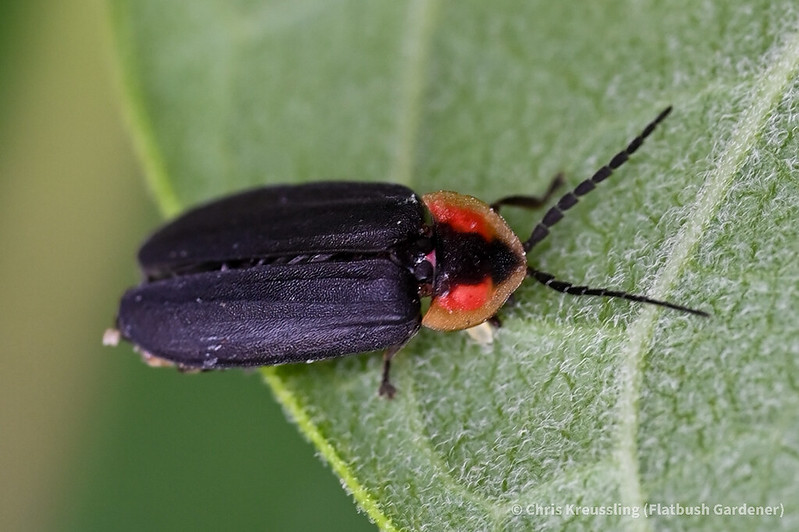
Lucidota atra, black firefly, found on milkweed along my driveway, 2022-07-05
The Firefly Atlas is a collaborative effort to better understand and conserve the diversity of fireflies in North America. Launched in 2022, the project aims to advance our collective understanding of firefly species’ distributions, phenology, and habitat associations, as well as to identify threats to their populations.

Although the Atlas tracks all species described from the US and Canada, we are currently prioritizing efforts for a subset of 13 threatened and data deficient species found in three focal regions of the US: the Mid-Atlantic, Southeast, and Southwest. These priority regions were chosen based upon having a high number of threatened species and/or a high number of data deficient species. - What is the Firefly Atlas?

2015-07-01

Pyrrhalta viburni, viburnum leaf beetle (VLB)

Pyrrhalta viburni, the viburnum leaf beetle, or VLB for short, is native to Europe. It was first discovered in North America barely two decades ago, in Maine in 1994. Both larvae and adults eat leaves. Our native Viburnum species are extremely vulnerable; they aren't adapted to this species of leaf beetle. With ample food supply, and no native predators to control its spread, VLB has rapidly expanded its range since.
The viburnum leaf beetle, Pyrrhalta viburni (Paykull), is an invasive, non-native beetle that first appeared in New York along Lake Ontario in 1996, and has steadily spread across the state and down the Hudson Valley. It is a voracious eater that can defoliate viburnum shrubs entirely. Plants may die after two or three years of heavy infestation, particularly when larvae strip plants after hatching out in spring followed by heavy adult feeding later in summer.
- Viburnum leaf beetle invading NYC?, Cornell Horticulture Blog, May 2009
It's been in New York City less than a decade. In Brooklyn, I first observed the damage on Viburnum dentatum, arrowwood, at the Brooklyn Botanic Garden in May 2012. Last year, I found it in Prospect Park; by May, arrowwoods there were shredded.
Pyrrhalta viburni, Viburnum leaf beetle, on Viburnum dentatum, arrowwood, Prospect Park, Brooklyn, May 2014

2006-06-23

Coleomegilla usurps Coccinella as New York State Insect

[Update, 2006.08.15: Corrected the date to 2006 from 2005!]


News, June 15, 2006, Albany, NY: The New York State Assembly bill A06247 passed and delivered to the Senate:
PURPOSE OR GENERAL IDEA OF BILL : Alters terminology of the state insect.

JUSTIFICATION : To change the official state insect from the Nine-spotted lady beetle (Coccinella novemnotata) species of the lady bug, which is no longer found in New York State, to another species of Lady Bug, the Spotted lady bug (Coleomegilla maculata).

PRIOR LEGISLATIVE HISTORY : New Bill.

FISCAL IMPLICATIONS : None.

EFFECTIVE DATE : Immediately.
Here's how the New York Times reported it today, June 23:
The state's official insect, a nine-spotted ladybug, would no longer fly in that role: it is extinct in New York State. So legislators took a break from bickering over health care spending and property taxes in the waning days of the session and found common ground on the issue of designating a new state insect, making it the pink spotted ladybug instead.
- A Few Things Lawmakers Can Agree On [requires subscription for viewing]
I think the correct term would be "extirpated" in New York State. Regardless, the article goes on to quote Nancy Calhoun, Republican, sponsor of the bill:
... "I know it's not earth-shattering," said the assemblywoman, Nancy Calhoun, who represents parts of Orange and Rockland Counties.

Ms. Calhoun says she was just trying to right a wrong. Lawmakers first adopted the state's official bug in 1989, but the nine-spotted ladybug had already become extinct in the state. Ms. Calhoun was alerted to the error by a reporter a couple of years ago and she submitted a bill to rectify the matter.

"Why do we want to get something like this wrong?" Ms. Calhoun said. "It would be like having a dinosaur as our state reptile." ...
It's an interesting question. In fact, New York State has a state fossil, the Sea Scorpion, which is an extinct relative of the Horseshoe Crab, which is not. So intentionally selecting an extinct state symbol is not out of the question. The comparison is not accurate, however. Dinosaurs were extinct before we got onto the scene; C. novemnotata was once common. A better question is: How did New York State get to have a once-native-but-no-longer-resident state insect?

The back-story can be found in the Fall 2003 issue of Wings, the magazine of the Xerces Society:

2006-06-19

Insect Profile: Apion (Rhopalapion) longirostre, Hollyhock weevil


Apion (Rhopalapion) longirostre, Hollyhock weevil, on, of all things, my hollyhocks in the sunny border at Garden #4 in Flatbush. The upper photo shows a single male, I believe, on a leaf. The lower photo shows a pair in their typical posture, ie: mating. The female has her (even longer) snout buried in the flower bud.
Photos taken: June 4, 2006

The taxonomy of Apion (Rhopalapion) longirostre, common name Hollyhock weevil or (sometimes) Black vine weevil, is confusing. I've seen it listed as being in the Family Brentidae, the straight snout weevils, the Apionidae or Apioninae, and the Curculionidae. Whatever! They are in the order Coleoptera, the beetles.

The genus Apion seem to generally have long snouts. Their antenna are jointed and located halfway along the snout. A. longirostre is distinguished from other Apion species by its orange legs.

Their native range of A. longirostre is in Eurasia, originally limited to southern and southeastern Europe and Asia Minor. It has since spread much further afield there. It was first detected in North America in Georgia in 1914. Within fifty years it had spread across the continent.