Showing posts with label Weeds. Show all posts

2018-08-19

Plant Blindness and Urban Ecology

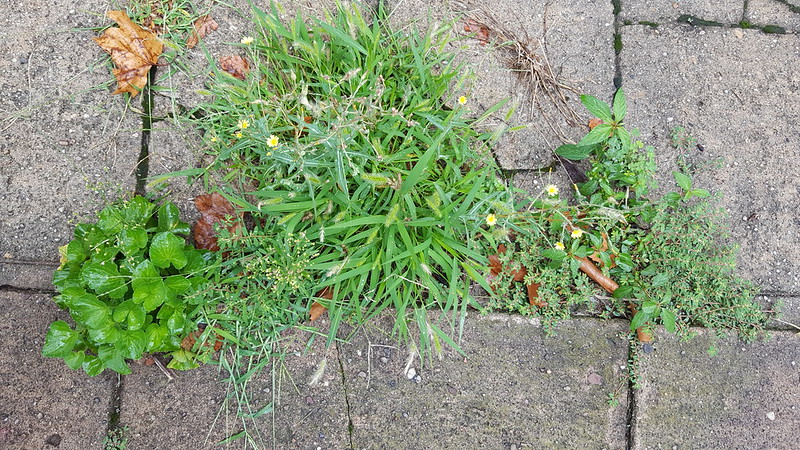
A small patch of biodiversity - i.e.: weeds - from my driveway.
Weeds in my driveway, August 2018

A recent article in the Wall Street Journal has people talking about it, e.g.: on the Twitter. The term "plant blindness" has been in use for a while, especially among those of us intensely interested in the subject of plants, from gardeners to botanists.

"Apps" and Social Media

I've seen folks get more interested in plants when they can reduce, or eliminate, the risk of being shamed by others for ignorance. (Which is nothing to be ashamed of, nor to shame others for. We all start out ignorant. Choosing to remain so, on the other hand ...)

2015-02-23

Invasive Plant Profile: Chelidonium majus, Celandine, Greater Celandine

Revised 2015-02-23: This was one of my earliest blog posts, first published in June 2006. I've overhauled it to 1) meet my current technical standards, and 2) improve the content based on the latest available information.


Chelidonium majus, Celandine or Greater Celandine, is a biennial (blooming the second year) herbaceous plant in the Papaveraceae, the Poppy family. It is native to Eurasia. It's the only species in the genus.

It's invasive outside its native range, and widespread across eastern North America. It emerges early in the Spring, before our native wildflowers emerge, and grows quickly to about 2 feet. That's one of the clues to identification. It's also one of the reasons why it's so disruptive. The rapid early growth crowds and shades out native Spring ephemerals.

2013-07-02

Rainbow Garden

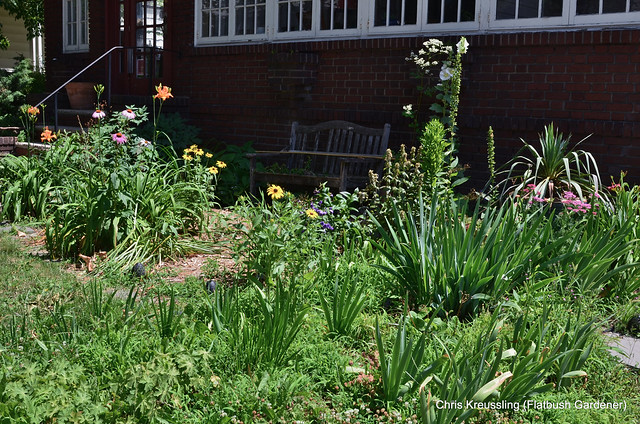
My front garden bloomed all the colors of the rainbow just in time for this past Pride Weekend.
Rainbow Garden

The plants in bloom include natives, heirlooms, passalongs from past plant swaps, and weeds. Not everything in bloom is visible in the photo. Some are too small to stand out at this scale. Others are just off-frame to the right.

2008-07-10

Weed Cortelyou some more this weekend

This weekend Flatbush residents have two more opportunities to weed, clean up, and mulch tree pits along Cortelyou Road:
  • Saturday, July 12, 9am to 12 noon, between Rugby and Marlborough Roads. Meet at the clock at the northwest corner of Rugby and Cortelyou, by the school and playground.
  • Sunday, July 13, 9am to 12noon, between East 16th and East 17th Streets. Meet at the corner of East 16th and Cortelyou.
One of the tree pits on Cortelyou Road between Rugby and Marlborough, across the street from the Food Co-op, June 28, 2008. The weeds were as high as the parking meter then. They're even higher now.
Major Weeds

We will be there both mornings from 9am to 12noon or when that block is weeded, whichever comes first. No gardening experience necessary! We will show you what to do.

Bring your own drinking water, sunscreen, and gloves and be ready to get dirty.

Thanks to Flatbush Development Corporation for buying mulch for the tree pits! And many thanks to my neighbor, Tracey Hohman, for jump-starting this cleanup!

Related Posts

Links


2008-07-05

Cortelyou Weeded (Partly)

Before: Weeding Cortelyou

This morning I joined about a dozen neighbors to weed, clean up, and mulch the tree pits on Cortelyou Road between Argyle and Rugby Roads. Many hands made light work of the 15 tree pits on the north and south sides of this one block. We got them all done in about 2-1/2 hours.

They look great. If you visit the Greenmarket tomorrow, or visit the block during the week, take a look and thank your neighbors. Thanks to Tracey Hohman for organizing this. And thanks to Flatbush Development Corporation for buying mulch for the tree pits!

After: Cortelyou Weeded

Weeded and mulched tree pit

We could only do this one block. There's more to be done. If you're available to help out on upcoming weekends, please let us know by responding to the poll in the upper-right of the sidebar, or email me at the address in my profile.

Related Posts

Weeding Cortelyou

Links

Flatbush Development Corporation
Invasive and Noxious Weeds of the Northeast, USDA PLANTS Database

2008-06-28

Weeding Cortelyou, Saturday, July 5, 2008

Update 7/7: See Cortelyou Weeded (Partly)Update 7/1: Please fill out the survey at the top of the sidebar to let us know if you're able to help weed this Saturday. Several folks have indicated that Saturday's not good for them, so if another date would work, please let us know that, too.
A tree pit on Cortelyou Road needin' weedin'. Note that the weeds are as high as the parking meter.Major WeedsNext Saturday morning, July 5th, starting at 9am, join Flatbush residents, gardening and non-gardening alike, to help weed and clean up the tree pits along Cortelyou Road between Coney Island Avenue and East 16th Street.
Tired of looking at all the weeds in our beautiful new tree pits? Come and help us weed Cortelyou! Meet at the Cortelyou Library at the corner of Argyle Road on Cortelyou, on Saturday, July 5th at 9am. We will be there all morning. No gardening experience necessary! We will show you what to do.Bring your own drinking water, sunscreen, and gloves and be ready to get dirty.
Thanks to Flatbush Development Corporation for buying mulch for the tree pits! And many thanks to my neighbor, Tracey Hohman, for jump-starting this cleanup!Neighbor Stacey Bell planting Daffodils in Fall of 2007.Tree Pit PlantingIf you have any questions, you can contact Tracey by email at thohman [at] verizon {dot} net, or contact me through the email in my profile, available in the sidebar.

Related Posts

Cortelyou Weeded, July 6, 2008Cortelyou Road

Links

Flatbush Development CorporationInvasive and Noxious Weeds of the Northeast, USDA PLANTS Database

2006-06-06

Invasive Plant Profile: Chelidonium majus, Celandine, Greater Celandine

Revised 2015-02-23: This was one of my earliest blog posts, first published in June 2006. I've overhauled it to 1) meet my current technical standards, and 2) improve the content based on the latest available information.


Chelidonium majus, Celandine or Greater Celandine, is a biennial (blooming the second year) herbaceous plant in the Papaveraceae, the Poppy family. It is native to Eurasia. It's the only species in the genus.

It's invasive outside its native range, and widespread across eastern North America. It emerges early in the Spring, before our native wildflowers emerge, and grows quickly to about 2 feet. That's one of the clues to identification. It's also one of the reasons why it's so disruptive. The rapid early growth crowds and shades out native Spring ephemerals.