Showing posts with label My Gardens. Show all posts

2022-03-11

Native Plant Profile: Amelanchier

I could probably talk about Amelanchier until my voice gave out (at least an hour!). It's such a great multi-season plant in the garden, and brings so much value to wildlife, as well. It's also a great example of how native plants convey a "sense of place" that is not imparted by conventional, non-native plants in the garden.

Although the Genus is distributed across the Northern hemisphere, the greatest diversity is found in North America. As you can see from the BONAP distribution map, Amelanchier diversity is the greatest in the Northeast. New York State hosts 14 species, varieties, natural hybrids, and subspecies. And New York City is home to 6 of those.

2013 BONAP North American Plant Atlas. TaxonMaps - Amelanchier

Amelanchier in my garden

Amelanchier was one of the key plants I included in my backyard native plant garden design in 2009. To fit my design, I needed a tree form with a single trunk and broad canopy.

2021-12-14

Garden Design Pattern Languages

Adapted from a tweet thread.

In a guest post on the ASLA's "Dirt" column, Alden E. Stone, CEO of Nature Sacred, writes:

[Our new report] is part research and part practical guide, and shares key insights gained through having co-created more than 100 Sacred Places across the country in communities, many under-resourced; in prisons, at universities, and in hospitals. A handful of these sites were also implemented as part of an expansive, decade-long design, build, and research project. ...

For the research portion of this paper, we focused our attention on four domains: nature’s impact on individual, community, economic and ecological health. ...

for many of the individual and community health benefits to kick in, people must engage with nature. Spend time in the green space. And this is where Nature Sacred has spent a lot of energy over the past two decades — looking at how to best engage the community and how to best design so that the community embraces, and spends time in, their green space.

She describes four "design elements":

  • Portal
  • Path
  • Destination
  • Surround

These design patterns recur in many different types of gardens, whether intentionally healing/sacred or not.

My backyard embodies all four elements. What follows is an exploration of the history of my backyard, from inception to its current state, viewed through the frame of those four design elements.

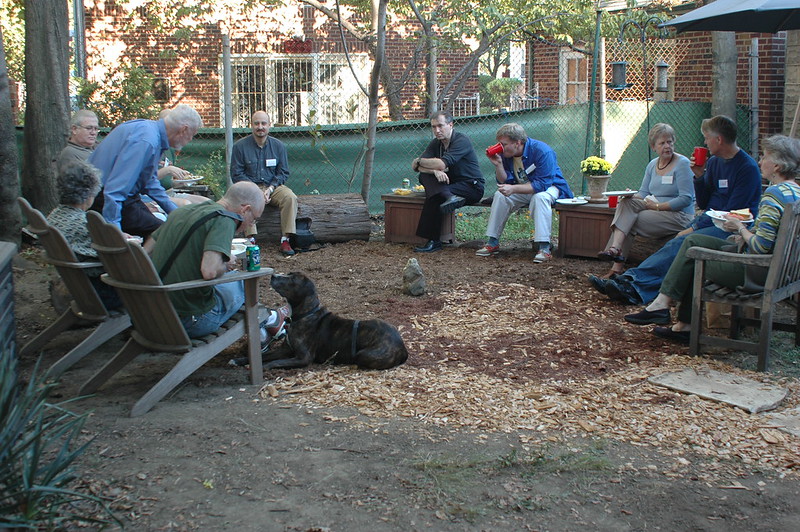
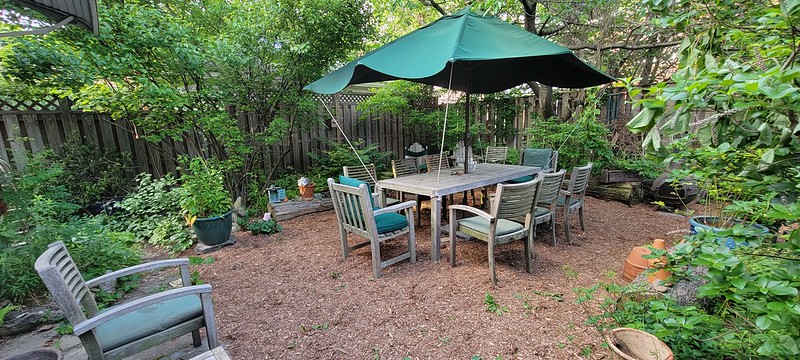
The Backyard, House Opening Party, October 2005 The Backyard, ready for visitors, June 2021

2020-05-14

Home of the Wild

A month ago, Carrie Seltzer (@carrieseltzer) created the "Home Projects" iNaturalist Umbrella Project - a Project of Projects - for "personal" Projects of people's homes, gardens, or yards:
As we all more closely inspect our immediate surroundings as of April 2020, it seemed like a good time to pull together some projects that capture biodiversity in homes around the world.

- Carrie Seltzer on iNaturalist

Growth of a Garden

I've been gardening in New York City for four decades, over four different gardens. I've incorporated native plants in each garden, though my knowledge, understanding, and focus, has shifted and grown over time.
Bombus citrinus, lemon cuckoo bumble bee, on Helianthus in my front yard, August 2018

2019-06-08

Sunday 6/23: Pollinator Safari: Urban Insect Gardening with Native Plants

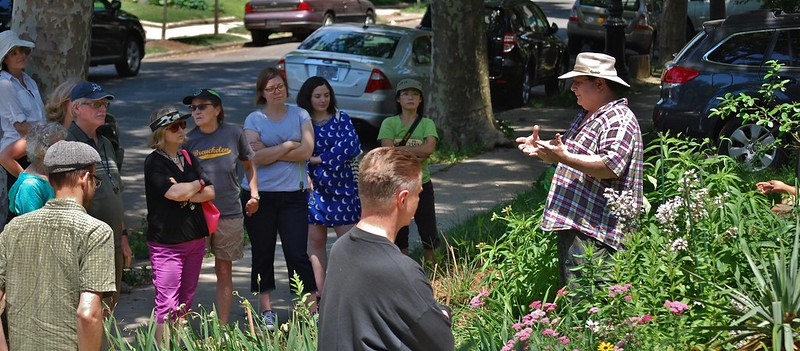
Me hosting the NYCWW Pollinator Week Safari in my Front Yard. Photo: Alan Riback

I'm pleased to announce that I'll be hosting a pollinator-focused garden tour and citizen science workshop in my garden for Pollinator Week, in association with NYC Wildflower Week.

Event Details

Date: Sunday, June 23, 2019
Time: 1-4pm
Location: Brooklyn, NY, corner of Stratford Road and Matthews Place
Cost: FREE!
RSVP: Eventbrite

1-2pm: I'll be focusing in using iNaturalist to observe and identify insects in the garden. Create a free account on iNaturalist, and install the app on your smart phone. I'll show you how to make observations in the garden with your phone!
2-4pm: We'll explore the garden, see examples of how to garden for insects and pollinators, look at insect-plant associations happening in the garden, and, optionally, make observations with iNaturalist.

These times are a rough guide. You can drop by any time.

2018-08-19

Plant Blindness and Urban Ecology

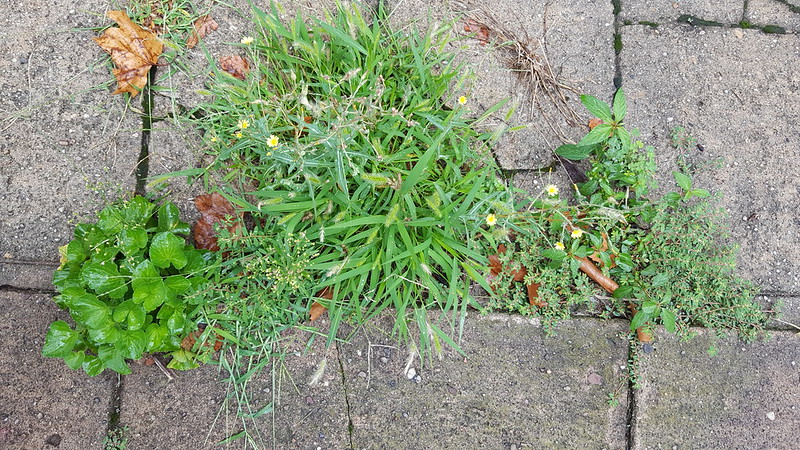
A small patch of biodiversity - i.e.: weeds - from my driveway.
Weeds in my driveway, August 2018

A recent article in the Wall Street Journal has people talking about it, e.g.: on the Twitter. The term "plant blindness" has been in use for a while, especially among those of us intensely interested in the subject of plants, from gardeners to botanists.

"Apps" and Social Media

I've seen folks get more interested in plants when they can reduce, or eliminate, the risk of being shamed by others for ignorance. (Which is nothing to be ashamed of, nor to shame others for. We all start out ignorant. Choosing to remain so, on the other hand ...)

2017-04-30

Blooming Now

NYC-Native Species

Asarum canadense, wild ginger

Fragaria virginiana, Virginia strawberry

Geranium maculatum

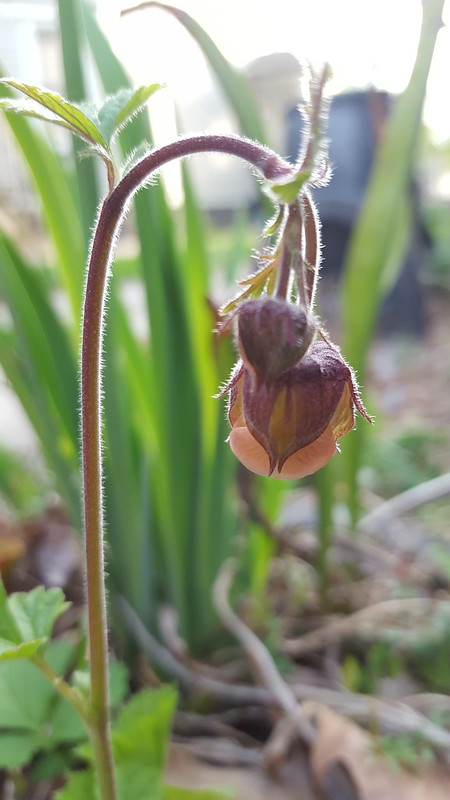
Geum rivale, purple avens
Geum rivale, water avens, purple avens

Podophyllum peltatum, mayapple

Polygonatum biflorum


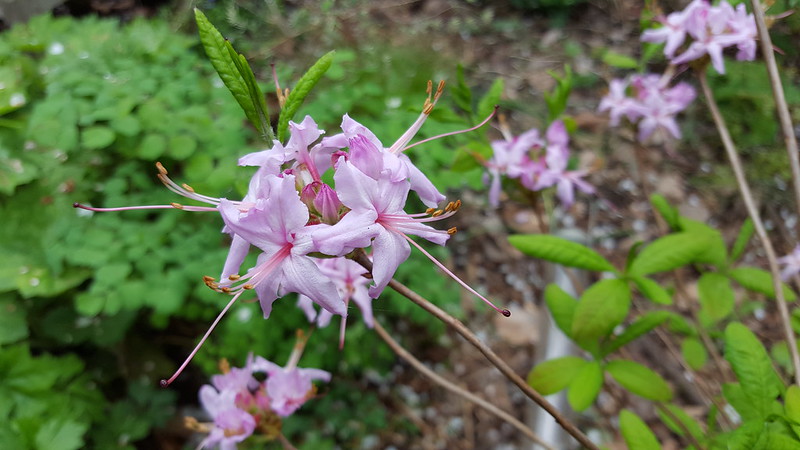
Rhododendron periclymenoides
Rhododendron periclymenoides, pinxterbloom azalea

Thalictrum thalictroides


Vaccinium angustifolium, lowbush blueberry

Vaccinium corymbosum, highbush blueberry

Viola lanceolata, bog white violet

Viola sororia, dooryard violet (several different varieties)

Zizia aurea, golden alexanders

Eastern Regional Native Species

Dicentra eximia
Fothergilla major
Phlox stolonifera (in bud)
Polemonium reptans, Jacob's ladder
Sedum ternatum
Stylophorum diphyllum, woodland poppy
Tiarella cordifolia, foamflower
Trillium grandiflorum, great white trillium

2015-06-22

What I'm About

Notice anything different about me? Until a few minutes ago, the by-line at the header of this blog read:
Adventures in Neo-Victorian, Wild, Shade, Organic and Native Plant Gardening, Garden Design, and Garden Restoration.
It now reads:
Urban Gardening with Native Plants
This better communicates the focus of my interests and expertise than the "anything goes" byline it replaces.

How I got here

We bought our house and garden 10 years ago. I started this blog 9 years ago.

The byline I just replaced reflected the experimental approach I was taking to having so much space to play with. Heirloom plants in the front yard, which might have been available to the original gardener of our home. Shade gardening because what urban gardener doesn't have to deal with shade somewhere? Wild, because something has to be left uncultivated. And always organic gardening.

I've gardened with native plants since my first garden in the East Village. Each of the 4 gardens I've worked on in New York City has incorporated native plants. When we bought our house 10 years ago, I had pretty much a blank slate to work with. I quickly decided that the backyard would be a woodland garden, populated with ephemerals, ferns, and others plants native to the forests of northeastern North America.

2015-06-14

Native Plant Acquisitions: LINPI 2015 Plant Sale

Saturday, June 13 was the last open day in 2015 for the Long Island Native Plant Initiative (LINPI) Plant Sale. I picked up another 13 species to add to my list, which has already grown this Spring to over 200 species of plants native to eastern North America. We'll see how many of them survive my, um "gardening."

As with all the plants available through LINPI, all are local ecotypes propagated by NYC Parks' Greenbelt Native Plant Center from wild populations on Long Island and Staten Island. It so happens all these species are also native to New York City.

Apocynaceae

(or Asclepiadaceae, depending on taxonomy)

Asclepias tuberosa, butterfly weed
I bought a 6-pack of these from the LINPI Plant sale two years ago. They are blooming now. I bought a flat (6 x 6-packs = 36 plants) this time. I want to have larger groups of them in several sunny areas to see where they thrive.

Asteraceae

Eupatorium hyssopifolium, hyssop-leaved throughwort, hyssop-leaved boneset

Eupatorium perfoliatum, common boneset, boneset thoroughwort
This species is only found in wetlands (Wetland indicator status OBL/"obligate"), so I'm planting this in and around the garage, for runoff, and planters, where it will benefit from overflow from watering.

Eupatorium serotinum, late-flowering thoroughwort
This was listed incorrectly as Eutrochium serotinum on LINPI's web site. This is the odd one out for nativity, which is challenged by some, e.g.: NEWFS.

Solidago nemoralis, gray goldenrod
One of the shade-tolerant goldenrods, I bought a flat of these to plant them all around the house as an experiment to see where/how they fare from sun to shade.

Solidago speciosa, showy goldenrod

Ericaeae

Vaccinum macrocarpon, cranberry
This is one of the species available on-site at the plant sale that wasn't listed on LINPI's web site. I already have two of these, one in each bog planter. I bought a 6-pack as an intentional duplicate. I planted 4 in the two bog planters I have. I need to fill in these planters so the squirrels won't keep digging them out. As an experiment, I planted the other two nearby, alongside the garage, where they'll get runoff from the roof and gutter downspout.

Fabaceae

Chamaecrista fasciculata, prairie senna, partridge pea, partridge sensitive-pea
Lespedeza hirta
Lespedeza virginica

Malvaceae

Hibiscus moscheutos, swamp rosemallow
Another obligate wetland species, I planted this by the side of the garage to benefit from runoff from the roof, and to server as a backdrop for this mixed shrub-perennial bed.

Poaceae

Panicum virgatum, switchgrass
Sorghastrum nutans, indian grass
Tridens flavus, purple top

Rosaceae

Rosa carolina, Carolina rose

Rubiaceae

Cephalanthus occidentalis, buttonbush

Related Content

Other blog posts about my native plant garden

Links

Long Island Native Plant Initiative (LINPI) Plant Sale

2015-05-14

Native New Yorkers: My Garden's NYC-Native Plant Checklist

This is a checklist of just the plant species native to New York City I'm growing in my garden. I'm posting this for the benefit of anyone attending the NYC Wildflower Week tour of my garden, Friday, May 15, from 1-3pm. It may also be of interest to those who attended Tuesday night's meeting of the Long Island Botanical Society. I only had time during that talk - Place, Purpose, Plants: Urban Gardening with Native Plants - to highlight a handful of plants I'm growing.

Visitors are also going to get to witness a rare treat: "My little bees", Colletes thoracicus, are actively nest-building in the garden right now. Most years, they would be finished by now, not to be seen until April of the next year. If we're lucky, we will also get to see the Nomada sp. cuckoo bees I just noticed in my garden for the first time this year.

2015-05-13

Place, Purpose, Plants: Urban Gardening with Native Plants

At last night's meeting of the Long Island Botanical Society, I spoke about my experiences gardening with native plants in an urban setting. These slides accompanied my talk.


Related Content

All my blog posts about My Garden
Other Native Plants blog posts, resources, and references
My insect photography on Flickr

Links


Bennington, J Bret, 2003. New Observations on the Glacial Geomorphology of Long Island from a digital elevation model (DEM) (PDF). Long Island Geologists Conference, Stony Brook, New York, April 2003.