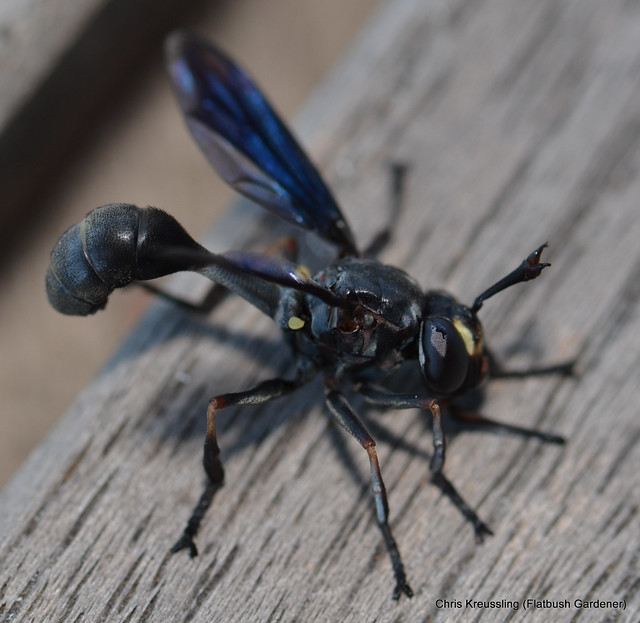
Trichopoda pennipes, Feather-legged Fly, on
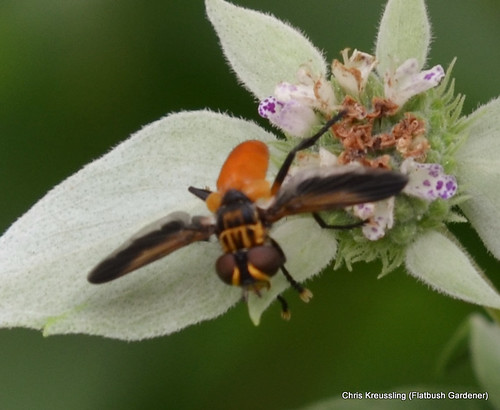
Pycnanthemum, Mountain-Mint, in my garden yesterday. Although it's widespread and common, occurring throughout North America, this was the first time I've noticed this species in my garden.
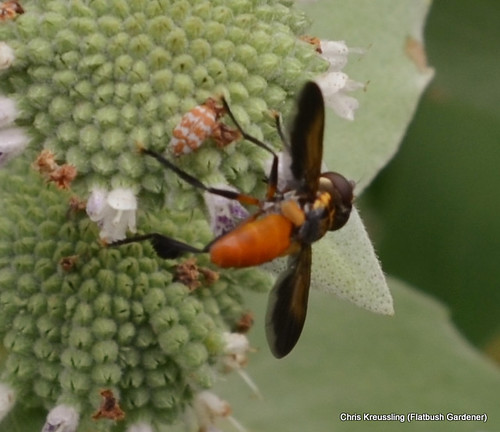
This photo shows several of the keys to identifying this species:
- "Feathered" fringes on the hindlegs, true of Trichopoda.
- Orange abdomen. Females have a black-tipped abdomen. Males, such as this one, have a completely orange abdomen.
- Wings are completely black. This species has a transparent margin to the wing.
Trichopoda is a parasitoid of Hempitera, true bugs, including many agricultural and garden pests, such as squash bugs and stinkbugs. For this reason, it's considered a "beneficial" insect:
Each female fly lays on average 100 eggs, which are placed singly on the body of a large nymph or adult bug. Most of the small, white or gray, oval eggs are placed on the underside of the thorax or abdomen, but they can occur on almost any part of the bug. Many eggs may be laid on the same host, but only one larva will survive in each bug. The young larva that hatches from the egg bores directly into the host body. The maggot feeds on the body fluids of the host for about two weeks, during which time it increases to a size almost equal to that of the body cavity of its host. When it has completed its development, the cream-colored third instar maggot emerges from the bug between the posterior abdominal segments. The bug dies after emergence of the fly, not from the parasitoid feeding, but from the mechanical injury to its body. The maggot pupates about an inch down in the soil in a dark reddish-brown puparium formed from the last larval skin, and an adult fly emerges about two weeks later. There can be three generations per year depending on location.
The fly overwinters as a second instar larva within the body of the overwintering host bug. Adult flies emerge in late spring or early summer. The only bugs large enough to parasitize at this time are overwintered adults. Subsequent generations develop on both nymphs and adults of the next generation.
- Trichopodes pennipes, Parasitoid of True Bugs
Related Content
Flickr photo set:
Trichopoda pennipes, Feather-Legged Fly
Links
BugGuide:
Trichopoda pennipes
University of Wisconsin-Madison, Department of Entomology, Midwest Biological Control News,
Trichopodes pennipes, Parasitoid of True Bugs
North Carolina State University, Raleigh, Dept. of Entomology,
Biological Control Information Center,
Trichopoda pennipes