2006-06-04

Garden Notes: Old roses with strong fragrance and good rebloom

I've been researching old roses for the heirloom garden for the front of the house. My primary search criteria are:
  • Strong fragrance. I want the fragrance available for passersby and open windows in the summertime.
  • Good rebloom. Since the front garden is not large, it needs to put on a good show for a long time.
  • Old/heirloom/antique. The variety was introduced before 1905, ideally in the late 1800s. Our house was built in 1900.
Additional requirements:
  • Non-invasive. Roses which are clearly invasive in the New York City area are R. multifora, Multiflora Rose and R. rugosa, Beach Rose.
  • Disease resistance for mildew, black spot, and so on.
  • Shrub form, non-climbing. Up to 6' high and wide is okay.
  • Long season interest. This is provided by good foliage, especially persistent or semi-evergreen leaves, rose hips, and interesting branching structure.
I've been able to find a surprisingly large number of varieties, primarily by taking advantage of the advanced search capabilities offered by the Web sites of Rogue Valley Roses (RVR) and Vintage Gardens (VG). Both of these offer searching by fragrance, rebloom, and year of introduction. I tried using HelpMeFind/Roses, but it doesn't offer any search by fragrance, and attempts to include year of introduction in the search returned nothing.

Of the list below, varieties which most interest me right now are marked with *. I don't think I have enough room to grow them all, since I'm not interested in growing a rose garden. I might try a few, keep the ones perform best in my gardens, and give away or donate the others. Varieties which are not suitable for my needs are marked with -.
  • Aimée Vibert (RVR, VG). Introduced 1828. Flower color: white/near white. Foliage: Dark green, semi-evergreen. Habit: Spreading. Height: 4'. Disease resistant.
  • *Ardoisée de Lyon (RVR, VG), a color sport of Baronne Prévost. Introduced 1858. Flower color: Deep pink/purple, fading to lavender and mauve. Habit: Upright. Height: 6'. Disease resistant. Good for hips. Good for cutting.
  • -Baltimore Belle (RVR, VG). Introduced 1843. Flower color: Blush pink (VG), White, near white (RVR). Habit: Rambler. Height: 10-15'. RVR doesn't list this as reblooming, while VG notes a long, moderate rebloom.
  • *Baronne Prévost (RVR, VG). Introduced 1842. Flower color: Rose/Clear/Deep Pink. Habit: Upright. Height: 6'. Disease resistant. Good for cutting.
  • -Blanc Double de Coubert (RVR, VG), classified as a Rugosa. Introduced 1892. Flower color: White. Sets few hips.
  • Blush Noisette (RVR, VG). Introduced 1814/1817. Flower color: Blush/Light pink. Habit: Shrub, upright. Height: 6-8'. Disease resistant.
  • Cecile Brunner, Everblooming Spray form (RVR). Introduced 1881.
  • *Clotilde Soupert (RVR, VG). Introduced 1890. Flower color: White with pink centers. Habit: Upright. Height: 3'. Both RVR and VG note that this variety "balls" for them, whatever that means, especially in the cool, wet weather of spring. It seems to mean that the buds never fully open.
  • -Deuil de Dr. Reynaud (RVR, VG). Introduced 1862. Flower color: Cerise, deep pink. Habit: Shrub, or climber. Height: 10-15'.
  • Eugene de Beauharnais (RVR). Introduced 1838.
  • Général Jacqueminot (General Jack) (RVR, VG). Introduced 1846/1853. Flower color: Dark red. Habit: Shrub or Climber. Height: 8-10'. Good for cutting.
  • Mme. Bérard (RVR, VG). Introduced 1870. Flower color: Apricot, Peach. Habit: Shrub. Height: 6-8'.
  • Mme. Creux (VG), likely Kaiserin Freidrich. Introduced 1890. Flower color: Apricot-Buff. Habit: Upright? Height: 4-5'?
  • -Mme. Ernest Calvat (RVR, VG), possibly sport of Mme. Isaac Pereire. Introduced 1888. Flower color: Light pink, lavender, cerise. Habit: Upright. Height: 10-15'. Shade Tolerant. Good for cutting.
  • *Mme. Isaac Pereire (RVR, VG). Introduced 1881. Flower color: Pink, amaranth, magenta, purple. Habit: Arching. Height: 8-10'. Good for hips. Good for cutting.
  • Mme. Lambard (RVR, VG). Introduced 1878. Flower color: Variable, pink, apricot, coppery. Habit: Spreading. Height: 6'. Good for cutting.
  • *Marie Pavie (RVR). Introduced 1888. Flower color: White. Habit: Upright. Height: 3'. Very disease resistant. Good for cutting.
  • Narrow Water (RVR, VG), sport of Nastarana. Introduced 1883. Flower color: Blush/Light pink. Habit: Shrub, upright? Height: 6-8'.
  • Nastarana (RVR, VG). Introduced 1879. Flower color: White. Habit: Shrub. Height: 6-8'. Good for cutting.
  • *Pierre Notting (RVR, VG). (Note: This is completely different from Souvenir de Pierre Notting.) Introduced 1863. Flower color: Dark red (VG), Mauve (RVR). Habit: Shrub. Height: 6-8'. Good for cutting.
  • Pink Soupert (VG). Introduced 1896. VG describes this as "Almost a ringer for Clothilde Soupert, and every bit as fragrant, but with somewhat smaller flowers a bit less double, foliage narrower, more rugose."
  • *Reine des Violettes (RVR, VG). Introduced 1860. Flower color: Violet/lilac/mauve. Habit: Shrurb. Height: 6-8'. Disease resistant.

Garden Diary: Mowing the lawn

Today I mowed the lawn.

It's incredible that I have a lawn to mow. I suppose the novelty will wear off. In the heat of summer, the delight of raking, and walking my push-reel mower back and forth across the width of the house, and gathering up the precious green clippings for the compost ... In the heat of summer, all this will be more of a chore, will require me to get up earlier in the morning, before it gets into the 80s, and 90s. But for now, when it's still possible to catch a cool day without rain, it's still a pleasure.

And I got to use my new toy: The cordless weed whacker. The grass in the median strip between the sidewalk and the street was heavy and wet from lack of mowing and the rain of the past few days. It's too choppy and trashy to use the push-reel. The heavy grass drained the battery of the whacker, but I got it done. I just didn't get to finish edging with it before the juice ran out. Another day for that.

Mowing the lawn puts me out with my neighbors. Across the street, some neighbors were doing the same with their lawn: whack, push, rake. Then I saw them trying to get a plastic bag out of a tree in their front yard. First the rake. Then standing on a plastic deck chair with the rake. Then a step ladder and the rake. Increasingly precarious. When one of them left to find another tool, I stopped my mowing, went to the garage, and got my pole-pruner. As I crossed the street toward them, they practically cheered me on. Standing on the ground, I extended the pole completely, snipped the small branch snagging the bag and brought it, and the bag, down. They told me the bag had been there for over a year! Introductions all around ...

Then there was my elderly neighbor down the block who walks the dogs who "don't like men." I think they would like me, if we were given the chance. I walked her through the gardens and showed her what was blooming, answering her numerous questions about what things were. I showed her what's coming up, what weeds there are I need to deal with, what's going to bloom later in the year. I gave her some Hosta and bachelor's button from my garden for her to plant in her yard. I'll give her some Iris when it finishes blooming.

All this from mowing the lawn. And more. On March 28th, during a difficult day, I wrote:
... I sat on the front steps, in the sun, trying to calm myself ... As I sat I saw a woman and three children walking up our block. The woman and one child walked on the sidewalk. The other two children alternately walked and ran across the lawns between the houses and the sidewalk. Children running on grass ...

I thought that, when they saw me sitting on my front steps, the might move to the sidewalk, and I would invite them to continue running across our lawn as well. I needn't have bothered. When they got to our yard, they continued across our lawn without visible pause or hesitation. The older barely regarded me. And on to the next lawn.

After they passed, I came to tears.
And so I weed, and mow, and rake, with gratitude.

2006-06-03

The Invasive Plant Council of NYS

... provide[s] an information clearinghouse for invasive plant identification, research and management ... by:

* Identifying the type and extent of impacts of invasive plants on biodiversity
* Developing working lists of invasive plants and guidelines for their management
* Compiling and facilitating access to information on invasive plants
* Promoting alternatives to the use of invasive plants
* Establishing statewide objectives for management of invasive plants
* Sponsoring and facilitating conferences and forums on invasive plants and their management
* Identifying potential and new plant invasions, facilitating awareness of invasive plant spread and associated ecological impacts, and promoting aggressive control as appropriate
- The Invasive Plant Council of NYS

Event: Brooklyn Week at StoryCorps, June 18-24, 2006

A photo of the StoryCorps booth in the PATH station at the World Trade Center.
The StoryCorps booth in the PATH station at the World Trade Center, taken when my partner and I recorded our remembrance of our friend David Joseph Wilcox on the 10th anniversary of his death from AIDS.
Photo taken: January 22, 2006

The Brooklyn Historical Society and StoryCorps are dedicating the week of Sunday, June 18 through Saturday, June 24 at the StoryCorp's Lower Manhattan StoryBooth to the stories of those who live and work in Brooklyn. To make a reservation, call StoryCorps at (646) 723-7027, Monday through Friday, 9:30 AM to 5:30 PM. Online reservations will not be accepted for this event.

Additional details are available on their Web sites:

Event: Brooklyn Pride Celebration, June 5-10, 2006


Event: Victorian Flatbush House and Garden Tour, Sunday, June 11, 2006

The view looking up the block from the sidewalk in front of our house.Flatbush Development Corporation's annual Victorian Flatbush House and Garden Tour is scheduled this year for Sunday, June 11, from 11am to 6pm.

The Victorian Flatbush section of Brooklyn ranges from Prospect Park on the north, to Brooklyn College in the south, and from Flatbush Avenue on the east, to Coney Island Avenue on the west. Most of the properties are fully "detached" houses built around the turn of the last century. There are a dozen different identified neighborhoods in this area. Real estate listings typically refer to this entire area inaccurately as "Ditmas Park", which is just one of these neighborhoods.

The photo above was taken May 4th, 2006. It shows the view looking up the block from the sidewalk in front of our house. In 2005, my partner and I bought our first home in another of these neighborhoods: Beverly Square West. Our house was built in 1900.

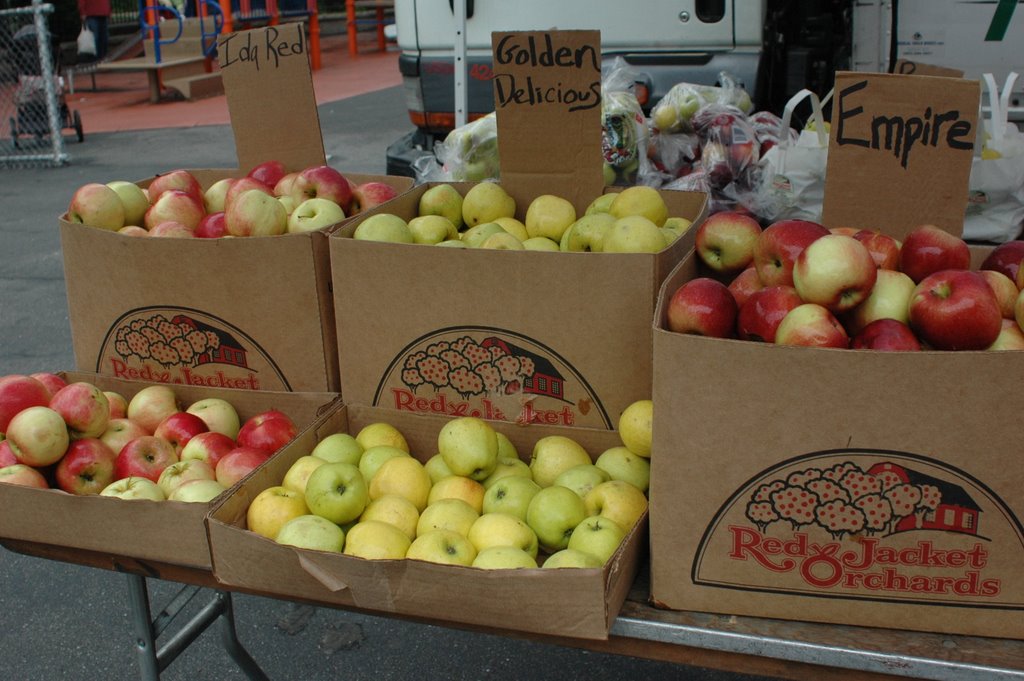
Opening Day, Cortelyou Greenmarket

Some of the apple varieties available from Red Jacket Orchards at the Courtelyou Greenmarket on opening day.
Photo taken: June 3, 2006

Today was the first day of the season for the Courtelyou Greenmarket which serves our neighborhood:
Greenmarket has organized and managed open-air farmers markets in NYC since 1976. By providing regional small family farmers with opportunities to sell their fruits, vegetables and other farm products to New Yorkers, Greenmarket supports farmers and preserves farmland for the future.
- Greenmarket Farmers Market
The Courtelyou Greenmarket is located in the schoolyard of P.S. 139 on Argyle Road, just up the block from Courtelyou Road. There were only three vendors there for opening day:
Based on our experience last year, the number of vendors will ramp up through the month of June. There's about a dozen during the summer, selling all kinds of fresh fruits and vegetables, plus meat, dairy, baked goods and some handcrafts.

Related Posts

Greenmarket

Links

Greenmarket

Event: Brooklyn Wild Parrot Safari, Saturday, June 3, 2006

A monk parakeet eyeing the photographer before digging into an apple from our next-door neighbor's tree.The next Brooklyn Wild Parrot Safari is Saturday, June 3, 2006.

The tours, guided by Steve Baldwin, start at 12 noon
at Brooklyn College's Hillel Gate, on Campus Road at Hillel Place, close to the last stop on the 2 train (Flatbush Avenue/Nostrand Avenue).

The photo above was taken September 29, 2005. It shows a parrot checking me out as s/he's about to get into a fruit from our next-door neighbor's apple tree. Their apple tree bloomed gloriously last Spring, just after we bought our house. More blooms = more bees = more apples = more parrots. This Spring the bloom was scant, so we expect fewer apples, and fewer parrots, this year than last.

Web Resource: Vintage Gardens, "Antique & Extraordinary Roses"

[Technical update, August 21, 2006: Removed new lines between table rows to eliminate white-space preceding table, per http://groups.google.com/group/blogger-help-publishing/browse_thread/thread/a2999c2c0017b5b0.]

I'm trying to select an "antique" rose or two for the heirloom garden, one which was available in 1905 or earlier. (Our house was built in 1900.) I don't want to have to learn how roses are classified: Floribunda, Musk, Bourbon, and so on. I want a rose which will perform well in a mixed border: long-/repeat-blooming, fragrant, disease-free.

Many of the rose growers I've found online assume that the visitor is a rose "geek." The only way to look at their offerings is to browse through a hierarchical listing of what's available. They require that you already know the rose you're looking for and how it's classified.

Vintage Gardens provides the best online search tool I've found.
Our rose collection has grown to over 3500 varieties, including every rose class from the very oldest to the most modern. It is the largest collection of roses offered by any nursery in the world today. We value each variety and look on this as a preservation collection that provides a valuable resource to gardeners and helps to preserve our heritage of roses. We go to the greatest lengths to maintain correct identifications on our roses. We research and compare with collections worldwide to ensure that our information is as accurate as it can be. In our catalogue we identify the source from which our mother plant came, to assist others who are seeking a specific rose.

Vintage Gardens
Below is a table listing partial results from a search for roses introduced in the 1800s with intense scent and rapid rebloom.

NameYear IntroducedColorNotes
Aimée Vibert1828White
Baltimore Belle1843Blush Pink
Blanc Double de Coubert1892White
Blush Noisette1814Blush Pink
Captain Christy, Climbing1881Blush Pink
Clotilde Soupert1890White, "pale blush with a lilac-pink heart"The photo of this on VG's Web site is gorgeous. They describe it as "Very round, very double flowers of Victorian perfection ..." Just what I need for the heirloom garden!
Deuil de Dr. Reynaud1862Cerise"... appears to be identical with the Bourbon rose labeled Philémon Cochet (Cochet-Cochet, 1895) at the Roserie de l'Hay."
Devoniensis, Climbing AKA "Magnolia Rose", "Tradd St. Yellow"1858Cream, "... primrose yellow, magnolia white or ivory, depending on the weather."
La France, Climbing1893Blush Pink
Mme. Bérard1870Peach Pink, "... honey colored flowers which take on golden-apricot shades in the Spring and Fall ..."
Mme. Creux (Kaiserin Freidrich)1893Apricot-Buff"As we have observed this over the past few years we grow convinced that this rose is identical with Kaiserin Freiderich, a modest growing Tea-Noisette. We suspect that the latter is more likely the correct identity."
Mme. Ernest Calvat1888Cerise
Mme. Isaac Pereire1881Purple, "... intensely colored claret pink, amaranth and magenta" ...Another which looks amazing on VG's Web site. "... perhaps the most extraordinary of the Bourbons. Large, intensely colored claret pink, amaranth and magenta flowers of surpassing fragrance ..."
Mme. Lambard1878Peach Pink, mutable, "... shades of pink, buff, apricot, rose, blush and coppery yellow"
Nastarana1879White
Pierre Notting1863Dark RedThis one's also on my short list for the heirloom garden. "Very full, large velvety red flowers which at their best have no peer among the Hybrid Perpetuals."
Pink Soupert1896Rose Pink

2006-06-02

Web Resource: New York Metropolitan Flora Project (NYMF)

Updated, 2013-08-25: Corrected links.

Brooklyn Botanic Garden's New York Metropolitan Flora Project (NYMF) documents the distribution of woody plant species among 25 counties in New York, New Jersey, and Connecticut within a 50-mile radius around New York City. Tools available online include:
While most of the botanical community concentrates on tracking the threats to biodiversity in the tropics, scientists at the Brooklyn Botanic Garden are undertaking the most comprehensive study ever of the plant biodiversity in metropolitan New York. Studying the vegetation changes in highly populated areas is critical to understanding the future of life in our rapidly urbanizing world. ...
Understanding the urban landscape is critical in our rapidly urbanizing world. Findings of BBG's Metropolitan Flora Project serve as vital references for those involved in environmental efforts, from preserving rare plants, to planning parks and greenways, to repairing degraded habitats, to designing home gardens in which native plant communities are preserved or restored.

Links

Brooklyn Botanic Garden: New York Metropolitan Flora Project