It's the week for the annual plant sale frenzy. All listed here are benefits for their respective gardens. It's a great way to support your local gardens, meet other gardeners, and pick up some cool plants.

Showing posts with label Windsor Terrace. Show all posts
2010-04-30
Plant Sales This Week in and near Brooklyn
BBG Plant Sale, May 2009

It's the week for the annual plant sale frenzy. All listed here are benefits for their respective gardens. It's a great way to support your local gardens, meet other gardeners, and pick up some cool plants.
2010-03-31
Windsor Farm breaks ground
A new Brooklyn community farm/garden, christened "Windsor Farm," broke ground Sunday, April 28 in Windsor Terrace. I went to lend my support, help out for a bit, and check out the scene.
It's a challenging site, even for an urban garden. The aerial photography of Google Maps revealed that the site is completely covered by trees. It didn't show that the property spans a steep slope.


Whatever this slope is, believe me, when you're on the side of it using edge tools to cut through the brambles, it feels a lot steeper!
Even more challenging are the weeds, which include:
Fallopia japonica, Japanese Knotweed, at Windsor Farm. These stalks, 3-6" high now, will grow to 8-9' tall by the end of the summer, and produce thousands of seeds.

It's a challenging site, even for an urban garden. The aerial photography of Google Maps revealed that the site is completely covered by trees. It didn't show that the property spans a steep slope.
Whatever this slope is, believe me, when you're on the side of it using edge tools to cut through the brambles, it feels a lot steeper!
Even more challenging are the weeds, which include:
- Ailanthus altissima, tree-of-heaven
- Fallopia japonica, Japanese Knotweed
- Gleditsia triacanthos, Honeylocust
- Hibiscus syriacus, Rose-of-Sharon
- Lonicera japonica, Japanese Honeysuckle
Fallopia japonica, Japanese Knotweed, at Windsor Farm. These stalks, 3-6" high now, will grow to 8-9' tall by the end of the summer, and produce thousands of seeds.
2008-01-06
Park Circle Mulchfest 2008: Sunday, January 6
219 trees were chipped at this location on Saturday, 564 on Sunday. The two-day total was 783. Not bad for the first time at this location.
I left Saturday about 12:45pm, so I didn't get to see how the rest of the day went. When I arrived Sunday morning, there was already a full corral of trees waiting to be chipped. I don't know how many of them were left over from Saturday. It's likely that many of them were dropped off overnight.

There was a much bigger turnout of volunteers today than yesterday. It took a while for everyone to get signed in this morning.

It's a good thing we had all the volunteers on hand. There were several large truckloads delivered during the day.


As expected, many more people brought their trees today rather than yesterday. There was a pretty regular stream of arrivals. Most of the folks brought their trees by car, but they also walked, as this couple did, wheeled their trees in laundry and shopping baskets, and even biked them in.

The chipper didn't operate constantly all day. We'd build up a large batch of trees, then the Parks staff would crank up the chipper and polish off the pile quickly. When the timing was right, and the chipper was active, folks dropping off their tree got to watch their very own tree getting chipped.

In the interest of photos of garden bloggers, here's an action shot of me bringing a tree from curbside to a Parks pickup truck. It's not in my garden, but it's somewhat gardening-related. Several of the Parks staff and some of the volunteers addressed me as "Santa".


Guardian of the Tools

Park Circle Mulchest 2008 [Flickr set]
I left Saturday about 12:45pm, so I didn't get to see how the rest of the day went. When I arrived Sunday morning, there was already a full corral of trees waiting to be chipped. I don't know how many of them were left over from Saturday. It's likely that many of them were dropped off overnight.
There was a much bigger turnout of volunteers today than yesterday. It took a while for everyone to get signed in this morning.
It's a good thing we had all the volunteers on hand. There were several large truckloads delivered during the day.
As expected, many more people brought their trees today rather than yesterday. There was a pretty regular stream of arrivals. Most of the folks brought their trees by car, but they also walked, as this couple did, wheeled their trees in laundry and shopping baskets, and even biked them in.
The chipper didn't operate constantly all day. We'd build up a large batch of trees, then the Parks staff would crank up the chipper and polish off the pile quickly. When the timing was right, and the chipper was active, folks dropping off their tree got to watch their very own tree getting chipped.
In the interest of photos of garden bloggers, here's an action shot of me bringing a tree from curbside to a Parks pickup truck. It's not in my garden, but it's somewhat gardening-related. Several of the Parks staff and some of the volunteers addressed me as "Santa".
Guardian of the Tools
Related Posts
My Mulchfest postsPark Circle Mulchest 2008 [Flickr set]
Links
Mulchfest 2008, Parks2008-01-05
Park Circle Mulchfest 2008: Saturday, January 5
Update 2008.01.06: I've added a post with photos from today.
Trees check in, they don't check out.

Today I volunteered for the city-wide Mulchfest at the Park Circle location. I had a great time, and I'm going back tomorrow.
The 3rd Street entrance to Prospect Park has been the focus of past years, and it was this year as well. By 11am, we heard that they had already handled over 300 trees. All the media were there, as well as the Parks Commissioner.
This is the first year that chipping is being done on-site at Park Circle. It was slow to start at 10am, but the pace picked up during the morning, and by the time I left around 12:30pm, I estimate at least 200 trees had been chipped and shredded, with more arriving every few minutes. Parks trucks went out with staff and volunteers to cruise the streets in the area for trees left for curbside pickup. They brought those back to park Circle for chipping. That was the source for most of the trees, though we had several drop-offs as well.
Because today was Three Kings Day, many people in the area of Park Circle had not yet taken down their trees. Tomorrow should be even busier.

The chipper empties into the back of a specialized dump-van/track. A couple of times during the day, the truck backs up and dumps out a huge pile of mulched Christmas trees.

The mulch is available for residents to come by and pick up. I got four big bags of it to use in my backyard. Parks staff and volunteers also moved the mulch to mulch trees around Park Circle. We'll be doing more of that tomorrow, as well.

Two of the volunteers at Park Circle were from the radio station Hot97. They sent a small crew over from 3rd Street to Park Circle. I think they interviewed everyone there, including me. So sometime in the next week there will be a very brief (about 10 seconds) video of me on their Web site.
Thank You Very Mulch!

Park Circle Mulchest 2008 [Flickr set]
HOT 97 at Mulchfest 2008
Trees check in, they don't check out.
Today I volunteered for the city-wide Mulchfest at the Park Circle location. I had a great time, and I'm going back tomorrow.
The 3rd Street entrance to Prospect Park has been the focus of past years, and it was this year as well. By 11am, we heard that they had already handled over 300 trees. All the media were there, as well as the Parks Commissioner.
This is the first year that chipping is being done on-site at Park Circle. It was slow to start at 10am, but the pace picked up during the morning, and by the time I left around 12:30pm, I estimate at least 200 trees had been chipped and shredded, with more arriving every few minutes. Parks trucks went out with staff and volunteers to cruise the streets in the area for trees left for curbside pickup. They brought those back to park Circle for chipping. That was the source for most of the trees, though we had several drop-offs as well.
Because today was Three Kings Day, many people in the area of Park Circle had not yet taken down their trees. Tomorrow should be even busier.
The chipper empties into the back of a specialized dump-van/track. A couple of times during the day, the truck backs up and dumps out a huge pile of mulched Christmas trees.
The mulch is available for residents to come by and pick up. I got four big bags of it to use in my backyard. Parks staff and volunteers also moved the mulch to mulch trees around Park Circle. We'll be doing more of that tomorrow, as well.
Two of the volunteers at Park Circle were from the radio station Hot97. They sent a small crew over from 3rd Street to Park Circle. I think they interviewed everyone there, including me. So sometime in the next week there will be a very brief (about 10 seconds) video of me on their Web site.
Thank You Very Mulch!
Related Posts
My Mulchfest postsPark Circle Mulchest 2008 [Flickr set]
Links
Mulchfest 2008, ParksHOT 97 at Mulchfest 2008
2007-11-28
Welcome to the (Online) Neighborhood
Our neighbors to the NorthWest in Windsor Terrace have formed the Windsor Terrace Alliance:
WTA Yahoo Group
StableBrooklyn Yahoo Group
The Windsor Terrace Alliance (WTA) is made up of residents, community groups and businesses of Windsor Terrace interested in advocating for our neighborhood. We are your neighbors. The more voices we have, the louder our voice will be. Please consider joining us to get involved or for updates on issues affecting our neighborhood (click on the Contact Us button below).via the StableBrooklyn Yahoo Group.
The WTA covers the area from Prospect Park West on the west, Prospect Park Southwest to Park Circle on the north, follows Ocean Parkway and then Caton Avenue on the east, and to McDonald Avenue on the south.These boundaries include the East 4th Street Community Garden which I recently visited.
Links
Windsor Terrace Alliance (WTA)WTA Yahoo Group
StableBrooklyn Yahoo Group
2007-11-03
East 4th Street Community Garden
Updated 2007.11.04: Added Community section.
Afternoon Morning Glory, East 4th Street Community Garden (Windsor Terrace Kensington Veterans Memorial Garden), Kensington, Brooklyn

This afternoon a couple of Flatbush neighbors and I visited the East 4th Street Community Garden. It occupies .184 acres at 179 East 4th Street, between Caton Avenue and Fort Hamilton Parkway in Kensington. It also serves the neighborhood of Windsor Terrace.


Here's a view from the North, from the shelter of the shady path which is one of the common areas in the garden.


The plots are edged with untreated, exterior-grade boards. These are concessions to decorum; as Michael explained, "Plots tend to expand." Well-defined plot edges, like good fences, make good neighbors. They also keep the plants from spilling into the paths, which need to be mowed regularly, and keep people walking the paths from trampling the plants and plots.


Plot Signs


One of the features which interested us today was the north side of the garden with several mature trees, including some old apple trees. The Flatbush site, with its forest of 50-year-old trees, has lots of shade. Here a path enjoys the shade from the trees, leading from the front to the rear of the garden, toward the compost area and pond.


Composting area

I thought the signs were a great way to encourage people to use the compost. They distinguish the finished product from that still in-process, and explicitly grant permission to people to use what they need.

Also important are clear signs detailing what can and can't go into the compost.

Salvaging building materials for reuse in the garden is a way to keep costs down and keep construction and other building debris out of the waste stream.


There's no free source of water for the garden. Their water bill runs about $400 a year. So collecting and storing rainwater is another sustainability practice that saves the garden money.


I want to build a bat house. Some of the Flatbush visitors wanted to know "where do you get the bats?" They didn't know that bats are already native residents of Brooklyn, and "if you build it, they will come."


According to Michael, the garden was "a well-kept secret for a long time." Today there are about 60 people on the mailing list, and 20-30 active members, with a 1 year waiting list. Dues are about $20/year.
Members come from within a four or five block radius of the garden. Maintenance requires weekly visits over the summer, so geographic proximity is important. Members also need to sign up for shifts for shared responsibilities, such as seasonal cleanups and keeping the garden open to the public during scheduled hours. They encourage members who don't yet have individual plots to plant and maintain containers, or sign-up for the numerous gardening tasks in the common areas. This gives them a feel for the time commitment it takes, especially important for those with little gardening experience.
The garden hosts the Kensington/Windsor Terrace CSA (Community-Supported Agriculture). This CSA is supplied by the Garden of Eve farm on the East End of Long Island. In a recent survey of CSA members, 100% of those responding said they were happy with the garden as a distribution site.
East 4th Street Community Garden (OASIS page)
East 4th Street Community Garden (Parks page)
Kensington/Windsor Terrace CSA (Blog)
Garden of Eve
[where: 179 East 4th Street, Brooklyn, NY]
Afternoon Morning Glory, East 4th Street Community Garden (Windsor Terrace Kensington Veterans Memorial Garden), Kensington, Brooklyn
This afternoon a couple of Flatbush neighbors and I visited the East 4th Street Community Garden. It occupies .184 acres at 179 East 4th Street, between Caton Avenue and Fort Hamilton Parkway in Kensington. It also serves the neighborhood of Windsor Terrace.
The dedicated local residents of the East Fourth Street Garden Association have tended this site, formerly known as the Windsor Terrace Kensington Veterans Memorial Garden, since they first organized it in 1979. The garden, incorporated in 1981, has come to serve a central role as a gathering place in this community. The East Fourth Street garden has funded its operations and special projects through dues collection, flea markets, and two Mollie Parnis Dress Up Your Neighborhood Awards.The purpose of our visit was to meet with our gardening neighbors to the west, get ideas from their gardens, and learn from their experience.I arrived around 3pm, before anyone else showed up. That's when I took most of these photos. I met one of the gardens, Mary Beth, who had brought her pumpkin for composting. We were then joined by two of my neighbors, Gary Jonas and Nelson Ryland. Michael O'Hara, who's been with the garden for six years, arrived, then Susan Siegel.
- Parks Sign, East 4th Street Community Garden
Established on city property, the East Fourth Street Garden uses land originally cleared of homes for the construction of the F subway line in the 1930s. Transit builders changed their plans, running the line underground where the Windsor Terrace branch of the Public Library now stands. In 1998, the Department of Housing Preservation and Development (HPD) surrendered the Fourth Street garden between Fort Hamilton Parkway and Caton Avenue to Parks. This arrangement safeguards the garden’s status as a green space while leaving the administration largely in the hands of its community developers.You can see the grates for the subway in the sidewalk in front of the garden. During our visit, we heard, and felt, the subway rumbling beneath us every few minutes. The future home for the Flatbush Community Garden is adjacent to the open-cut B/Q line; the sounds and sensations of subway trains will be frequent there, as well.
Individual Plots
Here's a view from the rear of the garden, looking West toward the entrance and East 4th Street. The individual plots are in the center of the photo, extending off-frame to the right. I counted 26 plots.Here's a view from the North, from the shelter of the shady path which is one of the common areas in the garden.
The plots are edged with untreated, exterior-grade boards. These are concessions to decorum; as Michael explained, "Plots tend to expand." Well-defined plot edges, like good fences, make good neighbors. They also keep the plants from spilling into the paths, which need to be mowed regularly, and keep people walking the paths from trampling the plants and plots.
Plot Signs
Common Areas
Common areas wrap the garden on its south, west, and north sides. Here are some views of the common areas along the front/street side of the garden.One of the features which interested us today was the north side of the garden with several mature trees, including some old apple trees. The Flatbush site, with its forest of 50-year-old trees, has lots of shade. Here a path enjoys the shade from the trees, leading from the front to the rear of the garden, toward the compost area and pond.
Necessaries
I met Mary Beth, one of the gardeners, here by the composting area. She came by to contribute her spent Jack-o-lantern. She lives in an apartment in the area. She told me she "always loved the smell of dirt" growing up. She now has an individual plot in the garden.Composting area
I thought the signs were a great way to encourage people to use the compost. They distinguish the finished product from that still in-process, and explicitly grant permission to people to use what they need.
Also important are clear signs detailing what can and can't go into the compost.
Salvaging building materials for reuse in the garden is a way to keep costs down and keep construction and other building debris out of the waste stream.
There's no free source of water for the garden. Their water bill runs about $400 a year. So collecting and storing rainwater is another sustainability practice that saves the garden money.
I want to build a bat house. Some of the Flatbush visitors wanted to know "where do you get the bats?" They didn't know that bats are already native residents of Brooklyn, and "if you build it, they will come."
Community
When we visited, the day was overcast and buffeted by winds from tropical storm Noel passing off-shore. We were there after the normal visiting hours, and the garden was empty except for the six of us. Michael told us that we would "have to come here on a busy day in the summer" to see the community in evidence in the garden.According to Michael, the garden was "a well-kept secret for a long time." Today there are about 60 people on the mailing list, and 20-30 active members, with a 1 year waiting list. Dues are about $20/year.
Members come from within a four or five block radius of the garden. Maintenance requires weekly visits over the summer, so geographic proximity is important. Members also need to sign up for shifts for shared responsibilities, such as seasonal cleanups and keeping the garden open to the public during scheduled hours. They encourage members who don't yet have individual plots to plant and maintain containers, or sign-up for the numerous gardening tasks in the common areas. This gives them a feel for the time commitment it takes, especially important for those with little gardening experience.
The garden hosts the Kensington/Windsor Terrace CSA (Community-Supported Agriculture). This CSA is supplied by the Garden of Eve farm on the East End of Long Island. In a recent survey of CSA members, 100% of those responding said they were happy with the garden as a distribution site.
Links
Flickr photo setEast 4th Street Community Garden (OASIS page)
East 4th Street Community Garden (Parks page)
Kensington/Windsor Terrace CSA (Blog)
Garden of Eve
[where: 179 East 4th Street, Brooklyn, NY]
2007-06-12
News: Creating Wildlife Habitat in Windsor Terrace
In the New York Daily News today:
I know of a "Greenway Project" in Brooklyn, but the one mentioned in the article seems to be a different effort. Jennifer, if you read this, please let us know more.
Whatever the name, it's important to educate and engage private landowners in maintaining and developing wildlife habitat by preserving and planting trees and other non-lawn plants on their properties.
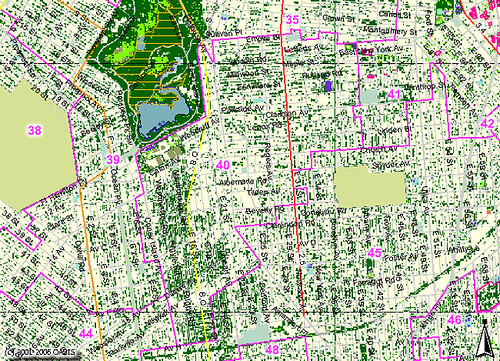
I've shown this map on this blog before. It shows the landcover classification for central Brooklyn.

Windsor Terrace forms a corridor between two refuges: Greenwood Cemetery and Prospect Park. Victorian Flatbush forms a corridor extending south from Prospect Park, pointing toward the bays, beaches, and Atlantic Ocean. I recently saw an ovenbird in my backyard, "rare in the city" according to Hopkins as cited in the article.
Most of the tree canopy in Brooklyn is in private hands. It's unprotected and vulnerable. If New York City is going to have a million more trees in the next ten years, we need to value and find ways to preserve and protect the ones we already have, including those on private property.
In the densely populated strip of land between Prospect Park and Green-Wood Cemetery, [Jennifer] Hopkins and fellow gardeners are creating oases of green for butterflies and birds.
The goal of the Greenway Project is to link two of Brooklyn's largest habitats - at least for airborne species.
- Oases of green for butterflies and birds, New York Daily News, June 12
For the birds, Hopkins plants berry bushes, has a cherry tree and keeps her birdbath full. One neighbor has followed in her footsteps and put up a humming bird feeder. Another has a bush where a family of cardinals is nesting. The nearby Immaculate Heart of Mary Catholic Church is also on board and is set to plant a garden this summer, she said.The article never mentions the name of the neighborhood "between Prospect Park and Green-Wood Cemetery." It's Windsor Terrace.
I know of a "Greenway Project" in Brooklyn, but the one mentioned in the article seems to be a different effort. Jennifer, if you read this, please let us know more.
Whatever the name, it's important to educate and engage private landowners in maintaining and developing wildlife habitat by preserving and planting trees and other non-lawn plants on their properties.
I've shown this map on this blog before. It shows the landcover classification for central Brooklyn.

Windsor Terrace forms a corridor between two refuges: Greenwood Cemetery and Prospect Park. Victorian Flatbush forms a corridor extending south from Prospect Park, pointing toward the bays, beaches, and Atlantic Ocean. I recently saw an ovenbird in my backyard, "rare in the city" according to Hopkins as cited in the article.
Most of the tree canopy in Brooklyn is in private hands. It's unprotected and vulnerable. If New York City is going to have a million more trees in the next ten years, we need to value and find ways to preserve and protect the ones we already have, including those on private property.
Subscribe to:
Posts (Atom)