2006-05-22

Liatris spicata, Dense Blazing Star

Liatris spicata, Dense Blazing Star, Marsh Blazing Star, Dense Gayfeather

You gotta love a plant called "Gay Feather"!

I first grew Liatris in Garden #1 in the East Village. It grew well even in the partial shade of that garden. The tall purple spikes were effective for a couple of weeks, and always drew comments from visitors.

Note that both the NYFA Atlas and USA PLANTS maps for this species show scattered distribution among New York counties, and only in Queens within New York City. NYFA Atlas list this species as NOT native to New York state.

References

NYFA Atlas: Plant ID 258
USDA PLANTS Database: Symbol LISP

2006 Greenest Block in Brooklyn Contest

The purpose of the contest is to promote streetscape gardening in the borough of Brooklyn through block associations and other community groups. The deadline for 2006 entries is June 5.

Five of the blocks in our neighborhood of Beverly Square West, including our block, were 2005 semi-finalists, and three of them were in 2004.

2006-05-21

Field Trip, Sunday, May 21, 2006: Brooklyn Terminal Market

Flats and racks of annuals at Whitey Produce, Brooklyn Terminal Market

This morning, some neighbors took me for my first visit to the Brooklyn Terminal Market. Several blocks of outdoor (this time of year, anyway) and indoor plants and supplies (fertilizers, mulch, and so on).

I couldn't resist buying several plants.

Perennials and annuals at A. Visconti & Son, Brooklyn Terminal Market

From A. Visconti & Son:
  • Dianthus caryophyllus SuperTrouper Dark Violet, Carnation, for windowboxes. This variety was the most fragrant, with a spicy clove scent, from all the varieties on hand.
  • Sempervivum "Bronco", Hens and Chicks, for windowboxes
  • Polystichum tsu-tsimense, for shade garden, shady path
Perennials at Harvest Produce, Brooklyn Terminal Market

From Harvest Produce:
  • Dicentra eximia "Aurora", white-flowering selection of native bleeding heart, for native plant garden
  • Heuchera "Color Dream", Coral Bells. These are one of the varieties of red-leaved Heucheras in the middle of the photo above.
  • Iris germanica "Zebra", variegated German Iris, for sunny border/cut flower garden
  • Liatris spicata "Kobold", cultivar of Dense Blazing Star, for native plant garden or sunny border/cut flower garden. You can see these in the foreground of the photo above.

Related posts

Sources of Plants for Brooklyn Gardeners

Links

Brooklyn Terminal Market

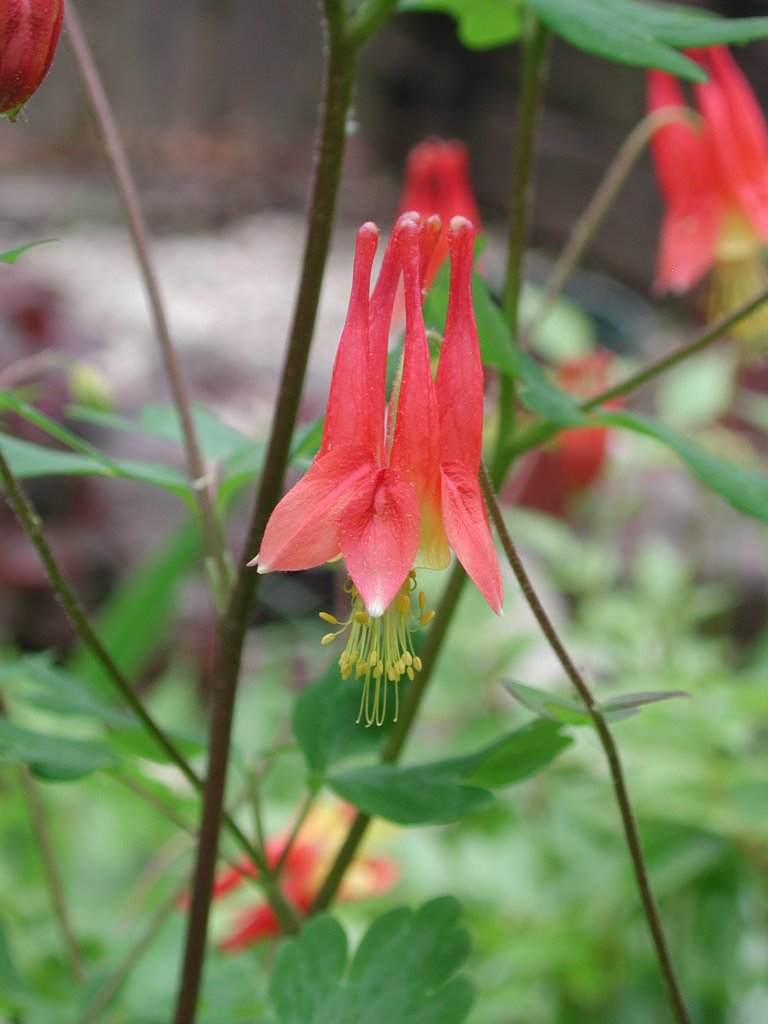
Aquilegia canadensis, Eastern Red Columbine

Macro photo of a single Columbine flower blooming in the backyard at Garden #3 in Park Slope.
Photo taken: May 8, 2004

Aquilegia canadensis, Eastern Red Columbine

One of my favorite native plants and wildflowers. It looks so delicate, yet it blooms early spring, when temperatures are still cool.

Tips for growing, based on my experience growing Columbine in several gardens over many years:

  • Columbine likes to grow among rocks. In the garden, bricks, stepping stones, and paths are good substitutes.
  • Blooms early-mid spring, before trees have fully leafed out. If you keep the seedheads pinched back, you can keep it blooming for two months.
  • Larger plants don't transplant well. Columbine has a fleshy root which is easily damaged in transplanting. It tends to not form a root ball, which makes it difficult to avoid damage and get the plant re-established in its new location.
  • Columbine is not a long-lived plant. Five years is a long time for a single plant. However, you can easily get more plants than you need through seed propagation.
  • Where you want Columbine to grow, plant one plant and let it go to seed. You can also collect seed from your plant and scatter it where you want more. Seed must winter over to germinate. It may take a year or two for new plants to establish themselves before they bloom.
  • Leaf-miner can be a problem; I find it's less of a problem with the species than with hybrids. The miners tunnel inside the leaves, beween the upper and lower surfaces, as larvae. They create distinctive widening, wandering trails; hold a leaf up to a light and you can actually watch the larvae chewing away inside the leaf. When they've had their fill, they cut a hole through the underside of the leaf, pupate, and drop into the soil. They emerge as flying adults to mate and lay eggs in new leaves. Dispose of affected leaves in the trash; don't compost leaves or affected plants or soil unless you know your compost gets hot enough for sterilization.

[TinyURL]

Links

NYFA Atlas: Plant ID 2583
USDA PLANTS Profile: Symbol AQCA

2006-05-20

Magnolia Warbler

I just saw a male Magnolia Warbler (additional link) in our neighbor's apple tree early this evening, just before dusk. He was darting around the tips of the branches. He looked like he was foraging for insects among the leaves.

Because he was at the ends of the branches, instead of the interior, and because I was watching him from our upstairs back porch, I was just a few feet away. I got several good looks at all sides of him, so I'm confident of the identification.

I've seen them before, at our old place in Park Slope. This is the first I've seen one at our new house. They're beautiful birds.

2006-05-19

Flatbush

The place name "Flatbush" is an Anglicization of one of the early Dutch names for the area. I've seen the Dutch variously given as vlacke bos, vladbos, and flakkebos. I've seen this translated as "wooded plain", "wooded land" and "flat woods". In other words, the name describes the landscape prior to Dutch colonization of the area in the 1600s.

Much of the area remained farmland and relatively undeveloped through the 19th Century. The last vestiges of these original woods were lost with Victorian-era development in the 1890s.

Related Content

Other Flatbush posts

Links

Generations of Dynamism in Flatbush, Francis Morrone, NY Sun, October 13, 2006

2006-05-16

NYC Garden #1, The East Village, the 1980s: The Shade Garden

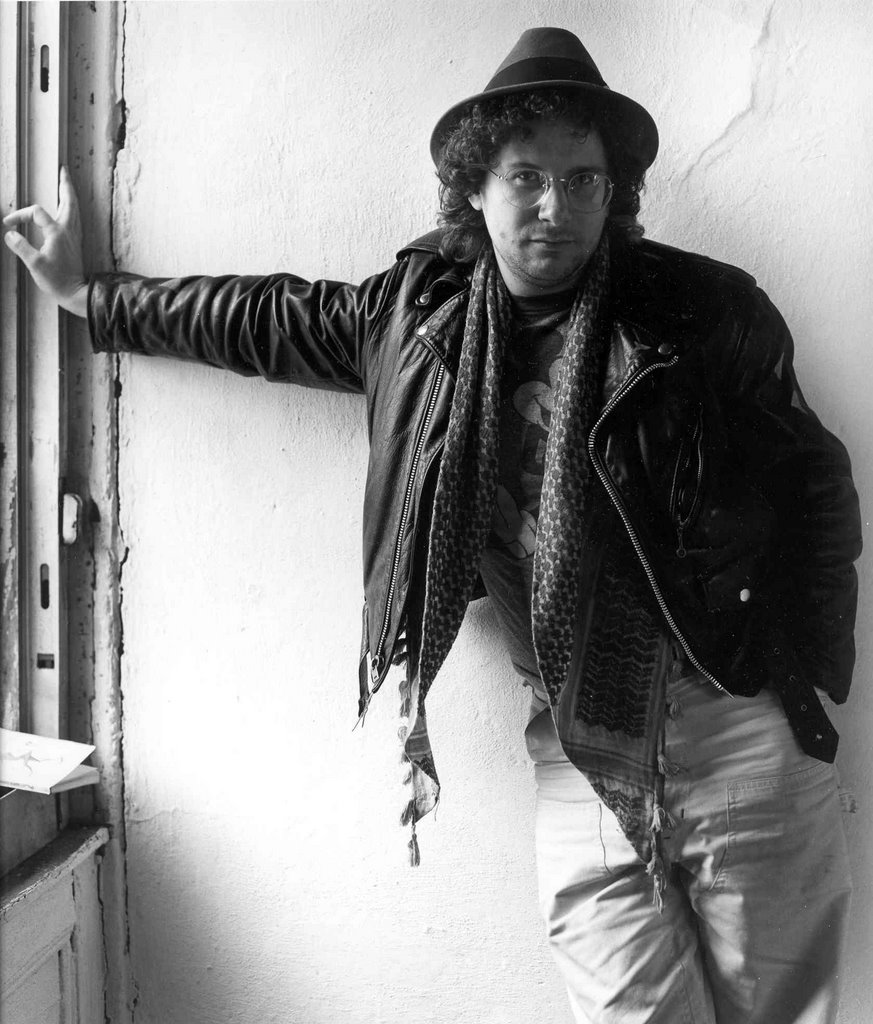
A portrait of me taken in the East Village during the 1980sThe East Village was the site of my first garden in New York City. My second lover in New York lived in a tenant-owned brownstone on First Avenue. When we were breaking up, he proposed a project for the two of us to work on together: turning the backyard behind the building into a garden. The space was dominated by two mature Ailanthus trees which, along with the buildings to the south, shaded the yard almost completely. On the ground grew nothing but liverworts and Ailanthus seedlings. In and on the ground were the remains of a back building which had been torn down a few years before.

I planned a simple asymmetrical loop of a path around the backyard. I identified a dozen different beds, based on their light exposure and site along the path. We started a compost bin. We weeded, and shredded and composted the remains. We sifted the soil to remove the building debris from the dirt. The soil level dropped by a foot in some places. We set aside the usable brick and stone. These became the paths and retaining walls of the new garden. We amended the dirt as best we could with organic fertilizers and bales of peat moss. (These days, I use coir, produced from the husks of coconuts during processing, instead of peat. Peat is not a renewable resource, and its harvesting destroys wetlands.)

We planted bulbs in the fall. I labelled everything. Friends remarked that it looked like a plant cemetery. In spring the first bulbs came up. We were ecstatic.

The garden continued to be developed and enhanced over the next few years by us, building residents, and other neighbors. One of the residents, a carpenter, built a deck over the broken concrete patio. One afternoon we had a load of topsoil delivered. Since there was no access to the backyard from the street, the truck dumped it all in a pile on the sidewalk. Neighbors pitched in and, with shovels, buckets, and a wheelbarrow, moved the soil through the building to a new pile in the garden. We learned about shade gardening. Wildflowers, ferns and hostas created a shady, green, cool oasis - a sanctuary from the noise and heat and, to be honest, stench of the street.

It took five years for the garden to feel completed. I continued to care for the garden until I moved to Brooklyn in the early 1990s. All my records and photographs of the garden over those years didn't make it with me.

2006-05-15

Garden Notes, May 15, 2006: Roses

[Transcribed from notebook]

Native Roses
  • R. carolina, Pasture Rose
  • R. palustris, Swamp Rose
  • R. setigera, Prairie Rose, Climbing Rose
  • R. virginiana, Wild Rose
  • R. blanda, Meadow Rose
  • R. acicularis, Prickly Rose
Old Roses
  • "American Beauty"
  • "General Jack"
  • "Pierre Notting"
  • "Reine des Violettes"
  • "Baronne Prevost"

2006-05-14

Garden Diary, May 12-14, 2006

[Transcribed from notebook. Summary of gardening work done over a long weekend.]
  • Dug bed in backyard to left of maple, along wooden fence. Worked in coir/cocoa fiber, HollyTone, Hydrogel. X-planted Royal Fern + Ostrich Fern.
  • TODO: X-Plant [to this same area under the maple]:
    • Iris cristata
    • Dryopteris marginalis
    • Phlox stolonifera
  • Planted Old House Gardens Dahlia "Union Jack" & Tuberose in Guy Wolff pots purchased last year.
  • X-planted from front yard to South border:
    • Campanula
    • Coreopsis
  • X-planted from pots to South border:
    • Jerusalem artichoke
    • Iris sibirica
    • Baptisia?
  • Planted seeds in South border:
    • Nicotiana (various)
    • Clary Sage
  • Planted in vine bed:
    • Moonvine (last weekend)
    • Scarlet runner bean

2006-04-30

Garden Diary, April 30, 2006: Four Gardens Revisited, and the Backyard Garden

[Text transcribed and sketch scanned from notebook.]
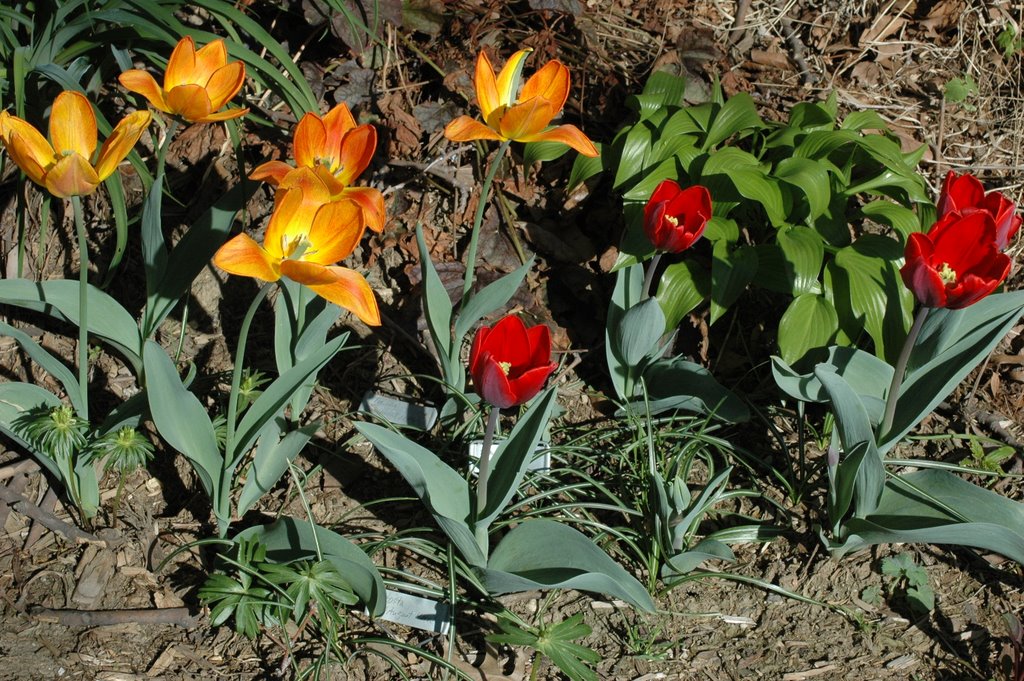
Heirloom Tulips Generaal de Wet (left, orange) and Couleur Cardinal (right, red)
A photo of two heirloom Tulip varieties blooming in the front yard. On the left is the orange "Generaal de Wet", introduced in 1904. On the right is the REALLY red "Couleur Cardinal", introduced in 1845. Both are from Old House Gardens, "America’s only mail-order source devoted entirely to heirloom bulbs."
Photo Taken: April 21, 2006

It's our first full Spring in our house, in our neighborhood. Trees have been in flower for months now, it seems. Dogwoods are in bloom now. And we're just coming into the riot of forsythia and azalea.

There were the first snowdrops, the first crocus, the first signs of irreversible Spring. In our front garden, eranthis, crocus, and now, still, the longest-blooming tulips I've ever seen, heirloom/antique bulbs all.

As always, my understanding of what the gardens want and need has evolved over the past year. Here's my current plan:
  • Front: heirloom/antique garden, all plants available 1905 or earlier
  • North: Shady path
  • South: "wild" garden, plants which seed themselves, mixed border, the "rough" garden
  • Back: the native garden and wildlife sanctuary
In the back, I want to put a trellis w/porch swing beneath the maple, angled to face back toward the house, and situated for sun in the winter, leafy shade in the summer. The bench will be 6', long enough to stretch out on for a nap. The trellis will be 8', long enough to put the roots of the vines away from the maple's trunk. Beneath the swing, moss and flagstones. Around the maple, moss, ferns and wildflowers. Mature shrubs will block the views out of the garden from this spot, and onto this spot from outside. A sheltered destination. A sanctuary.
A sketch of the proposed placement of the trellis-swing in the backyard. The back of the house faces East; South is to the right in this sketch. The swing will go beneath, in front of, the maple in the northeast corner of the backyard. In summer, when the sun is high, it's shaded by the maple, the cherry tree, and our neighbor's apple tree (not shown in the sketch).
This spot is visible from the driveway on the south of the house, and from the street along the north side of the house. Placing two large shrubs will block these lines of sight, providing privacy from without, and enclosing the views from within. The new lines of sight from/to the swing, constrained by the mature shrubs, are shown on the sketch.