I just saw a male Magnolia Warbler (additional link) in our neighbor's apple tree early this evening, just before dusk. He was darting around the tips of the branches. He looked like he was foraging for insects among the leaves.
Because he was at the ends of the branches, instead of the interior, and because I was watching him from our upstairs back porch, I was just a few feet away. I got several good looks at all sides of him, so I'm confident of the identification.
I've seen them before, at our old place in Park Slope. This is the first I've seen one at our new house. They're beautiful birds.

Please visit the NEW SITE for Flatbush Gardener
2006-05-20


2006-05-19
Flatbush
The place name "Flatbush" is an Anglicization of one of the early Dutch names for the area. I've seen the Dutch variously given as vlacke bos, vladbos, and flakkebos. I've seen this translated as "wooded plain", "wooded land" and "flat woods". In other words, the name describes the landscape prior to Dutch colonization of the area in the 1600s.
Much of the area remained farmland and relatively undeveloped through the 19th Century. The last vestiges of these original woods were lost with Victorian-era development in the 1890s.
Much of the area remained farmland and relatively undeveloped through the 19th Century. The last vestiges of these original woods were lost with Victorian-era development in the 1890s.
Related Content
Other Flatbush postsLinks
Generations of Dynamism in Flatbush, Francis Morrone, NY Sun, October 13, 20062006-05-16
NYC Garden #1, The East Village, the 1980s: The Shade Garden
 The East Village was the site of my first garden in New York City. My second lover in New York lived in a tenant-owned brownstone on First Avenue. When we were breaking up, he proposed a project for the two of us to work on together: turning the backyard behind the building into a garden. The space was dominated by two mature Ailanthus trees which, along with the buildings to the south, shaded the yard almost completely. On the ground grew nothing but liverworts and Ailanthus seedlings. In and on the ground were the remains of a back building which had been torn down a few years before.
I planned a simple asymmetrical loop of a path around the backyard. I identified a dozen different beds, based on their light exposure and site along the path. We started a compost bin. We weeded, and shredded and composted the remains. We sifted the soil to remove the building debris from the dirt. The soil level dropped by a foot in some places. We set aside the usable brick and stone. These became the paths and retaining walls of the new garden. We amended the dirt as best we could with organic fertilizers and bales of peat moss. (These days, I use coir, produced from the husks of coconuts during processing, instead of peat. Peat is not a renewable resource, and its harvesting destroys wetlands.)
We planted bulbs in the fall. I labelled everything. Friends remarked that it looked like a plant cemetery. In spring the first bulbs came up. We were ecstatic.
The garden continued to be developed and enhanced over the next few years by us, building residents, and other neighbors. One of the residents, a carpenter, built a deck over the broken concrete patio. One afternoon we had a load of topsoil delivered. Since there was no access to the backyard from the street, the truck dumped it all in a pile on the sidewalk. Neighbors pitched in and, with shovels, buckets, and a wheelbarrow, moved the soil through the building to a new pile in the garden. We learned about shade gardening. Wildflowers, ferns and hostas created a shady, green, cool oasis - a sanctuary from the noise and heat and, to be honest, stench of the street.
It took five years for the garden to feel completed. I continued to care for the garden until I moved to Brooklyn in the early 1990s. All my records and photographs of the garden over those years didn't make it with me.
2006-05-15
Garden Notes, May 15, 2006: Roses
[Transcribed from notebook]
Native Roses
Native Roses
- R. carolina, Pasture Rose
- R. palustris, Swamp Rose
- R. setigera, Prairie Rose, Climbing Rose
- R. virginiana, Wild Rose
- R. blanda, Meadow Rose
- R. acicularis, Prickly Rose
- "American Beauty"
- "General Jack"
- "Pierre Notting"
- "Reine des Violettes"
- "Baronne Prevost"
2006-05-14
Garden Diary, May 12-14, 2006
[Transcribed from notebook. Summary of gardening work done over a long weekend.]
- Dug bed in backyard to left of maple, along wooden fence. Worked in coir/cocoa fiber, HollyTone, Hydrogel. X-planted Royal Fern + Ostrich Fern.
- TODO: X-Plant [to this same area under the maple]:
- Iris cristata
- Dryopteris marginalis
- Phlox stolonifera
- Planted Old House Gardens Dahlia "Union Jack" & Tuberose in Guy Wolff pots purchased last year.
- X-planted from front yard to South border:
- Campanula
- Coreopsis
- X-planted from pots to South border:
- Jerusalem artichoke
- Iris sibirica
- Baptisia?
- Planted seeds in South border:
- Nicotiana (various)
- Clary Sage
- Planted in vine bed:
- Moonvine (last weekend)
- Scarlet runner bean
2006-04-30
Garden Diary, April 30, 2006: Four Gardens Revisited, and the Backyard Garden
[Text transcribed and sketch scanned from notebook.]
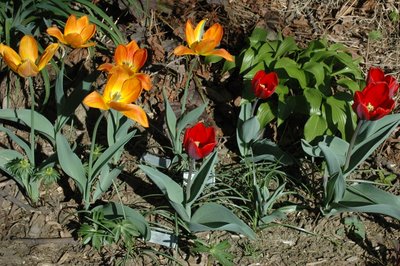
It's our first full Spring in our house, in our neighborhood. Trees have been in flower for months now, it seems. Dogwoods are in bloom now. And we're just coming into the riot of forsythia and azalea.
There were the first snowdrops, the first crocus, the first signs of irreversible Spring. In our front garden, eranthis, crocus, and now, still, the longest-blooming tulips I've ever seen, heirloom/antique bulbs all.
As always, my understanding of what the gardens want and need has evolved over the past year. Here's my current plan:
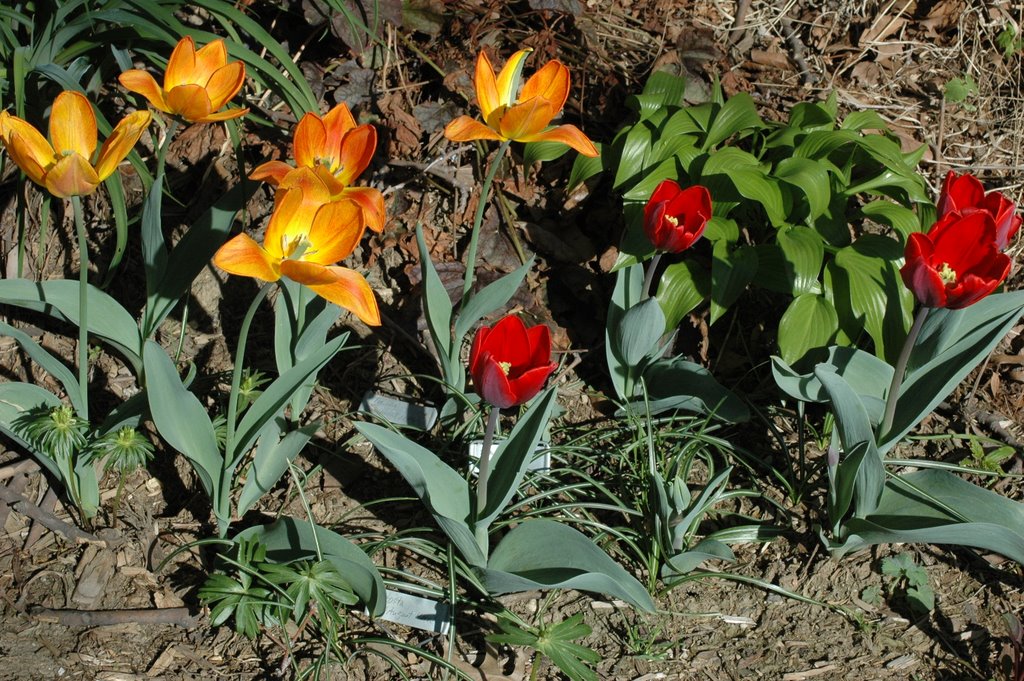
A photo of two heirloom Tulip varieties blooming in the front yard. On the left is the orange "Generaal de Wet", introduced in 1904. On the right is the REALLY red "Couleur Cardinal", introduced in 1845. Both are from Old House Gardens, "America’s only mail-order source devoted entirely to heirloom bulbs."
Photo Taken: April 21, 2006
It's our first full Spring in our house, in our neighborhood. Trees have been in flower for months now, it seems. Dogwoods are in bloom now. And we're just coming into the riot of forsythia and azalea.
There were the first snowdrops, the first crocus, the first signs of irreversible Spring. In our front garden, eranthis, crocus, and now, still, the longest-blooming tulips I've ever seen, heirloom/antique bulbs all.
As always, my understanding of what the gardens want and need has evolved over the past year. Here's my current plan:
- Front: heirloom/antique garden, all plants available 1905 or earlier
- North: Shady path
- South: "wild" garden, plants which seed themselves, mixed border, the "rough" garden
- Back: the native garden and wildlife sanctuary

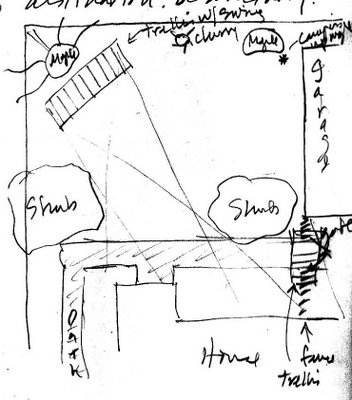
A sketch of the proposed placement of the trellis-swing in the backyard. The back of the house faces East; South is to the right in this sketch. The swing will go beneath, in front of, the maple in the northeast corner of the backyard. In summer, when the sun is high, it's shaded by the maple, the cherry tree, and our neighbor's apple tree (not shown in the sketch).
This spot is visible from the driveway on the south of the house, and from the street along the north side of the house. Placing two large shrubs will block these lines of sight, providing privacy from without, and enclosing the views from within. The new lines of sight from/to the swing, constrained by the mature shrubs, are shown on the sketch.
2006-03-28
Garden Diary, March 28, 2006: The Porch Vine Bed
[Partially transcribed from diary for garden references. The rest of it need not concern you!]
[Written while waiting for and riding subway into the city.]
...
I planted seeds today. Actually, the planting was the smallest part of what I did today, but it was the excuse for all I did. Last weekend I cleared all the ivy from the side porch. Today I sifted all the leaf mold and broke up the soil in the narrow strip between the porch foundation and the driveway. Finally, eventually, I planted the sweet pea seeds I started soaking last night before I went to bed. I moved the leaf mold and dirt from the tarp I'd set up on the driveway to the backyard.
I was exhausted. I moved a log to contain one of the new beds I'd just created, reset the adirondack chairs, the ones I'd built ... from kits at the apartment [Garden #3 in Park Slope], and collapsed into one of them.
I was too tired to move. For this I was rewarded. Not only did the bird feeder, just 10' from me, continue [ended abruptly for subway transfer.]
2005-10-15
Field Trip, October 15, 2005: New York State Sheep & Wool Festival
My partner and I drove from our new home in Brooklyn to the New York State Sheep & Wool Festival, held each year at the Dutchess County Fairgrounds in Rhinebeck, New York. It was a looong drive there and back, but the festival was interesting, and great fun. I hope the photos below convey this.


2005-07-24
Notes from a visit to the Brooklyn Botanic Garden, Late July 2005
[Transcribed from note book and amended. No date recorded. I was taking notes of plants which were effective or just caught my eye at the time of my visit.]
[From the Compositae/Daisy Family Garden]
Silphium perfoliatum: Large: 6'H x 5'W (supported). Large leaves.
Liatris pycnostachya: 2' tall
L. spicata: 3-4' tall
Helianthus giganteus
Epilobium augustifolium [Chamerion angustifolium, Fireweed, Onagraceae]
Unidentified "weed": ~2-3' tall, leaves opposite, cordate, fuzzy, flowers yellow, 3 petals/sepals
Begonia grandis
[In the Native Flora Garden, I was noting plants which could work in my backyard native plant garden. Several of those listed are plants I grew in the widlflower bed in Garden #1 in the East Village.]
Native Flora Garden
*=blooming
Solidago rugosa
*Allium cernuum
*Dicentra eximia
*Eupatorium fistulosum: 8' tall
Viola pubescens
Vaccinium corymbosum
*Lilium superbum: 8' tall
Polemonium reptans
*Lysimachia ciliata
Polygonatum biflorum
Sanguinaria canadensis
Asarum canadense
Viola striata (same as home?)
Hepatica acutiloba
*Cimicifuga racemosa: 5-6' tall, fragrant
*Allium tricoccum (blooming w/out leaves)
Opuntia humifusa
2005-07-15
Garden Diary, July 2005: Envisioning the Fourth Garden
[Transcribed from notebook. Specific date was not recorded.]
We moved into our new house about six weeks ago, the last Thursday in May. This will be my fourth garden in New York City since I moved here 26 years ago, in the Winter of 1979.
House and garden have both been neglected. Both are in need of maintenance, repair, and loving back to their full flower. Both will need work, time, patience, investment. I can envision the trajectories and futures of both.
Particularly, I can imagine bringing the house and garden(s) back together. Each want the other, each need the other. In time, the house will become part of the gardens, grwing out of them, sheltering them, providing the largest bones in the architecture of the garden.
And the house will change to fit and frame the gardens. The siding will be returned to its original design of clapboard and shingle, though how many years and $10K it will take I shudder to comprehend. In longer time, the back will be returned, I believe, to an open porch, the kitchen expanded and opened up to blur the boundary between indoor and outdoor space, between house and garden, between the manufactured and the spontaneous.
Vines will climb up the sides of the screened porches, screening and sheltering them further, filling the porches with fragrance, filtered light, luminous color. Mature shrubs will shade the south side of the house in summer, and draw birds to their berries and hold the snow in winter. Flowers and foliage will spill from window boxes and containers ankling the paths, forcing one to stop to inspect, to smell, to feel, to slow down.
I can see all this as it will be, as it's coming to be.
Subscribe to:
Posts (Atom)