Showing posts with label Diseases. Show all posts

2020-05-06

Grief and Gardening: The Defiant Gardener

Rhododendron periclymenoides, pinxterbloom azalea, blooming in the backyard, May 2020

Normally, this time of year would be busy with garden tours, workshops, talks and lectures, plant swaps and sales. In past years, my garden has been on tour for NYC Wildflower Week. Two years ago I spoke at the Native Plants in the Landscape Conference in Millersville, Pennsylvania. Last June I hosted the most recent of my Pollinator Safaris in my garden.

I had multiple engagements planned for this Spring, and into the Summer. I was going to speak on a panel about pollinators in NYC. This past weekend would have been the 10th Anniversary of the Great Flatbush Plant Swap, of which I was one of the founders. I would have been doing hands-on workshops on gardening with native plants in community gardens.

This year there is none of that. The reason, of course, is the global pandemic, COVID-19, caused by the coronavirus known as SARS-CoV2.

As I write this, I have been working from home for 8 weeks. The same week I started working from home, the first death from COVID-19 was recorded in New York City. Now, less than 2 months later, nearly 20,000 are dead.


We still have 200 dying every day. This is not anywhere near "over".

The language and lessons of trauma - and recovery - are what we need to embrace right now.

2020-04-13

Correspondence, April 2020

I received an unexpected, and much-welcomed, message from a colleague, asking how I was doing. My response ran a little long, so I thought I would reproduce it here. Annotated with links, where applicable.

Double-flowering bloodroot, Sanguinaria canadensis, blooming in my backyard, April 2020

We are doing well, as well as can be expected. My husband and I have both been (lucky enough to be) working from home. It's 5 weeks for me this week.

2020-04-06

Grief and Gardening: A Feast of Losses

It's been barely a month since the first handful of COVID-19/SARS-CoV2 cases were reported in New York State. On March 4, there were 6 confirmed cases.

As I write this:
  • There are nearly 5,000 dead in New York.
  • Nearly 3,500 have died in New York City alone. If NYC was a country, it would be 6th in the world in deaths.
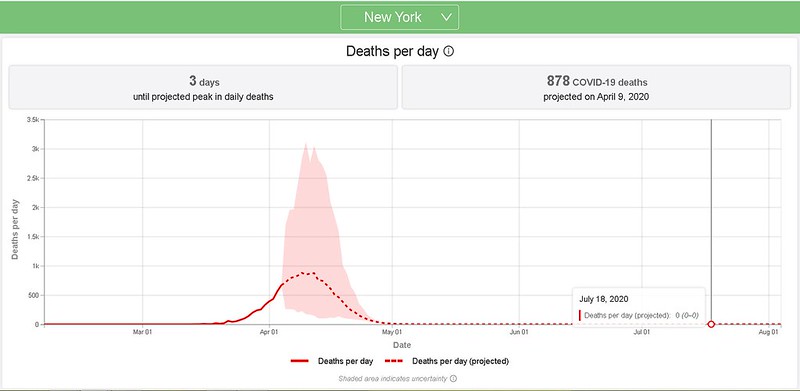
It's not over. We face the worst in the days ahead. But an end - for New York, at least - is in sight.

Projected COVID-19 Deaths per Day for NY as of 2020-04-04

2020-03-19

Grief and Gardening: A Dissetling Spring


"The Return of Persephone", Frederic Leighton, 1896 (four years before his death)

The March Equinox - Spring or Vernal, in the Northern Hemisphere - occurs at 11:49 PM Eastern Daylight Time this evening. It's the earliest it's occurred in over a century. It seems fitting, given the warm, nearly snowless winter, and the quickened pace of everything else.

2010-01-30

Central Park Rabies Outbreak

This month, 23 raccoons in and around Central Park have tested positive for rabies. In addition, 11 animals tested positive during December 2009, bringing the two-month total to 34.

Animal Rabies in Central Park, 12/1/2009-1/29/2010, NYC DOH

In contrast, from 2003-2008, only one raccoon tested positive in Manhattan. In 2008, only 19 animals tested positive for all of New York City.

This increase may be the result of increased surveillance by the Health Department:
With the identification of three raccoons with rabies in Manhattan’s Central Park in recent months – two during the past week – the Health Department is cautioning New Yorkers to stay away from raccoons, skunks, bats, stray dogs and cats and other wild animals that can carry rabies. The recent cluster of findings suggests that rabies is being transmitted among raccoons in the park. The Health Department is increasing surveillance efforts to determine the extent of the problem.
- Press Release, 2009-12-07
Historically, raccoons are by far the most commonly reported animal, comprising about 3/4 of reports from 1992-2008. Raccoons are nocturnal, and should be active only at night. Anyone observing a raccoon active during the daytime, or any animal that appears disoriented, placid, or aggressive, should call 311 immediately to report the location. Animal attacks should be reported to 911.

2009-03-26

Bats, Bat Houses, and White-Nose Syndrome 2009

Mosquito control is a perennial topic on the Flatbush Family Network, one of the numerous email discussion groups which cover the different neighborhoods of Brooklyn. Bat houses invariably come up as a way of attracting a natural predator to keep mosquito populations in check. Here I'm reprising and updating my posts on these and related topics from last year.

White-Nose Syndrome (WNS)

Last Spring I wrote about White-Nose Syndrome (WNS). A breakthrough that occurred just in the past few months is that the "White-Nose" has been identified as a group of previously unknown species of Geomyces fungus. It's still unknown whether it's a symptom - such as an opportunistic infection - or a cause or contributor.

Bats exhibiting white-nose syndrome in Hailes Cave, Albany County, NY, one of the first caves in which WNS was observed. Photo: Nancy Heaslip, NYS DEC.


Bob Hoke of the District of Columbia Grotto (DCG) of the National Speleological Society (NSS) maintains an excellent chronology of WNS news and understanding. WNS has already killed hundreds of thousands of bats across the northeast over the past four winters. Mortality has been as high as 90% in some caves. It's estimated that 75% of northeastern bats have died in just four years. Unfortunately, it continues to spread; for the first time, it's also been found or suspected in New Hampshire, New Jersey, Pennsylania, Virginia and West Virginia.

Map of occurrence of White Nose Syndrome by county as of March 4, 2009. WNS was later confirmed in Virginia. Credit: courtesy of Cal Butchkoski, Pennsylvania Game Commission
Counties with White Nose Syndrome

Because of the high mortality, rapid spread, and still-unknown causes of the disease, the U.S. Fish and Wildlife Service (US FWS) has issued a cave advisory to suspend all caving activities in affected states, and take precautions in states where WNS has not yet been detected:
The evidence collected to date indicates that human activity in caves and mines may be assisting the spread of WNS. Therefore, the U.S. Fish and Wildlife Service is recommending actions to reduce the risks of further spread of WNS:
  1. A voluntary moratorium on caving in states with confirmed WNS and all adjoining states;
  2. Nationally, in states not WNS-affected or adjoining states, use clothing and gear that has never been in caves in WNS-affected or adjoining states;
  3. State and federal conservation agencies should evaluate scientific activities for their potential to spread WNS; and
  4. Nationally, researchers should use clothing and gear that has never been in caves in a WNS-affected or adjoining state.
This also applies to mines used by cavers.

These recommendations will remain in effect until the mechanisms behind transmission of WNS are understood, and/or the means to mitigate the risk of human-assisted transport are developed.
There was a big thing that came out in the environmental reports last year that chemical mosquito killers are quite bad for the environment and killed more than just mosquitoes. They might even be part of the reason why there is a bacteria/virus killing off northeastern bats. Although, scientists haven't found anything conclusive it seems.
- via Flatbush Family Network
WNS research is ongoing, but it's still not known what the cause is. A plausible explanation is immunodeficiency caused by environmental contamination, such as insecticides sprayed for West Nile Virus, but again, that's just one of several hypotheses being explored by researchers. A pathogen such as a virus, bacteria or fungus is likely due to the patterns by which it's spreading.

Bat Houses

Bat houses seem like a great idea. At night, bats eat about 1,000 pesky insects an hour. I don't know how one attracts bats to your bat house but I've seen them in the evening in Prospect Park, amazing little creatures that they are.
- via Flatbush Family Network
I wrote about bat houses last year. Bats have specific requirements for roosting sites. Most of the houses I've seen commercially available are too small or lacking in other requirements. The National Wildlife Federation (NWF) article, "Why I Built a Bat House," contains detailed instructions for building a house that meets current knowledge about bats roosting needs.

The bat house I purchased last year from Bat Conservation International before I installed it on the side of the second floor porch - my "tree fort" - at the back of my house.
Bat House

Note that this is the time of year when bats are looking for their "summer homes." I put mine up mid-April last year, which was a little late. I'm hoping they find it and set up house this year!

General information about bats

Is there ANY danger to my 4 year old son? Do bats poop/pee/spit anything bad for him? Do they really only come out at night?
- via Flatbush Family Network
Bats really do only come out at night. You're most likely to see them at dusk, when they leave their roosts, and dawn, when they return. At the end of last summer, I saw a few on my block flying amidst the gaps between the canopies of the street trees. They seemed to be feasting on the insects attracted to the street lights.

Many people are concerned about rabies. While sensible caution is warranted, the risk is extremely low. In New York City, you're more likely to contract West Nile Virus (WNV), which bats help combat by eating mosquitoes which carry the virus. If you see any normally nocturnal animal - such as a bat, raccoon or opossum - out in the open during the day, keep children and pets away from it and notify animal control by calling 311.

[bit.ly]
[TinyURL]

Related Content

Rabies in NYC: Facts and Figures, 2008-07-08
Bat Houses, 2008-04-13
Northeastern Bats in Peril, 2008-03-18
Other posts about bats

Links

Bats
Bats of New York, Eileen Stegemann and Al Hicks, Conservationist, February 2008, NYSDEC
Bat Conservation International (BCI)
Bat Houses
Why I Built a Bat House, Carla Brown, National Wildlife Federation (NWF) (H/T Sara S. via Flatbush Family Network)
Bats Wanted, Al Hicks and Eileen Stegemann, Conservationist, February 2008, NYSDEC
The importance of bat houses, Organization for Bat Conservation
The Bat House Forum
White-Nose Syndrome
An excellent chronology of WNS is maintained by Bob Hoke of the District of Columbia Grotto (DCG) of the National Speleological Society (NSS).

White-Nose Syndrome Confirmed in VA Bats, WHSV, Richmond, VA, 2009-04-02
Cave activity discouraged to help protect bats from deadly white-nose syndrome, Press Release, U.S. Fish & Wildlife Service, 2009-03-26
Fungus Kills About 90 Percent Of Connecticut's Bats, Rinker Buck, Hartford Courant, 2009-03-18 (H/T NewYorkology via Twitter)
Newly Identified Fungus Implicated in White-Nose Syndrome in Bats, Press Release, U.S. Department of the Interior, U.S. Geological Survey (USGS), 2008-10-31
Bats dying off across western Maine, Maine Sun Journal, 2008-07-19 (H/T Center for Biological Diversity)
Dying Bats in the Northeast Remain a Mystery, USGS Newsroom, 2008-05-09
First It Was Bees, Now It's Bats That Are Dying, Natural News, 2008-04-11
Bats in the Region Are Dying From a Mysterious Ailment, Litchfield County Times, 2008-04-03
Bats Perish, and No One Knows Why, New York Times Science Section, 2008-03-25
Bat Die-Off Prompts Investigation, Environment DEC, March 2008, NYSDEC

White-nose Syndrome Threatens New York's Bats, New York State Department of Environmental Conservation (NYSDEC)
White-Nose Syndrome, Pennsylvania Game Commission (PGC)
White-Nose Syndrome in bats: Something is killing our bats, U.S. Fish & Wildlife Service, Northeast Region

Mystery Disease Kills U.S. Bats, Bat Conservation International
Bat Crisis: The White-Nose Syndrome, Center for Biological Diversity

White Nose Syndrome Page, Liaison on White Nose Syndrome, National Speleological Society (NSS)

Something is killing our bats: The white-nose syndrome mystery, U.S. Fish and Wildlife Service

Wikipedia: White-nose syndrome

2008-03-18

Northeastern Bats in Peril

Bat House at the East 4th Street Community Garden in Kensington/Windsor Terrace
Bat House

A discussion thread about mosquito control on the Flatbush Family Network led to this question:
I heard that bat houses are a possible long-term solution for mosquitos. I guess you put a bat house up and hope that they come and live there. It can take a few seasons to get them to do it but an average bat eats lots of mosquitos a day. Seems strange to try and seduce bats to your house but those mosquitos are terrible. Anyone else heard about these bat houses?
The photo above is of a bat house in the East 4th Street Community Garden, which I visited for the first time last November. One of the questions they get when they explain what it's for is, "Where do you get the bats?" If you build it, they will come. We have bats here in Brooklyn. Whether we will continue to have them is in question.

A newly emerging epidemic is wiping out bat colonies. First discovered last winter in a single cave near Albany, New York, this winter it's been found to have spread to more locations, including sites in Vermont and Massachusetts. Mortality has been as high as 90% in some caves:
Thousands of hibernating bats are dying in caves in New York State and Vermont from unknown causes ... The most obvious symptom involved in the die-off is a white fungus encircling the noses of some, but not all, of the bats. Called "white-nose syndrome," the fungus is believed to be associated with the problem, but it may not necessarily contribute to the actual cause of death. It appears that the affected bats deplete their fat reserves months before they would normally emerge from hibernation and die as a result ...

"What we've seen so far is unprecedented," said Alan Hicks, DEC's bat specialist. "Most bat researchers would agree that this is the gravest threat to bats they have ever seen. We have bat researchers, laboratories and caving groups across the country working to understand the cause of the problem and ways to contain it."
- Bat Die-Off Prompts Investigation, New York State Department of Environmental Conservation
Bat populations are particularly vulnerable during hibernation as they congregate in large numbers in caves-clusters of 300 per square foot in some locations-making them susceptible to disturbance or disease. The vast majority of the hundreds of thousands of bats known to hibernate in New York do so in just five caves and mines. Because bats often migrate hundreds of miles to their summer range, effects on hibernating bats can have significant implications for bats throughout the Northeast.

Indiana bats [Myotis sodalis], a state and federally endangered species, are perhaps the most vulnerable. Half the estimated 52,000 Indiana bats that hibernate in the state are located in just one former mine-a mine that is now infected with white-nose syndrome. Eastern pipistrelle [Perimyotis subflavus], northern long-eared [Myotis septentrionalis] and little brown [Myotis lucifugus] bats also are dying. Little brown bats, the most common hibernating species in the state, have sustained the largest number of deaths.

Related Posts

Bat Houses, April 13, 2008
Other posts about bats

Links

Chronology
Bat Die-Off Prompts Investigation, New York State Department of Environmental Conservation
Mystery Disease Kills U.S. Bats, Bat Conservation International
Something is killing our bats: The white-nose syndrome mystery, U.S. Fish and Wildlife Service
Wikipedia: White-nose syndrome

Flatbush Family Network (requires membership)

News

Dying Bats in the Northeast Remain a Mystery, USGS Newsroom, May 9, 2008
First It Was Bees, Now It's Bats That Are Dying, Natural News, April 11, 2008
Bats in the Region Are Dying From a Mysterious Ailment, Litchfield County Times, April 3, 2008
Bats Perish, and No One Knows Why, New York Times Science Section, March 25, 2008


2007-09-07

News, September 7, NYC: Brooklyn Woman Tests Positive for West Nile Virus

The Health Department today confirmed the season’s first human case of West Nile virus (WNV) in a 41-year-old Brooklyn woman. So far this season, the Health Department has identified WNV in 139 mosquito pools citywide – eastern Queens, southeastern Bronx and Staten Island have had significant activity. WNV has been detected in all five boroughs.
- Press Release
In past years, WNV cases have been reported much earlier in the year.
The patient began feeling ill in mid-August. Her symptoms included fever, headache, fatigue, weakness and muscle pain. She was hospitalized on August 25th, and is now home recovering. Because she traveled outside of New York City during the two weeks preceding her illness, she may have been exposed to WNV either in New York City, or elsewhere.

2007-05-11

The Liberty Elm Project

Update 2007.05.29: Cornell University does not recommend Liberty Elm because:
'Liberty' is highly susceptibility to elm yellows and is not recommended due to variability of resistance to Dutch elm disease.
- American Elm Cultivars (PDF), Recommended Urban Trees, Cornell Urban Horticulture Institute
Their top choices for American Elm Cultivars are "Valley Forge" and "New Harmony", both of which they rate "resistant" to Elm Yellows and Elm leaf beetle, in addition to resistance to DED.


At last night's 2nd Annual Brooklyn Blogfest, one of the highlights for me was getting interviewed by Dope on the Slope. He had some great gardening questions for me, and I hope I did them justice.

One thing I got wrong, though, was in response to his question about the American Elm, Ulmus americana. He mentioned that Home Despot is selling American Elms resistant to Dutch Elm Disease (DED). I responded that, although there are hybrids which are resistant, they're not fully American Elms.

I Was Wrong
The Liberty elm is not a hybrid. ERI's [Elm Research Institute] American Liberty elm is actually a group of six genetically different cultivars. All six look like classic, old fashioned American elms. ...
- About the American Liberty Elm
DED is caused by at least three fungi strains: Ophiostoma (Ceratocystis) ulmi, O. himal-ulmi, and O. novo-ulmi. At least two species of bark beetles - the native elm bark beetle, Hylurgopinus rufipes, and the European elm bark beetle, Scolytus multistriatus - serve as vectors for infection. American Elms, which used to be premier street trees across the country, were devastated by the disease since it reached U.S. shores on imported lumber in 1928. European Elms have been similarly affected.

The Liberty Elm, or American Liberty Elm, is the outcome of a decades-long research and breeding program to develop a strain of American Elm, developed only from American Elms, reliably resistant to DED. These are not inter-specific hybrids. They have been developed from survivors collected and propagated from across the country. The resulting plants are propagated vegetatively for distribution.
Genetic differences provide diversity. Having six cultivars in the series is insurance against all the elms being wiped out by any disease or problem, even one that might show up in the future. ERI mixes all six cultivars in its shipments.

During the research phase for all these new elms, they were challenged with injections of the Dutch Elm Disease (DED) fungus in controlled tests. But the American Liberty elm is now long past the experiment stages, and at this point it has been through the additional test of growing in public locations around the country for over 18 years, where it has been exposed naturally to DED fungus where it may occur in those environments.

There is no known American elm variety that can be called entirely immune to DED. The American Liberty elm is resistant to DED, and its resistance has a strong record. In the 18 years since the tree's introduction, ERI has confirmed less than 100 cases of DED among the 250,000 elms it has sent out.

- About the American Liberty Elm
Cornell University notes other DED-resistant cultivars available, including 'Princeton', 'Independence', 'Valley Forge', 'New Harmony' and 'Jefferson'. They also note all of these elms are susceptible to Elm Yellows and should not be used where that disease occurs.

Any of you gardeners out there have any knowledge about these trees? Do you know of any growing in your area?