2009-06-05

Bee Watchers Needed in NYC (and a rant)

The Great Pollinator Project, a joint effort of the Greenbelt Native Plant Center and the Center for Biodiversity and Conservation, is recruiting volunteers for 2009 to record and report observations of native bee species in New York City. They are conducting orientations over the next week from 6-8pm at the following locations:

Brooklyn: Monday, June 8th at Brooklyn Botanic Garden, 1000 Washington Avenue
Staten Island: Tuesday, June 9th at Greenbelt Nature Center, 700 Rockland Avenue
Bronx: Tuesday, June 9th at Van Cortlandt House Museum, Van Cortlandt Park
Queens: Wednesday, June 10th at Alley Pond Environmental Center (APEC) 228-06 Northern Blvd.
Manhattan: Tuesday, June 16th at Central Park, North Meadow Recreation Center (Off of 97th St. Transverse Road)

You can RSVP online, by emailing beewatchers@gmail.com, or by calling 718-370-9044.

I'll take this opportunity to rant a bit. Honeybees, which we manage both for their products - honey and beeswax - and their service as pollinators, are a single, non-native, species of bee. Colony Collapse Disorder (CCD) has been widely reported for several years and is well-embedded in the public consciousness. Meanwhile, the circumstances of the thousands of bee species native to North America go unreported.

Much has been made of agriculture's dependence on honeybees for pollination. Dire outcomes from the loss of honeybees - widespread crop failures, famine, even human extinction - have been proffered. Perhaps these things would come to pass. However, the underlying cause would not be the loss of honeybees but our dependence on them through unsustainable agricultural practices.

Honeybees are livestock. They are animals which we manage for our uses. We provide them with housing, maintenance, even move them from field to field as we let cows into different pastures for grazing.

Native pollinators will do the job, but only if we leave them a place to live. We clear land for orchards and fields, removing the hedgerows and other "messy" places that had been their home. The monocultures of agriculture are magnified in the deserts of diversity they create. Of course we need to ship domesticated pollinators around (burning fossil fuels in the process); we've eliminated the native pollinators by destroying their habitats. In the process, we've also driven out native predators of plant pests, thereby initating the addictive cycle of pesticides, fertilizers, more and more inputs needed just to tread water on land until our systems collapse around us.

If that should come to pass, just don't blame the bees.
One-third of our food depends on the services of a pollinator—bee or other insect, bird, or mammal. Bees are the most important pollinators in the Northeastern U.S., and there are more than 200 species of bees that live right here in New York City. We need to protect these local pollinators that help keep our parks and green spaces healthy and beautiful, and our farmers’ markets stocked with fresh produce.

In 2007, the Center for Biodiversity and Conservation and the Greenbelt Native Plant Center began the Great Pollinator Project (GPP) in collaboration with the Great Sunflower Project in San Francisco, CA. The goals of the GPP are:
1) identify which areas of New York City have good pollinator service (as determined by how quickly bees show up to pollinate flowers at various locations throughout the city);
2) increase understanding of bee distribution;
3) raise public awareness of native bees; and
4) improve park management and home gardening practices to benefit native bees.

If you are interested in our local pollinators, we need your help!

- The Great Pollinator Project
There are many ways to be a Bee Watcher:
  • Observe bee visitation at selected plants that will be distributed at our spring orientations. Conduct your observations in your own garden and submit your data online.
  • Become a Mobile Bee Watcher. Conduct your observations on flowers in your neighborhood or at selected bee gardens planted at various locations throughout New York City and submit your data online.
- Bee Watchers

Related Content

Bees, a Mockingbird, and Marriage Equality, 2009-05-22
Cellophane Bees Return, 2009-05-09
Colletes thoracicus (Colletidae), Cellophane Bees, 2008-05-26

Links

Great Pollinator Project
Greenbelt Native Plant Center
Center for Biodiversity and Conservation

2009-06-04

Magicicada Brood II emerges

I was excited to hear that periodical cicadas are emerging on Staten Island. Knowing my interest in such things, Blog Widow alerted me that he had just read about it on one of his favorite blogs, Joe My God, reporting on an article in the Staten Island Advance:
Batches of cicadas, those giant, singing insects that emerge in a massive swarm every 17 years, have begun to poke their heads out of the earth ... Similar early risers have been detected all along the Eastern Seaboard ... Some of the obnoxiously loud insects have been seen, and heard, in Wolfe's Pond Park in Huguenot and in Great Kills backyards in recent weeks.
- Cicadas are out, loud and early, Phil Helsel, Staten Island Advance, 2009-06-04
I wrote last year about Magicicada, the genus of periodical cicadas, last year, in anticipation of the emergence of Brood XIV in Brooklyn. Alas, they never showed up; they seem to have been extirpated in Brooklyn, historically part of their range.
In any given area, adult periodical cicadas emerge only once every 13 or 17 years, they are consistent in their life cycles, and populations (or "broods") in different regions are not synchronized. Currently there are 7 recognized species, 12 distinct 17-year broods, and 3 distinct 13-year broods, along with 2 known extinct broods, found east of the Great Plains and south of the Great Lakes, to the Florida Panhandle.
- Magicicada Mapping Project
The next brood in the NYC area was Brood II, a 17-year brood, expected in 2013. But it has emerged four years early, in 2009.
Some periodical cicadas belonging to Brood II are emerging in several states along the east coast. ... The extent of this year’s acceleration is not known, but could occur anywhere in the Brood II distribution ...
- Cicadas, College of Mount St. Joseph
Off-year emergence, whether it precedes or follows the expected year, is called "straggling":
The exact causes, or even the prevalence, of straggling is not well understood. Straggler records have long confounded attempts to make accurate maps of Magicicada broods, which is one of the reasons the Magicicada mapping project exists. Among 17-year cicadas, straggling seems particularly common 1 or 4 years before or after an expected emergence (e.g., cicadas emerging in 13, 16, 18, and 21 years), although stragglers with other life cycle lengths have also been found. Straggling has been detected in all seven Magicicada species.
- Stragglers, Magicicada Mapping Project
The historical range of Brood II does not, unfortunately, include Brooklyn.


Similar early risers have been detected all along the Eastern Seaboard, and an Ohio researcher who has studied the bugs for 35 years is sure warmer winters are to blame.


"This is the fifth brood where part of it is coming out early," said Gene Kritsky, an entomologist and professor at the College of Mount St. Joseph in Cincinnati. "When you have a phenomenon that is that widespread, the most likely candidate is some kind of climate-driven response." ...


Parts of broods coming out four years too early is a phenomenon first documented in 1969 in Chicago, but prior documents suggest it may have occurred earlier. The last time Brood II came out in full force was in 1996, and most of that brood still will burrow out of their underground homes on time in 2013.


Kritsky, who has studied cicadas for 35 years and expects his most recent findings to be published this month in Proceedings of the Indiana Academy of Science, said the fluid disruption caused by warm winters affects cicadas only during their first five years of life, and it always results in emerging four years too early.
- Cicadas are out, loud and early
[bit.ly]

Related Content

(Magi)Cicada Watch, 2008-05-21

Links

Cicadas are out, loud and early, Phil Helsel, Staten Island Advance, 2009-06-04
Cicadas Appear Four Years Early, Joe MY God, 2009-06-04

Brood II, Magicicada Mapping Project

Brood XIV, Massachusetts Cicadas

magicicada.org
Cicada Central, University of Connecticut
Cicada Web Site, College of Mount St. Joseph, Cincinnati, OH
Chicago Cicadas
Magicicada, Wikipedia
Mathematicians explore cicada's mysterious link with primes, Michael Stroh, Baltimore Sun, May 10, 2004

Shedd Aquarium, Chicago

I got to Chicago early last week, ahead of the Chicago Spring Fling 2009 (CSF) weekend meetup of garden bloggers from across the country, so I could do a little touristy stuff. I didn't get out as much as I had planned; mostly, I corrected my sleep deprivation. But I did get to go to the Shedd Aquarium.

When I was a boy, I lived in Florida for six years. That period of my childhood secured many of the interests that sustain me today, including photography, cosmology and space exploration, general natural history, and oceanography. I've lived my entire life no more than 20 miles from the Atlantic Ocean, and most of it less than 5 miles. If you had asked me, when I was 10 or 11 years old, what I wanted to be when I grew up, I would have responded: "A neurosurgeon, or a marine biologist." (Yes, I have always been a geek, and proud of it.)

So, when I travel, I try to make a pilgrimage to whatever oceanographic attractions area nearby. Chicago's Shedd Aquarium has been on my list to see. So it was easy to make that my first (and, it turned out, only) side-trip during CSF.

Shedd Aquarium

I didn't know that much of what I saw was brand new. I also didn't anticipate that, by mid-morning, I would be jostling for viewing space with thousands of school-children of all ages. I would have stayed longer, but I needed to eat. The line for the cafeteria went down the exhibit hall, so I had to leave earlier than I wanted to forage elsewhere.


Belugas

Beluga Trail

Beluga Trail

Beluga Tank

Beluga Tank

Belugas

Belugas

Sea Otters

A Ball of Sea Otter

Sea Otter

Otter Watch

[bit.ly]

Related Content

Flickr photo set

Links

Shedd Aquarium

2009-06-01

Model Railroad Garden, Chicago Botanic Garden

Last Friday morning, the Chicago Spring Fling meetup of garden bloggers traveled to the Chicago Botanic Garden, one of the sponsors of the event. They provided a shuttle between the train station and the garden, free entry, and passes for the tram and this area: the Model Railroad Garden.

I had imagined a small kiddie ride of a train traveling through a garden. I thought it unseemly that a botanic garden should have an amusement ride in it. I also doubted that such a machine would have trouble handling my mass. So I wasn't planning to visit this garden, despite the free pass.

However, as I left the landscape gardens behind, the entrance to this garden was right there. Since I had a free pass, I thought, "What the heck." Similar to the New York Botanical Gardens annual display, this garden features, yes, model trains running continuously among model houses, buildings, dioramas and other scenes made of plant material. The difference is that this is outdoors, on and in the ground, with permanent plantings.

As a garden, it didn't move me. But that's not what this is about. It's model trains. Leave your cynicism behind.


The 7,500-square-foot Model Railroad Garden features 17 garden-scale (G-scale) trains on 1,600 feet of track. The garden-scale trains are 1/29th the size of life-sized trains. Train and garden enthusiasts, young and old, return year after year for the delightful sights and sounds of the miniature trains traversing high and low through tunnels, across bridges, and around buildings — all intricately handcrafted with natural materials, including twigs, bark, leaves, acorns, and pebbles. More than 5,000 tiny trees, shrubs, groundcovers, and flowering plants of close to 300 varieties re-create the topographical landscape of America. Vignettes of tiny people and animals give the exhibit a storybook feel, while sound effects and a working geyser capture visitors’ imaginations.
- Railroad Garden
[bit.ly]

Related Content

Flickr photo set

Chicago Spring Fling 2009

Links

Railroad Garden

2009-05-31

Alfred Caldwell Lily Pool, Lincoln Park, Chicago

A masterpiece of Prairie School landscape architecture.


Originally built in 1889 for raising tropical water lilies, the Lily Pool was redesigned in the prairie style during the 1930’s by Alfred Caldwell. The landscape design of the Caldwell Lily Pool is a tribute to the natural ecology of the Midwest. It was originally designed to mimic a river formed by a melting glacier’s flow of water cutting through limestone. The stonework and paths have a natural look that conveys the interpretation that melted glacial water flows are cutting through moraines, creating dramatic limestone bluffs. A waterfall near the north end of the lily pool represents the source of this glacial river.
- Lincoln Park Alfred Caldwell Lily Pool
After decades of disrepair and neglect, this site was rehabilitated and refurbished in 2001 and 2002 and reopened to the public.

[bit.ly]

Related Content

Flickr photo set

Chicago Spring Fling 2009

Links

Lincoln Park Alfred Caldwell Lily Pool

2009-05-29

Chicago Spring Fling 2009

It's going to take me several days to slog through the 350 photos I shot today, let alone what's coming tomorrow. Suffice to say that I was overwhelmed and inspired by what I saw.

Here's the outline for my entire Chicago trip. I'll be adding the links as I write the posts for each feature of the tours.
This is a 180-degree panoramic shot stitched together from eight hand-held and panned shots using the pano tool built into Microsoft Vista. Best viewed at the largest resolution your monitor can support. I took this shot while standing on the Nichols Bridgeway, just opened two weeks ago, which joins Millennium Park to the new modern wing of the Art Institute of Chicago. Monroe Street passes underneath, on the left and right of the photo. Downtown Chicago is to the left, and Lake Michigan is to the right. Millenium Park, including the Great Lawn and Lurie Garden, are roughly in the center of the photo.
Chicago Panorama: Millenium Park, Nichols Bridgeway and Lurie Garden

I created this panorama of the Native Plant Garden at the Chicago Botanic Garden the same way.
Native Plant Garden, Chicago Botanic Garden


[bit.ly]

Related Content

Native Plant Garden, Chicago Botanic Garden
Edible Plant Garden, Chicago Botanic Garden
Rick Bayless Garden
Alfred Caldwell Lily Pool

Links

Each Little World
Garden Punks
Gardening While Intoxicated
Mr. Brown Thumb: Words, Pictures
On the Shores of Lake Chicago: Day 1, Days 2 & 3
Our Little Acre
Prairie Rose's Garden

Chicago Botanic Garden
Lurie Garden

2009-05-28

Viburnum Leaf Beetle reaches New York City

Viburnum Leaf Beetle, Pyrrhalta viburni, has been confirmed in New York City this Spring:
John Jordan, Natural Resources Supervisor at Prospect Park Alliance has found evidence of the beetle there, and says that there was a confirmed report on North Brother Island (between Manhattan and Queens) last year. VLBs are suspected to be in some of the larger parks in the Bronx, northern Manhattan and northern Queens.
- Viburnum leaf beetle invading NYC?, Cornell Horticulture Blog, 2009-05-22
Damage caused by feeding larvae. Photo: Paul Weston, Cornell


Unfortunately, my recently transplanted Viburnum dentatum is one of the highly susceptible species. When I left yesterday morning to attend Chicago Spring Fling, it was still in spectacular bloom, covered with white flowers. I would hate to lose it; it's the largest plant I have, except for the cherry tree. I haven't noticed any feeding damage, but I will examine it closely when I return, now that I know what to look for.

Damage caused by feeding adults. Photo: Paul Weston, Cornell

The viburnum leaf beetle, Pyrrhalta viburni (Paykull), is an invasive, non-native beetle that first appeared in New York along Lake Ontario in 1996, and has steadily spread. It is a voracious eater that can defoliate viburnum shrubs entirely. Plants may die after two or three years of heavy infestation.
Hat tip to @AboutInsects

[bit.ly]

Related Content

Viburnum dentatum, Arrowwood, 2009-04-20

Links

Cornell VLB Home Page
Viburnum leaf beetle invading NYC?, Cornell Horticulture Blog, 2009-05-22

2009-05-25

Tracking to 100,000 and counting

Sometime this week, one of the counters I use to keep track of visitors to this blog will reach 100,000. I began tracking visits in August 2006, just three months after I launched this blog in May 2006.

Each tracking service counts things differently, and the counters I have disagree on how many visitors I've had. While the lead counter says I've had 99,859 visitors at this writing, another reports only 90,318, a discrepancy of 10%.

For this and other reasons, I don't use these counters for exact tracking, but for trends and general patterns. For those purposes, they're accurate enough; using trackers from different sources balances the systematic counting errors any single algorithm would incur.

So, regardless of whether it's 90,000, or 100,000, or some other number, I am grateful for all the visitors I've had over the years. My goal has never been to manage my "hit count." If it hasn't been obvious, this is a personal blog. I strive to avoid (or at least minimize) self-indulgence, and make my posts timely, relevant, and informative. But it will always be with my own voice. I own my words. I recognize that's not to everyone's taste. For those of you who do visit here, welcome, and thanks.

[bit.ly]

Related Content

The Brownstoner Effect, 2007-11-10
Rabies More Popular Than Sex, 2007-03-02

2009-05-22

Bees, a Mockingbird, and Marriage Equality

2022-05-29: This is now the FOURTH time WNYC has broken the link. Fixed again. (What the *^!% is wrong with them?!)
2022-04-13: Updated - yet again - the link to the recording which WNYC broke for the third time.
2012-05-21: Updated - again - the links which WNYC broke - again.
2011-08-23: Updated to current links from the old ones which WNYC voided.

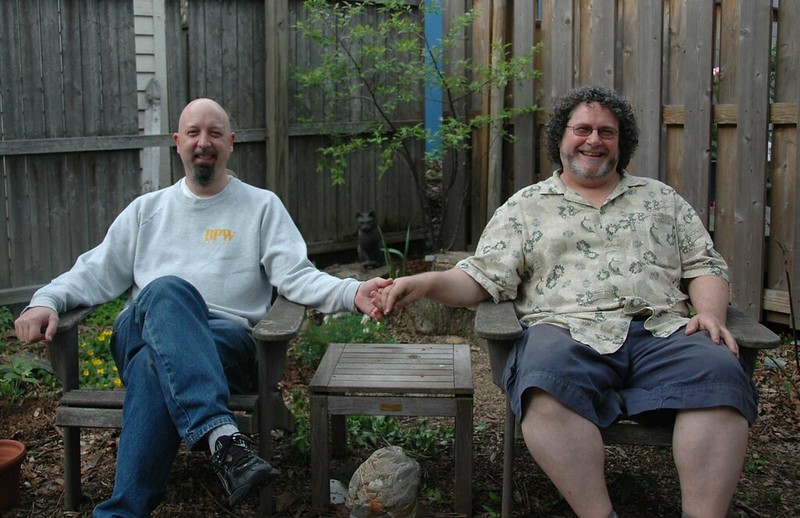
Domestic Bliss: Blog Widow (left) and me in the gardener's nook on the occasion of the interview. I had just transplanted the female Ilex verticillata in the background that morning.
Flatbush Gardener (right) and Blog Widow
Two weekends ago, Blog Widow and I were interviewed by WNYC's Kathleen Horan on the topic of marriage equality - marriage for all - in New York state. The piece aired this morning, and is available on the WNYC News Blog. We make our appearance about 4:55 into the segment.

Marriage Equality, Kathleen Horan, 2009-05-22

I didn't get to listen to it when it aired at 7:50am this morning. I thought it might be off-topic for the blog. But since most of my part of the aired conversation is about the garden, I figure it it's not much of a stretch. Please give it a listen, and let me know what you think in the comments below.

Related Content

Wildflowers in a Flatbush Backyard, 2009-05-11
Cellophane Bees Return, 2009-05-09

Links

Debating "Marriage Equality" , Kathleen Horan, WNYC