Sunday, I tabled for Sustainable Flatbush at the Flatbush Frolic. For the second year, Sustainable Flatbush presented an Environmental Fair at the Frolic, partnering with organizations that represent their four main initiatives: Energy Solutions, Livable Streets, Zero Waste, and Urban Gardens & Farms.
Now in its 33rd year, the Flatbush Frolic is one of a handful of street fairs that stands out from the hundreds NYC hosts annually. The Frolic is locally organized, and features local businesses and organizations.
Because I spent most of the day tabling, I didn't get to see much of the Frolic, but here's some of what I did see.

Please visit the NEW SITE for Flatbush Gardener
2009-09-15


2009-08-29
Brine Garden, Pawling, NY
A path in the Brine Garden in Pawling in Dutchess County, NY, north of New York City.

Last Sunday, Blog Widow and I drove up to Pawling, NY and spent the day with a friend of ours. I also got to meet Julia and Duncan Brine. In their landscape design firm, they specialize in native plants, so I was excited to meet them and visit their gardens.
The gardens ramble over six acres. In contrast to the familiar limitations of urban gardening, it may as well have been 600 acres. The property slopes, steeply at times, from the unpaved entrance drive down to Route 22. Water flows through the property. The day of my visit, precipitation seamlessly cycled through mist, drizzle, sprinkles. There was nearly a film of water over the gardens. I'm not exaggerating. My friend's sneakers became soaked just from walking through the long, wet grass. And it was wet enough for this fellow to crawl over the ground to his burrow of mud at the base of a log.

With the almost constant rains we've had this summer, everything was lush, full, and green. The rampant growth encroached from all sides, overtaking and disguising any intended boundaries of the cleared areas. This contributed to the fluid expression of "path" at play in the Brine Garden. Narrows suggest passage; wider bays encourage a slower pace.


Last Sunday, Blog Widow and I drove up to Pawling, NY and spent the day with a friend of ours. I also got to meet Julia and Duncan Brine. In their landscape design firm, they specialize in native plants, so I was excited to meet them and visit their gardens.
The gardens ramble over six acres. In contrast to the familiar limitations of urban gardening, it may as well have been 600 acres. The property slopes, steeply at times, from the unpaved entrance drive down to Route 22. Water flows through the property. The day of my visit, precipitation seamlessly cycled through mist, drizzle, sprinkles. There was nearly a film of water over the gardens. I'm not exaggerating. My friend's sneakers became soaked just from walking through the long, wet grass. And it was wet enough for this fellow to crawl over the ground to his burrow of mud at the base of a log.
With the almost constant rains we've had this summer, everything was lush, full, and green. The rampant growth encroached from all sides, overtaking and disguising any intended boundaries of the cleared areas. This contributed to the fluid expression of "path" at play in the Brine Garden. Narrows suggest passage; wider bays encourage a slower pace.
Related Content
Brine Garden, Pawling, NY, Flickr photo setLinks
Brine Garden2009-08-24
Study Guide for BBG Plant ID Class
Clerodendrum bungei Steud., Rose Glory Bower

This Wednesday I take the final for the Brooklyn Botanic Garden's Herbaceous Landscape Plant Identification class. [Spelling counts! So please let me know of any typos.] Thursday, I start Urban Garden Maintenance, the last of the eight classes I need for my Certificate in Urban Horticulture from BBG. I started the program in Winter 2008. This is the home stretch; I can't believe I'm almost done with it.
Unlike the "woodies" class, I already knew most of the plants introduced in the class over the past five weeks. Either I've grown them myself sometime over my 30 years of gardening in NYC, or I've researched and studied them. However, there have been several, such as the interesting Clerodendrum above, which I've never even heard of, or never knew the names of.
This post is the index to my photographic study guide. Plant names are listed by week, in alphabetical order by botanical name within each week. Botanical names are given, corrected for typos, as they were introduced in the class; that's what we'll be tested on for the final this Wednesday evening. Plant names are linked to my Flickr Set, where I have one. You can also browse my Flickr Collection for this class, where all the plants are listed by botanical name.

Observed:
Pennisetum alopecuroides, Fountain Grass

Angelica gigas, Purple Angelica

This Wednesday I take the final for the Brooklyn Botanic Garden's Herbaceous Landscape Plant Identification class. [Spelling counts! So please let me know of any typos.] Thursday, I start Urban Garden Maintenance, the last of the eight classes I need for my Certificate in Urban Horticulture from BBG. I started the program in Winter 2008. This is the home stretch; I can't believe I'm almost done with it.
Unlike the "woodies" class, I already knew most of the plants introduced in the class over the past five weeks. Either I've grown them myself sometime over my 30 years of gardening in NYC, or I've researched and studied them. However, there have been several, such as the interesting Clerodendrum above, which I've never even heard of, or never knew the names of.
This post is the index to my photographic study guide. Plant names are listed by week, in alphabetical order by botanical name within each week. Botanical names are given, corrected for typos, as they were introduced in the class; that's what we'll be tested on for the final this Wednesday evening. Plant names are linked to my Flickr Set, where I have one. You can also browse my Flickr Collection for this class, where all the plants are listed by botanical name.
Week 1, 2009.07.22
Callirhoe involucrata, Purple Poppy-MallowObserved:
- Callirhoe involucrata, Poppy Mallow
- Epimedium grandiflora 'Lilafee', Barrenwort
- Lychnis coronaria, Rose Campion, Ragged Robin
- Podophyllum peltatum, Mayapple
- Polygonatum odoratum var. pluriflorum 'Variegatum', Variegated Solomon's Seal
- Sarracenia sp., Pitcher Plant
- Smilacina racemosa, False Solomon's Seal
- Verberna bonariensis, Vervain
- Aquilegia canadensis, Columbine. This grows as a Spring ephemeral in our region; none were available to observe at this late date.
- Geranium macrorrhizum, Bigroot Geranium. Omitted primarily for time constraints; also, it was out of bloom by this time of the year. Too bad, since it's a handsome plant, and there are lots of them around the grounds of BBG.
Week 2, 2009-07-29
We got 11 plants this week to make up for being two short the previous week.- Acanthus hungaricus, Bear's Breeches
- Alchemilla mollis, Lady's mantle
- Amsonia hubrichtii, Blue Star Amsonia, Threadleaf Bluestar
- Asarum splendens, Chinese Wild Ginger
- Begonia grandis, Hardy Begonia
- Borago officinalis, Borage
- Crocosmia 'Lucifer', Montbretia
- Helleborus foetidus, Stinking Hellebore
- Heuchera micrantha var. diversifolia 'Palace Purple'
- Humulus lupulus, Hop Vine
- Pachysandra procumbens, Allegheny Spurge
Week 3, 2009-08-05
- Agastache rupestris, Hyssop
- Asclepias tuberosa, Native Milkweed, Butterfly-Weed
- Belamcanda chinensis, Blackberry Lily, Leopard Flower
- Clerodendrum bungei, Rose Glory Bower, Mexican Hydrangea
- Echinacea purpurea, Purple Coneflower
- Foeniculum vulgare 'Purpureum', Bronze/Copper Fennel
- Macleaya cordata, Plume Poppy, Tree Celandine
- Passiflora caerulea, Maypop, Passionflower
- Stachys byzantina, Wooly Lamb's Ears
- Thalictrum rochebrunianum, Meadow Rue, Lavender Mist
Week 4, 2009-08-12
This was the only themed week of the class, consisting solely of grasses, ferns and fern allies.Pennisetum alopecuroides, Fountain Grass
- Adiantum pedatum, Northern/Eastern Maidenhair Fern
- Asplenium scolopendrium, Hart's-Tongue Fern
- Athyrium nipponicum 'Pictum', Japanese Painted Fern
- Blechnum spicant, Deer Fern
- Calamagrostis x acutiflora 'Karl Foerster', Feather Reed Grass
- Chasmanthium latifolium, Northern Sea Oats, River Oats, Indian Wood-Oats
- Equisetum hyemale, Scouring Rush, Horsetail
- Hakonechloa macra, Japanese Forest Grass
- Pennisetum alopecuroides, Fountain Grass
- Polystichum polyblepharum, Tassel/Bristle Fern
Week 5, 2009-08-19
The last class before the in-class final.Angelica gigas, Purple Angelica
- Anemone x hybrida, Japanese Anemone, Windflower
- Angelica gigas, Purple Angelica
- Colocasia esculenta 'Illustris', Taro, Imperial Taro, Dasheen, Poi, Elephant Ears
- Convallaria majalis, Lily of the Valley
- Dicentra eximia, Wild/Fringed/Eastern Bleeding-Heart
- Eupatorium dubium, Little Joe Pye Weed
- Euphorbia dulcis 'Chameleon', Mole Spurge
- Hibiscus coccineus, Scarlet Rose Mallow, Swamp Mallow
- Opuntia humifusa, Eastern Prickly Pear Cactus
- Tricyrtis hirta, Toad Lily
2009-08-18
Sphecius speciosus, Eastern Cicada Killer
Although I've lived in Brooklyn since 1992, I didn't encounter Sphecius speciosus, the Eastern Cicada Killer, until we moved to Flatbush in 2005. It was summer, and I was working outside in the garden. Suddenly, here was the biggest wasp I had ever seen, large and loud, buzzing around my driveway and digging into the lawn next to it. I freaked out. I hosed out the burrow and destroyed the nest.
I regret having done that. I attribute my over-reaction partially to the stresses of being a first-time homeowner. I now find them beautiful. I consider myself lucky that we live in an urban area where these specialists can thrive. Besides, they are much too busy during their short adult lives to bother with people.
Sphecius speciosus, Eastern Cicada Killer, with prey, just inside the Eastern Parkway entrance of the Osborne Garden at Brooklyn Botanic Garden, August 2009

They have a fascinating, if gruesome by human standards, life history. It could easily be the inspiration for the xenomorph of the Alien movie series.
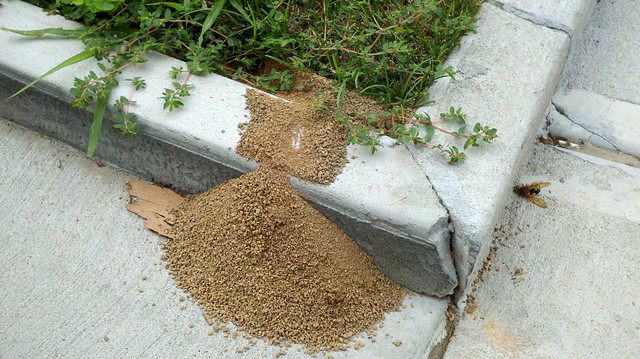
After mating, the female digs out a deep tunnel leading to a multi-chambered nest. They're impressive excavators. This debris pile appeared overnight alongside our driveway and sidewalk in August of 2012. The concrete curb is 3" high.
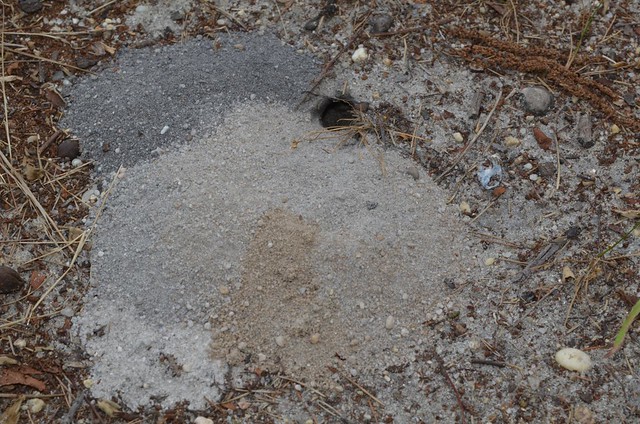
Here's the entrance to a nest in Cattus Island Park in Toms River, in the coastal pine barrens of New Jersey, in August of 2011. Note there are 4 different colors of sand, showing the different layers, and depths, the female reached.
The female then hunts for and captures an adult cicada, paralyzing it with its sting without killing it. It returns with the cicada to its burrow, dragging it into one of the chambers of the nest. It lays a single egg on the cicada. It repeats this process several times. The female dies soon after egg-laying.
Sphecius speciosus, Eastern Cicada Killer, with prey, at the Flatbush CommUNITY Garden, July 2008

When the egg hatches, the larva feeds on the still-living cicada. When the cicada hs been completely consumed, the larva spins a cocoon and overwinters as a pre-pupa. In Spring it emerges from the cocoon as a pupa, eventually metamorphosizing and emerging as adults, male and female, for mating and renewing the cycle.
Dog-day Cicada (annual Cicada) in Prospect Park, July 2008


I was prompted to write this in response to a message sent out on the Flatbush Family Network:
Flickr photo set
Wikipedia
University of Kentucky Entomology
Ohio State University Extension
I regret having done that. I attribute my over-reaction partially to the stresses of being a first-time homeowner. I now find them beautiful. I consider myself lucky that we live in an urban area where these specialists can thrive. Besides, they are much too busy during their short adult lives to bother with people.
Sphecius speciosus, Eastern Cicada Killer, with prey, just inside the Eastern Parkway entrance of the Osborne Garden at Brooklyn Botanic Garden, August 2009
They have a fascinating, if gruesome by human standards, life history. It could easily be the inspiration for the xenomorph of the Alien movie series.
After mating, the female digs out a deep tunnel leading to a multi-chambered nest. They're impressive excavators. This debris pile appeared overnight alongside our driveway and sidewalk in August of 2012. The concrete curb is 3" high.
Here's the entrance to a nest in Cattus Island Park in Toms River, in the coastal pine barrens of New Jersey, in August of 2011. Note there are 4 different colors of sand, showing the different layers, and depths, the female reached.
The female then hunts for and captures an adult cicada, paralyzing it with its sting without killing it. It returns with the cicada to its burrow, dragging it into one of the chambers of the nest. It lays a single egg on the cicada. It repeats this process several times. The female dies soon after egg-laying.
Sphecius speciosus, Eastern Cicada Killer, with prey, at the Flatbush CommUNITY Garden, July 2008
When the egg hatches, the larva feeds on the still-living cicada. When the cicada hs been completely consumed, the larva spins a cocoon and overwinters as a pre-pupa. In Spring it emerges from the cocoon as a pupa, eventually metamorphosizing and emerging as adults, male and female, for mating and renewing the cycle.
Dog-day Cicada (annual Cicada) in Prospect Park, July 2008
Cicada killers are solitary wasps. Males emerge from pupal cases in mid-July to early August, a few weeks before the females. The males tunnel out of the ground, leaving telltale holes, and select a territory that they actively defend. Females mate soon after emerging, and then begin digging burrows in the ground using their mandibles and legs. The burrows can be several feet deep with numerous branches.Felis catus ssp. cicadakilleratus 'Ripley' on my back porch, August 2009
Once construction is complete, the female searches in trees and shrubs. Upon capturing a cicada, the female stings it injecting venom. Then, she carries the cicada back to the burrow, where she lays an egg on its living, but paralyzed body. Within two weeks, the egg hatches into a larva, eats the cicada, and develops into a pre-pupa, the stage at which it will spend the winter. Cicada killers are active in late summer, the same time that cicadas are present. By September, most adults have died.
Although visually alarming, these wasps pose little threat. Females are not aggressive and rarely sting, unless excessively provoked. Males often display territorial behavior and will dive-bomb people’s heads; however, they have no sting and pose no real threat.
- Cicada Killer, Master Beekeeper Program, Cornell University
I was prompted to write this in response to a message sent out on the Flatbush Family Network:
We seem to have an underground yellow jacket nest on our front walkway with a "Queen" that is about 2.5 inches long.....a little frightening to me but will absolutely scare the wits out of my kids- she looks like she can carry her own luggage! Anyone know an exterminator that can come and get rid of this Quick!?[bit.ly]
Thanks, Lori
Related Content
Dog-Day Cicadas, 2008-07-11Flickr photo set
Links
BugGuideWikipedia
University of Kentucky Entomology
Ohio State University Extension
2009-08-16
Eristalis transversa, Transverse Flower Fly
This beautiful creature is not a bee. It's a fly of the Syrphidae, a family of flies renowned for bee mimics. This is Eristalis transversa, Transverse Flower Fly. I had noticed it in my garden for the first time this summer. yesterday was the first chance I had to capture some photos of it. Consider this a belated Garden Blogging Bloom Day post, but with a native pollinator as the focal point.


The flower it's visiting is Aster novae-angliae 'Chilly Winds', a selection of the native New England Aster from Seneca Hills Perennials in upstate New York. This plant has been a pollinator magnet in my backyard native plant garden for weeks. It's massive and overgrown and poorly placed, crowding out everything else around it. I'll have to find it another place for next year.
[bit.ly]
My BugGuide images
Seneca Hills Perennials
The flower it's visiting is Aster novae-angliae 'Chilly Winds', a selection of the native New England Aster from Seneca Hills Perennials in upstate New York. This plant has been a pollinator magnet in my backyard native plant garden for weeks. It's massive and overgrown and poorly placed, crowding out everything else around it. I'll have to find it another place for next year.
[bit.ly]
Related Content
Flickr photo setMy BugGuide images
Links
BugGuide pageSeneca Hills Perennials
2009-07-29
Flatbush Rezoning Proposal approved by City Council
Updated 2009-07-30: Added more links.
Today the City Council approved the Flatbush Rezoning Proposal. Brooklyn Community Board 14 posted this statement on their Web site: "We greatly appreciate the hard work of our elected officials, the neighborhood associations and their able leadership, and particularly the great staff at the Brooklyn office of the Department of City Planning for making this happen!" Knowing that the Council also sealed the fate of Coney Island, i.e.: Miami Beach, tempers my satisfaction with the outcome for Flatbush.
As some relief for today's beastly weather, please enjoy this scene of one of the hundreds of homes now protected with today's vote.

[bit.ly]
[bk.ly]
CPC approves Flatbush Rezoning Proposal, Council hearing 7/27, 2009-06-18
Flatbush Rezoning Hearing at Borough Hall 5/7, 2009-05-05
Flatbush Rezoning Proposal CB14 Public Hearing April 2, 2009-03-16
DCP-CB14 briefing on Inclusionary Housing provisions, 2009-03-10
Flatbush Rezoning Proposal certified, enters public review process, 2009-03-02
Flatbush Rezoning Proposal scheduled for certification, 2009-02-28
New Flatbush Rezoning Proposal Gets It Right, 2008-10-07
Flatbush Rezoning Proposal will define the future of Victorian Flatbush, 2008-06-13
Flatbush Rezoning Proposal, 2008-05-23
Preserving Livable Streets: DCP's Yards Text Amendment, 2007-11-07
Victorian Flatbush at risk from inappropriate zoning, 2007-10-23
State of Flatbush/Midwood, 2007-10-05
Landscape and Politics in Brooklyn's City Council District 40, 2007-02-14
NASA Earth Observatory Maps NYC's Heat Island, Block by Block, 2006-08-01
Flatbush Rezoning, Ditmas Park Blog, 2009-07-30
Residence District Zoning Explained
Table comparing R1 through R3 (PDF)
Table comparing R4 through R5 (PDF)
Inclusionary Housing Program, DCP
DCP Zoning Glossary
ULURP: Uniform Land Use Review Procedure
Brooklyn Community Board 14
Brooklyn Community District 14 Profile (PDF)
Today the City Council approved the Flatbush Rezoning Proposal. Brooklyn Community Board 14 posted this statement on their Web site: "We greatly appreciate the hard work of our elected officials, the neighborhood associations and their able leadership, and particularly the great staff at the Brooklyn office of the Department of City Planning for making this happen!" Knowing that the Council also sealed the fate of Coney Island, i.e.: Miami Beach, tempers my satisfaction with the outcome for Flatbush.
As some relief for today's beastly weather, please enjoy this scene of one of the hundreds of homes now protected with today's vote.
[bit.ly]
[bk.ly]
Related Content
Flickr photo setCPC approves Flatbush Rezoning Proposal, Council hearing 7/27, 2009-06-18
Flatbush Rezoning Hearing at Borough Hall 5/7, 2009-05-05
Flatbush Rezoning Proposal CB14 Public Hearing April 2, 2009-03-16
DCP-CB14 briefing on Inclusionary Housing provisions, 2009-03-10
Flatbush Rezoning Proposal certified, enters public review process, 2009-03-02
Flatbush Rezoning Proposal scheduled for certification, 2009-02-28
New Flatbush Rezoning Proposal Gets It Right, 2008-10-07
Flatbush Rezoning Proposal will define the future of Victorian Flatbush, 2008-06-13
Flatbush Rezoning Proposal, 2008-05-23
Preserving Livable Streets: DCP's Yards Text Amendment, 2007-11-07
Victorian Flatbush at risk from inappropriate zoning, 2007-10-23
State of Flatbush/Midwood, 2007-10-05
Landscape and Politics in Brooklyn's City Council District 40, 2007-02-14
NASA Earth Observatory Maps NYC's Heat Island, Block by Block, 2006-08-01
Links
City Council Adopts Flatbush Rezoning, Brooklyn Community Board 14, 2009-07-30Flatbush Rezoning, Ditmas Park Blog, 2009-07-30
Important DCP Links
Flatbush Rezoning Proposal, City PlanningResidence District Zoning Explained
Table comparing R1 through R3 (PDF)
Table comparing R4 through R5 (PDF)
Inclusionary Housing Program, DCP
DCP Zoning Glossary
ULURP: Uniform Land Use Review Procedure
Other Links
South Midwood Residents AssociationBrooklyn Community Board 14
Brooklyn Community District 14 Profile (PDF)
2009-07-26
Wicked Plants with Amy Stewart at the Brooklyn Botanic Garden
A large group assembled for Amy Stewart's tour of Wicked Plants along the Annual Border of Brooklyn Botanic Garden's Lily Pool Terrace.
 Saturday afternoon, Blog Widow and I went to the Brooklyn Botanic Garden for an afternoon of Wicked Plants: a tour led by Amy Stewart, a book signing, and a cake baked for the occasion.
Amy Stewart, rigged with portable amplification


 Ricinus communis, Castor Bean plant
 Book purchase display

 "Everything is edible, except the boards," said one of the cake wranglers. Well, that and the stems of the flowers.
The flowers were incredibly lifelike.
 It's hard to justify eating artistry like this. But it was a hot and humid day, so what can you do?!
 Amy regards a Tulip before taking a bite of it.
 Blog Widow peals a petal off a Tulip. It tasted vaguely like wax lips. Technically edible.
 The base was seven layers of chocolate and vanilla cake with mocha cream. Delicious, and worth the wait.

 Dragonfly
 Hens and Chicks
 Okay, wicked, but kinda cool, huh?

Saturday afternoon, Blog Widow and I went to the Brooklyn Botanic Garden for an afternoon of Wicked Plants: a tour led by Amy Stewart, a book signing, and a cake baked for the occasion.
Amy Stewart, rigged with portable amplification
Ricinus communis, Castor Bean plant
Book purchase display
The Cake
A Wicked Cake enters the Lily Pool Terrace
"Everything is edible, except the boards," said one of the cake wranglers. Well, that and the stems of the flowers.
The flowers were incredibly lifelike.
It's hard to justify eating artistry like this. But it was a hot and humid day, so what can you do?!
Amy regards a Tulip before taking a bite of it.
Blog Widow peals a petal off a Tulip. It tasted vaguely like wax lips. Technically edible.
The base was seven layers of chocolate and vanilla cake with mocha cream. Delicious, and worth the wait.
Glam Shots
Not everything we saw that day was wicked. Double-Flowering Lotus
Dragonfly
Hens and Chicks
Okay, wicked, but kinda cool, huh?
Slideshow
[bit.ly] [bk.ly]Related Content
Flickr photo setLinks
Wicked Plants, Brooklyn Botanic Garden Wicked Plants, Amy Stewart Pretty Poison: Plants to Die For, CBS News Sunday Morning, 2009-08-022009-07-21
Rabies reminder from NYC DOH
Not to fan the annual flames of rabies hysteria we usually get in the Brooklyn blogosphere, but the New York City Department of Health, in response to recent identification of rabid animals in Manhattan, the Bronx, and Queens, issued a press release today to remind New Yorkers to 1) avoid contact with wild animals, and 2) have your pets vaccinated for rabies. Note that NYC law requires rabies vaccinations of pets.
Meta: Rabies More Popular Than Sex, 2007-03-07
News: Raccoon Tests Positive for Rabies in Manhattan, 2007-02-28
Six rabid animals — all raccoons — have been identified in New York City this year. Four were found in the Bronx, one in Manhattan (near Inwood Hill Park), and one in Queens (Long Island City). Raccoons are the most commonly reported rabid animals in New York City. Rabid raccoons are a relatively common occurrence in Staten Island and the Bronx, but rare in Queens and Manhattan. Bats with rabies have also been found in all five boroughs.The six reported animals lags far behind the 19 reports for 2008. In recent history, Staten Island has the highest incidence of rabies among wild animals, followed closely by the Bronx. Queens, Manhattan and Brooklyn lag far behind. See Rabies in NYC: Facts and Figures for more info.
People and unvaccinated animals can get rabies, most often through a bite from an infected animal. Infection leads to a severe brain disease that causes death unless the person is treated promptly after being bitten. To reduce the risk of rabies, New Yorkers should avoid all wild animals, as well as any animal that seems sick, disoriented or unusually placid or aggressive. Report such animals by calling 311. Animals that have attacked or may attack should be reported to 911.
To protect yourself against rabies
- Do not touch or feed wild animals, or stray dogs or cats.
- Keep garbage in tightly sealed containers.
- Stay away from any animal that is behaving aggressively or a wild animal that appears ill or is acting unusually friendly. Call 311 or your local precinct to report the animal.
- If you find a bat indoors that may have had contact with someone, do not release it before calling 311 to determine whether it should be tested. For information on how to safely capture a bat, visit http://www.health.state.ny.us/diseases/communicable/zoonoses/rabies/.
To protect your pet against rabies
- Make sure your dog or cat is up-to-date on rabies vaccinations.
- Do not leave your pets outdoors unattended.
- Do not try to separate animals that are fighting.
- If your pet has been in contact with an animal that might be rabid, contact your veterinarian, and report the incident to 311.
- Feed pets indoors.
If you are bitten by an animal
- Immediately wash the wound with lots of soap and water.
- Seek medical care from your health care provider.
- If you know where the animal is, call 311 to have it captured.
- If the animal is a pet, get the owner's name, address and telephone number to give to the Health Department so they can ensure the animal is not rabid.
- Call the Animal Bite Unit (212-676-2483) between 9 a.m. and 5 p.m., or file a report online at www.nyc.gov/html/doh/html/vet/vetegp.shtml.
- For information about medical follow-up, call 311 or your medical provider.
Related Content
Rabies in NYC: Facts and Figures, 2008-07-08Meta: Rabies More Popular Than Sex, 2007-03-07
News: Raccoon Tests Positive for Rabies in Manhattan, 2007-02-28
Links
Press ReleaseTextile recycling expands August 1 in NYC
The Council on the Environment of New York City (CENYC) has been working since 2007 to divert textiles from the waste stream by offering drop-off points at select Greenmarkets. Textiles such as clothing and linens comprise nearly 6% of residential waste in the city, adding to landfills and disposal costs.
Fort Greene Greenmarket, Saturday, 8am-3pm
Washington Park at DeKalb
McCarren Park Greenmarket, Saturday, 8am-2pm (Starting August 1)
Bedford & Lorimer, Greenpoint
Grand Army Plaza Greenmarket, Brooklyn, 8am-4pm (open now)
(NW Entrance to Prospect Park)
[bit.ly]
NYCWastele$$
How does textile recycling work?
Clean clothing, shoes, bedding, linens, hats, handbags, belts and other textiles, whether in usable or non-usable condition, can be dropped off at several locations around NYC. Donations are sorted into different grades such as cotton blend and synthetic scrap and then redistributed to markets where there is a demand for these materials, such as wearable clothing or stuffing for mattresses.Brooklyn drop-off locations
Starting August 1, CENYC will now accept donations at the Greenpoint and Fort Greene Greenmarkets, in addition to the existing drop-off at the Grand Army Plaza location.Fort Greene Greenmarket, Saturday, 8am-3pm
Washington Park at DeKalb
McCarren Park Greenmarket, Saturday, 8am-2pm (Starting August 1)
Bedford & Lorimer, Greenpoint
Grand Army Plaza Greenmarket, Brooklyn, 8am-4pm (open now)
(NW Entrance to Prospect Park)
[bit.ly]
Links
Clothing and textile recycling collections, CENYCNYCWastele$$
2009-07-19
Apollo: a personal/biographical perspective
40 years ago, we watched the landing on television like much of the rest of the world. Days before, my father had packed our little family into the car and drove to the causeway overlooking the Kennedy Space Center to watch, and feel, Apollo 11 send men to land on the moon for the first time. My father worked for Grumman, which had the contract to develop the Lunar Excursion Module (LEM), later dubbed simply the Lunar Module (LM), for the Apollo space program. He worked on the LEM's telemetry systems. Part of my father is on the moon.
My Dad at work, circa 1960s

My family moved twice while I was growing up. Until I moved to New York City, I didn't live anywhere longer than six years. In the winter of 1964-1965, we moved from Long Island, east of new York City, to Merritt Island, Florida. As you can see from this map, our home was just a little over 10 miles from the Apollo 11 launchpad. I used to watch rockets launch from my bedroom window. On most launches, our windows shook.
View Apollo in a larger map
The Apollo program had an enormous economic and human toll, an important part of the story which I've yet to read anywhere else. Shortly after we moved to Florida, my father began working 60-80 hours a week, a pace which didn't let up until nearly the end of the development program. Once it became routine to send men to the moon, the development program ended abruptly. Hundreds of thousands lost their jobs simultaneously in a region whose development was triggered by this one program. My dad was able to find another job within Grumman, but it required moving back to Long Island. With no buyers, we were only able to sell our home at a greatly reduced price, losing all our equity, and having nothing with which to buy a new home.
We moved back to Long Island in the fall of 1970, just in time for me to start the school year, though just one week late.
[bit.ly]
My Dad at work, circa 1960s
My family moved twice while I was growing up. Until I moved to New York City, I didn't live anywhere longer than six years. In the winter of 1964-1965, we moved from Long Island, east of new York City, to Merritt Island, Florida. As you can see from this map, our home was just a little over 10 miles from the Apollo 11 launchpad. I used to watch rockets launch from my bedroom window. On most launches, our windows shook.
View Apollo in a larger map
The Apollo program had an enormous economic and human toll, an important part of the story which I've yet to read anywhere else. Shortly after we moved to Florida, my father began working 60-80 hours a week, a pace which didn't let up until nearly the end of the development program. Once it became routine to send men to the moon, the development program ended abruptly. Hundreds of thousands lost their jobs simultaneously in a region whose development was triggered by this one program. My dad was able to find another job within Grumman, but it required moving back to Long Island. With no buyers, we were only able to sell our home at a greatly reduced price, losing all our equity, and having nothing with which to buy a new home.
We moved back to Long Island in the fall of 1970, just in time for me to start the school year, though just one week late.
[bit.ly]
Related Content
Links
Subscribe to:
Posts (Atom)