Showing posts sorted by relevance for query raccoon. Sort by date Show all posts

2008-06-26

Summer Nights

Update 2010.01.03: Corrected all links to the old Gowanus Lounge domain to the new memorial domain.

Flatbush Raccoon

I know it's summer when the fireflies are out in force. As are the raccoons (Procyon lotor).

Both made their first appearance in the backyard about two weeks ago: just two fireflies, and just one raccoon. Tonight, multiple fireflies in everyone's yards, front and back. And a family of raccoons, as we get every year. I saw three little ones at once. I saw the adult separately.

Here are, I think, two of the young'uns, one in a tree, and one on the ground. It could also be the same young raccoon. The one in the tree climbed down, shortly after which the "other" appeared on the ground.

Flatbush RaccoonFlatbush Raccoon

The groundling was very curious about my camera, and came within four feet of me before it realized the camera was attached to a person.

Flatbush Raccoon

Gowanus Lounge recently reported on raccoons sighted in Carroll Gardens. Some folks raised concerns about rabies. I left the following comment:

We love our Brooklyn raccoons!

They are annual visitors to our backyard. And our kitchen on the second floor. They climbed my neighbor’s apple tree to get there. They don’t scale building walls, they climb trees and other structures.

They’re scavengers, looking for easy grub. Don’t leave pet food outside. Don’t feed stray and feral cats and dogs. Keep garbage cans and compost bins and piles covered.

As for rabies, Brooklyn is the best off of all the five boroughs, with only 5 animal cases detected in the past 15 years; the most recent, in 2005, was a bat. Rabies is endemic in the Bronx and Staten Island.

Related Posts

Links

Old news

2007-02-28

News: Raccoon Tests Positive for Rabies in Manhattan

The NYC Department of Health and Mental Hygiene announced today that a raccoon has tested positive for rabies in Manhattan. Rabies is prevalent in Staten Island. it seems just a matter of time before it's detected in Brooklyn.
A raccoon dropped off by two New Yorkers at the Manhattan Animal Care and Control Shelter tested positive for rabies yesterday, the New York City Department of Health and Mental Hygiene reported today. The Health Department is trying to identify these individuals, who may have been exposed to rabies while handling the animal. Rabies is a fatal disease, but it can be prevented if exposed individuals get rabies shots. There has not been a case of human rabies in New York City for more than 50 years.
The individuals brought the injured raccoon, wrapped in a blanket and placed in a pet carrier, to the East 110th Street shelter on the evening of Friday, February 23rd. They were described as a white man and woman in their thirties wearing medical scrubs. They left before giving any contact information to the shelter staff. [Okay, so how do you know they were New Yorkers as you state in the first paragraph?!] These people should seek medical care immediately and call 311 to notify the Health Department. The Health Department is also alerting City doctors and veterinarians of the possible exposure.

It is not known if this raccoon was living in Manhattan, which has had very few cases of rabid animals compared to Staten Island and the Bronx. It may have been transported from another borough. This raccoon is the first animal that has tested positive in Manhattan in 2007; one bat tested positive in 2006. DOHMH warns New Yorkers to avoid contact with stray cats and dogs or other potentially rabid animals such as raccoons, skunks, or opossums and to ensure that their pets’ rabies vaccinations are kept up to date.

To protect yourself against rabies:

Rabies is most often transmitted through the bite or scratch of an infected animal or when saliva of the infected animal comes into contact with an open wound or mucous membrane (such as nose or mouth). Simple contact with a wild animal will not result in rabies.
  • Do not touch or feed wild animals, stray dogs or cats, or bats.
  • Keep garbage in tightly sealed containers.
  • Stay away from any animal that is displaying unusual behavior or appears ill, particularly if the animal is behaving aggressively or if a wild animal acts unusually friendly. Call 311 to report animals that are displaying these or other unusual behaviors.
To protect your pet against rabies:
  • Make sure your dog or cat is up-to-date on its rabies vaccinations.
  • Do not leave your pets outdoors unattended.
  • If your pet has been in contact with an animal that might be rabid, contact your veterinarian.
  • Feed pets indoors.
If you are bitten by an animal:
  • First, wash the wound with soap and water IMMEDIATELY.
  • Talk to a doctor right away to see if you need tetanus or rabies shots. If you don’t have a regular doctor, go to a hospital emergency room.
  • Call 311 to report the bite.

Related Content

Raccoons in Brooklyn, 2006-07-31

Links

Press Release

2008-02-03

Raccoon Fight

I just heard a raccoon fight in my backyard. It's the first time I've seen a raccoon here in the winter.

I didn't know it was a raccoon fight at first. When I heard the ruckus, I looked out from the second floor porch, but couldn't see anything. I went downstairs with a flashlight and looked out from one of the back bedrooms. I saw what I thought was a cat hiding behind one of the Adirondack chairs.

I went back upstairs to the back porch. Then I heard the screeching and screaming again. Decidedly un-catlike. I could tell it was coming from the corner of the yard, but I couldn't see anything. I thought it might be just beyond one of our neighbors' fences.

Then I saw it, lumbering into view. One of the big mama-jama raccoons. Unhurried and unconcerned. Probably the winner of whatever altercation had just ensued. In the beam of my flashlight, it turned to look up at me, then stood on its back legs to get a better look. Satisfied, I guess, it went under my back neighbor's deck.

It was all over in less than five minutes, so no photos from tonight's squabble. You can find photos in my related posts.

Related Posts

Flatbush Wildlife Report: Raccoons and Opposums, July 9, 2007
Midnight Photo Blogging: Raccoons in Brooklyn, July 31, 2006

2008-07-08

Brooklyn's Raccoons in the New York Times

Update 2010.01.03: Removed all links to the old Gowanus Lounge domain, which has since been appropriated by some parasitic commercial site.

Flatbush Raccoon, June 26, 2008
Flatbush Raccoon

Last week, I was interviewed by reporter Ann Farmer for the New York Times about my experiences with raccoons. The article is published in today's Times:
Raccoons have long been widespread in New York City, and there is no way to say with any statistical certainty whether there are more now. But Capt. Richard Simon of the Urban Park Rangers, which is part of the city’s Parks Department, said a rise in the number of 311 callers reporting sightings, encounters or interactions suggests that “the citywide population of raccoons has increased.”

One thing seems clear. In the leafy neighborhoods surrounding Brooklyn’s Prospect Park and Green-Wood Cemetery, residents have been flooding the Internet with raccoon stories.
- The City’s Latest Real Estate Fight: Humans Against Raccoons, Ann Farmer, New York Times, July 8, 2008
That pesky Internet! Ms. Farmer cites the Brooklyn blogosphere as one source for the reports:
Chris Kreussling, a computer programmer who lives just south of Prospect Park in Flatbush, posted pictures on his Flatbush Gardener blog recently of several raccoons in his backyard. It elicited a quick round of similar testimonies.

Another Brooklyn blog, the Gowanus Lounge, chronicled multiple raccoon sightings in recent days (link defunct) in Park Slope, Carroll Gardens, Windsor Terrace and Red Hook.

When contacted, many bloggers recalled raccoons rooting around in gardens and compost piles, traipsing into children’s wading pools and sometimes rearing up on their hind legs when startled. Many expressed awe at seeing the nocturnal mammals so close.

“People need access to wildlife in urban areas,” Mr. Kreussling said. “I consider it a bonus.”
That last quote is a reference to biophilia, literally "love of life or living systems." I think the way I expressed it in the interview was something like: People need nature around them.

Ms. Farmer also interviewed several of my neighbors. Check out Nelson Ryland's cautionary tale of the hazards of cat doors!

Thanks to my neighbor Brenda of Crazy Stable and Prospect: A Year in the Park for putting Ms. Farmer on the trail!

Related Posts

Rabies in NYC: Facts and Figures
Summer Nights, June 26, 2008
Raccoons

Links


The City’s Latest Real Estate Fight: Humans Against Raccoons, Ann Farmer, New York Times, July 8, 2008

2010-01-30

Central Park Rabies Outbreak

This month, 23 raccoons in and around Central Park have tested positive for rabies. In addition, 11 animals tested positive during December 2009, bringing the two-month total to 34.

Animal Rabies in Central Park, 12/1/2009-1/29/2010, NYC DOH

In contrast, from 2003-2008, only one raccoon tested positive in Manhattan. In 2008, only 19 animals tested positive for all of New York City.

This increase may be the result of increased surveillance by the Health Department:
With the identification of three raccoons with rabies in Manhattan’s Central Park in recent months – two during the past week – the Health Department is cautioning New Yorkers to stay away from raccoons, skunks, bats, stray dogs and cats and other wild animals that can carry rabies. The recent cluster of findings suggests that rabies is being transmitted among raccoons in the park. The Health Department is increasing surveillance efforts to determine the extent of the problem.
- Press Release, 2009-12-07
Historically, raccoons are by far the most commonly reported animal, comprising about 3/4 of reports from 1992-2008. Raccoons are nocturnal, and should be active only at night. Anyone observing a raccoon active during the daytime, or any animal that appears disoriented, placid, or aggressive, should call 311 immediately to report the location. Animal attacks should be reported to 911.

2006-07-31

Midnight Photo Blogging: Raccoons in Brooklyn


Oh, yeah. They're here.

I happened to go into the kitchen and heard noise out in the garden. I went out into the tree fort and heard lots of rustling around, sounding like it was along the back fence. I went back inside and got a flashlight to shine down in the yard.

The first one I saw running along the bottom of the reed screen I put up along the back fence. It was so fast, it could have been a cat. I kept hearing noise, so I kept looking. That's when I saw something on the reed screen. With the flashlight, it was clearly a small raccoon.

Now I know why my screen keeps falling down. It's a raccoon ride.

By this time a light was on from our tenants downstairs, and I saw a flash of light from a camera. Grabbed my camera, keys, flashlight and went outside to the backyard. One of our tenants was in the backyard with a camera, and I joined in, using the flashlight to spot them - in the trees, along the phone lines, behind the fence - and take pictures. I only have the flash in my camera, which isn't very powerful. The shot above is the only one in which I got all three of them. [2006.07.31-16:28 EDT: Replaced with photo adjused for brightness.]

They're clearly young, they seem well-fed, and they were having a lot of fun with each other. They didn't seem interested in my compost bins at all. They did seem to like rustling around in the leaves. I know there's lots of earthworms in there, and probably other good eats. Gnawing on phone junction boxes also seems to be a pastime, not one of which I approve.

They were back the following night. There were three, again, but one of them seemed larger than the other two and stayed on the ground. The three photographed above were all about the same size, and all up and down the threes, along, behind, and on the fence and screen, and so on. That time my partner got to see them, which was great fun.

It's been too hot since then to keep a raccoon vigil.

Related posts

Raccoons

2008-12-31

2008 Wrap-up

A young raccoon in my backyard in Flatbush, Brooklyn in June of 2008. My post about them was in the top five of 2008, measured both by visits and number of comments.
Flatbush Raccoon

It was a year of great changes and terrible losses for me. I began 2008 by taking classes at the Brooklyn Botanic Garden toward a Certificate in Horticulture, which I hope to complete by the end of this year. I remain involved in the gardening activism of Sustainable Flatbush, both in the Gardening Committee, and in the Flatbush CommUNITY Garden. I organized a Brooklyn Blogade, a meeting of bloggers, at the Brooklyn Botanic Garden, and helped with the 2008 annual Blogfest. I also lost two of my best friends: my cat, Spot, at the beginning of the year, and my father, Jerry, just four weeks ago.

To see out this old year and welcome in the new one, I thought I'd review and recap some of what I've written for this blog during 2008, and your responses to it.

Overall stats

Number of posts published: 236 (averaging 2 posts every 3 days)
Busiest month: April, with 38 posts (more than 1 per day)
Slowest month: November, with only 10 posts (1 every 3 days)

22,896 people visited this blog during 2008. There were 32,073 visits, an average of 88 per day. About 70% were first-time visitors.

Greatest Hits of 2008

The most popular content on the blog.
By visits
According to Google Analytics, from which I've collected these stats, "unique page views" are the number of visits during which a page was viewed. Page views are higher, since the same page may be viewed multiple times during a single visit. Unique pageviews, however, doesn't distinguish multiple visits from the same person or IP address.
  1. (Magi)Cicada Watch, about the Brood XIV Magicicadas, which unfortunately have been extirpated in Brooklyn, 2008-05-21, 763 visits
  2. Flatbush Rezoning Proposal will define the future of Victorian Flatbush, my report on a public hearing and analysis of the proposal, 2008-06-13, 483 visits
  3. Summer Nights, my photographic report on raccoons in my backyard, 2008-06-26, 405 visits
  4. Sources of Plants for Brooklyn Gardeners, 2008-04-29, 367 visits
  5. These two posts, both of them memorials, are close enough to call it a tie:
Special mention goes to my tutorial on the OASIS mapping service. Although I wrote it in February of 2007, almost two years ago, it was the third most popular page during 2008, with 433 unique page views. It's got "legs".
By comments
It's interesting to me that my two most commented posts this year were both obituaries. It's been a year of big changes in my life.
  1. Spot, 2008-02-23, 14 comments
  2. Gerard Kreussling, 1931-2008, 2008-12-01, 12 comments
  3. Summer Nights, my photographic report on raccoons in my backyard, 2008-06-26, 11 comments
  4. Snake in the Garden, Prospect Park, about a guy ripping branches off a cherry tree, 2008-04-26, 10 comments
  5. Three-way tie, with 9 comments each:

In case you missed it

Here are some other posts that remain relevant, interesting, or which I'm otherwise proud of.

2007-03-02

Meta: Rabies More Popular Than Sex

Update 2010.01.03: Corrected all links to the old Gowanus Lounge domain to the new memorial domain.

Looking at charts of the visits and page views to my blog over the past month, it's obvious that something unusual happened on February 20 and yesterday, March 1. The first chart is from SiteMeter, the second from StatCounter.
blogstats_sitemeter
blogstats_statcounter
What happened? I got some link love.

I posted about the condoms on 2/16. Gowanus Lounge, another but oh-so-much-more-popular Brooklyn blog, picked up the story on 2/20, and New York Magazine added it to their Web site the same day. And yesterday, New York Magazine picked up the rabies post.

Here's a table showing the number of visits as reported by StatCounter and Google Analytics. Site meter doesn't give me a way to view the numbers, and I can't find a way to capture the Flash-based Google graphics. The numbers are remarkably close, within 5% of each other, so I have some confidence in them.
Source Visits, 2/20 Visits, 3/1
StatCounter 99 124
Google 94 123

I was surprised when the rabies post out-tracked the condoms post. It's not really a fair comparison. The New York magazine item, a daily feature called Neighborhood Watch, was titled "You, With the Pet Raccoon! Time for Your Rabies Shot" and had a stock photo of a raccoon with gaping jaws. It was also on their home page for most of yesterday. Most of the hits to my blog yesterday were referrals from the New York Magazine home page.

2006-07-19

Wildlife sighting: Raccoons in Brooklyn.

Sorry, no pics. I did not see them. But our tenants, while eating dinner in the backyard last night, saw two raccoons, which came within about six feet of them. From their description, they sound like juveniles.

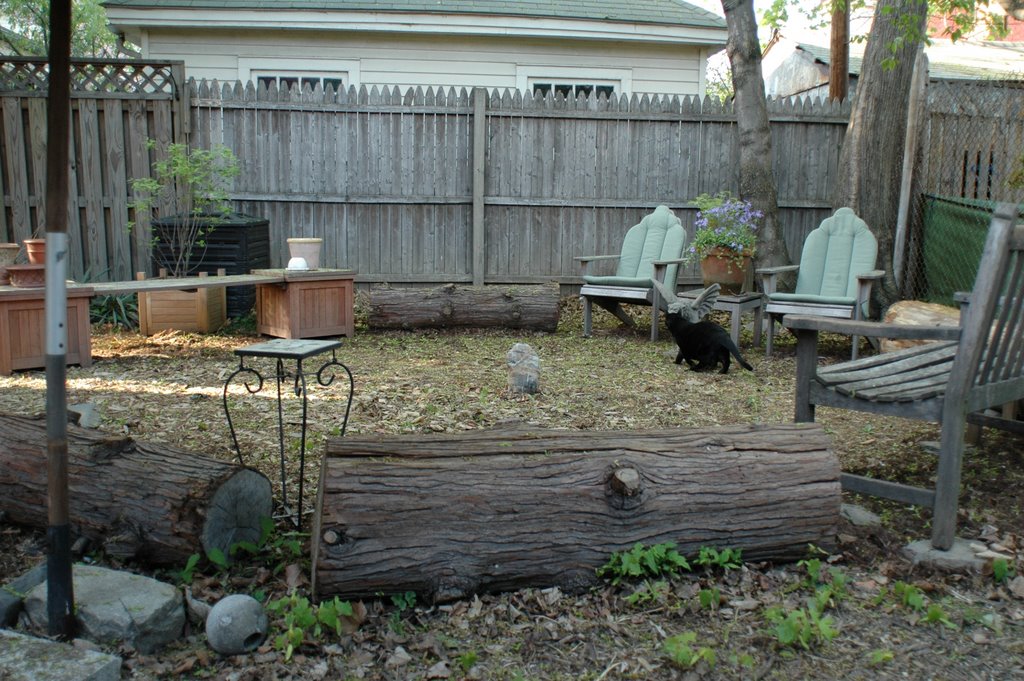
To set the stage, here's a photo of the backyard:


The tenants were seated in the Adirondack chairs. The raccoons were at the log in the foreground.

Melanie, a next-door neighbor, has been vindicated. Several months ago, I saw an opposum in our backyard. Right out the back window, nosing around the leaf litter and bags of mulch. And all the neighbors said "Oh, yeah, we've see the opposum." Like there would only ever be one. Where there is one opposum, there be much opposa. In that conversation, Melanie said that she'd seen a raccoon in her backyard. At which the neighbors scoffed "Maybe it was a cat." For none but Melanie had seen a raccoon.

Until last night.

Note the compost bin in the photo above. There is another directly behind where the photographer is standing, against the garage. I think this is what is attracting the raccoons. The tenants were very excited about being able to compost their kitchen scraps, and I've encouraged this. I've let them know what not to compost (meat, bones, fats or oils) and what to compost (vegetable, fruit, coffee grounds, eggshells, and so on). But the bins do not have secure lids; I sometimes even leave them unlidded if they're dried out.

I've never had to contend with raccoons in 25 years of urban gardening. We live one block from Coney Island Avenue: a seven-lane thoroughfare lined, at our latitude, with auto shops, car washes, gas stations, row houses, and Pakistani restaurants. Granted, we also only live four or five blocks from Prospect Park. But raccoons?!

Is this a problem for you suburban and exurban composters? Should I do anything? What do you do?

Related posts

Raccoons

2009-07-21

Rabies reminder from NYC DOH

Not to fan the annual flames of rabies hysteria we usually get in the Brooklyn blogosphere, but the New York City Department of Health, in response to recent identification of rabid animals in Manhattan, the Bronx, and Queens, issued a press release today to remind New Yorkers to 1) avoid contact with wild animals, and 2) have your pets vaccinated for rabies. Note that NYC law requires rabies vaccinations of pets.
Six rabid animals — all raccoons — have been identified in New York City this year. Four were found in the Bronx, one in Manhattan (near Inwood Hill Park), and one in Queens (Long Island City). Raccoons are the most commonly reported rabid animals in New York City. Rabid raccoons are a relatively common occurrence in Staten Island and the Bronx, but rare in Queens and Manhattan. Bats with rabies have also been found in all five boroughs.

People and unvaccinated animals can get rabies, most often through a bite from an infected animal. Infection leads to a severe brain disease that causes death unless the person is treated promptly after being bitten. To reduce the risk of rabies, New Yorkers should avoid all wild animals, as well as any animal that seems sick, disoriented or unusually placid or aggressive. Report such animals by calling 311. Animals that have attacked or may attack should be reported to 911.
The six reported animals lags far behind the 19 reports for 2008. In recent history, Staten Island has the highest incidence of rabies among wild animals, followed closely by the Bronx. Queens, Manhattan and Brooklyn lag far behind. See Rabies in NYC: Facts and Figures for more info.

To protect yourself against rabies

  • Do not touch or feed wild animals, or stray dogs or cats.
  • Keep garbage in tightly sealed containers.
  • Stay away from any animal that is behaving aggressively or a wild animal that appears ill or is acting unusually friendly. Call 311 or your local precinct to report the animal.
  • If you find a bat indoors that may have had contact with someone, do not release it before calling 311 to determine whether it should be tested. For information on how to safely capture a bat, visit http://www.health.state.ny.us/diseases/communicable/zoonoses/rabies/.

To protect your pet against rabies

  • Make sure your dog or cat is up-to-date on rabies vaccinations.
  • Do not leave your pets outdoors unattended.
  • Do not try to separate animals that are fighting.
  • If your pet has been in contact with an animal that might be rabid, contact your veterinarian, and report the incident to 311.
  • Feed pets indoors.

If you are bitten by an animal

  • Immediately wash the wound with lots of soap and water.
  • Seek medical care from your health care provider.
  • If you know where the animal is, call 311 to have it captured.
  • If the animal is a pet, get the owner's name, address and telephone number to give to the Health Department so they can ensure the animal is not rabid.
  • Call the Animal Bite Unit (212-676-2483) between 9 a.m. and 5 p.m., or file a report online at www.nyc.gov/html/doh/html/vet/vetegp.shtml.
  • For information about medical follow-up, call 311 or your medical provider.
[bit.ly]

Related Content

Rabies in NYC: Facts and Figures, 2008-07-08
Meta: Rabies More Popular Than Sex, 2007-03-07
News: Raccoon Tests Positive for Rabies in Manhattan, 2007-02-28

Links

Press Release

2007-09-27

Sidewalk Skull

Sidewalk Skull, Westminster Road

Tuesday morning I detoured slightly from my usual work commute routine to pay a visit to 251 East 19th Street. Along the way I found the item above, sitting in the middle of the sidewalk, as if it had been placed there.

I don't know what it is, or was. I'm thinking raccoon, maybe opposum? Anyone out there able to provide an id?

This is the sort of found treasure I would normally snatch up and take home, to Blog Widow's chagrin. Except that I was on my way to work, not home, and running late at that. Oh, and because it still had stuff on it; looks like remnants of skin on the right cheek. And me without a baggy to put it in.

I also didn't have the foresight to whip out my ruler and place it alongside for scale. (Yes, I always carry a collapsible ruler in my bag.) It was a medium-sized skull, as skulls go. Bigger than a cat or a squirrel. Bigger than my fist, slightly smaller than my hand with fingers extended. Could have been a small dog, I guess.

The large eye orbits make me think it's a nocturnal animal. The nasal ridges are also interesting. Whatever it was, it had a good nose.

2009-03-26

Bats, Bat Houses, and White-Nose Syndrome 2009

Mosquito control is a perennial topic on the Flatbush Family Network, one of the numerous email discussion groups which cover the different neighborhoods of Brooklyn. Bat houses invariably come up as a way of attracting a natural predator to keep mosquito populations in check. Here I'm reprising and updating my posts on these and related topics from last year.

White-Nose Syndrome (WNS)

Last Spring I wrote about White-Nose Syndrome (WNS). A breakthrough that occurred just in the past few months is that the "White-Nose" has been identified as a group of previously unknown species of Geomyces fungus. It's still unknown whether it's a symptom - such as an opportunistic infection - or a cause or contributor.

Bats exhibiting white-nose syndrome in Hailes Cave, Albany County, NY, one of the first caves in which WNS was observed. Photo: Nancy Heaslip, NYS DEC.


Bob Hoke of the District of Columbia Grotto (DCG) of the National Speleological Society (NSS) maintains an excellent chronology of WNS news and understanding. WNS has already killed hundreds of thousands of bats across the northeast over the past four winters. Mortality has been as high as 90% in some caves. It's estimated that 75% of northeastern bats have died in just four years. Unfortunately, it continues to spread; for the first time, it's also been found or suspected in New Hampshire, New Jersey, Pennsylania, Virginia and West Virginia.

Map of occurrence of White Nose Syndrome by county as of March 4, 2009. WNS was later confirmed in Virginia. Credit: courtesy of Cal Butchkoski, Pennsylvania Game Commission
Counties with White Nose Syndrome

Because of the high mortality, rapid spread, and still-unknown causes of the disease, the U.S. Fish and Wildlife Service (US FWS) has issued a cave advisory to suspend all caving activities in affected states, and take precautions in states where WNS has not yet been detected:
The evidence collected to date indicates that human activity in caves and mines may be assisting the spread of WNS. Therefore, the U.S. Fish and Wildlife Service is recommending actions to reduce the risks of further spread of WNS:
  1. A voluntary moratorium on caving in states with confirmed WNS and all adjoining states;
  2. Nationally, in states not WNS-affected or adjoining states, use clothing and gear that has never been in caves in WNS-affected or adjoining states;
  3. State and federal conservation agencies should evaluate scientific activities for their potential to spread WNS; and
  4. Nationally, researchers should use clothing and gear that has never been in caves in a WNS-affected or adjoining state.
This also applies to mines used by cavers.

These recommendations will remain in effect until the mechanisms behind transmission of WNS are understood, and/or the means to mitigate the risk of human-assisted transport are developed.
There was a big thing that came out in the environmental reports last year that chemical mosquito killers are quite bad for the environment and killed more than just mosquitoes. They might even be part of the reason why there is a bacteria/virus killing off northeastern bats. Although, scientists haven't found anything conclusive it seems.
- via Flatbush Family Network
WNS research is ongoing, but it's still not known what the cause is. A plausible explanation is immunodeficiency caused by environmental contamination, such as insecticides sprayed for West Nile Virus, but again, that's just one of several hypotheses being explored by researchers. A pathogen such as a virus, bacteria or fungus is likely due to the patterns by which it's spreading.

Bat Houses

Bat houses seem like a great idea. At night, bats eat about 1,000 pesky insects an hour. I don't know how one attracts bats to your bat house but I've seen them in the evening in Prospect Park, amazing little creatures that they are.
- via Flatbush Family Network
I wrote about bat houses last year. Bats have specific requirements for roosting sites. Most of the houses I've seen commercially available are too small or lacking in other requirements. The National Wildlife Federation (NWF) article, "Why I Built a Bat House," contains detailed instructions for building a house that meets current knowledge about bats roosting needs.

The bat house I purchased last year from Bat Conservation International before I installed it on the side of the second floor porch - my "tree fort" - at the back of my house.
Bat House

Note that this is the time of year when bats are looking for their "summer homes." I put mine up mid-April last year, which was a little late. I'm hoping they find it and set up house this year!

General information about bats

Is there ANY danger to my 4 year old son? Do bats poop/pee/spit anything bad for him? Do they really only come out at night?
- via Flatbush Family Network
Bats really do only come out at night. You're most likely to see them at dusk, when they leave their roosts, and dawn, when they return. At the end of last summer, I saw a few on my block flying amidst the gaps between the canopies of the street trees. They seemed to be feasting on the insects attracted to the street lights.

Many people are concerned about rabies. While sensible caution is warranted, the risk is extremely low. In New York City, you're more likely to contract West Nile Virus (WNV), which bats help combat by eating mosquitoes which carry the virus. If you see any normally nocturnal animal - such as a bat, raccoon or opossum - out in the open during the day, keep children and pets away from it and notify animal control by calling 311.

[bit.ly]
[TinyURL]

Related Content

Rabies in NYC: Facts and Figures, 2008-07-08
Bat Houses, 2008-04-13
Northeastern Bats in Peril, 2008-03-18
Other posts about bats

Links

Bats
Bats of New York, Eileen Stegemann and Al Hicks, Conservationist, February 2008, NYSDEC
Bat Conservation International (BCI)
Bat Houses
Why I Built a Bat House, Carla Brown, National Wildlife Federation (NWF) (H/T Sara S. via Flatbush Family Network)
Bats Wanted, Al Hicks and Eileen Stegemann, Conservationist, February 2008, NYSDEC
The importance of bat houses, Organization for Bat Conservation
The Bat House Forum
White-Nose Syndrome
An excellent chronology of WNS is maintained by Bob Hoke of the District of Columbia Grotto (DCG) of the National Speleological Society (NSS).

White-Nose Syndrome Confirmed in VA Bats, WHSV, Richmond, VA, 2009-04-02
Cave activity discouraged to help protect bats from deadly white-nose syndrome, Press Release, U.S. Fish & Wildlife Service, 2009-03-26
Fungus Kills About 90 Percent Of Connecticut's Bats, Rinker Buck, Hartford Courant, 2009-03-18 (H/T NewYorkology via Twitter)
Newly Identified Fungus Implicated in White-Nose Syndrome in Bats, Press Release, U.S. Department of the Interior, U.S. Geological Survey (USGS), 2008-10-31
Bats dying off across western Maine, Maine Sun Journal, 2008-07-19 (H/T Center for Biological Diversity)
Dying Bats in the Northeast Remain a Mystery, USGS Newsroom, 2008-05-09
First It Was Bees, Now It's Bats That Are Dying, Natural News, 2008-04-11
Bats in the Region Are Dying From a Mysterious Ailment, Litchfield County Times, 2008-04-03
Bats Perish, and No One Knows Why, New York Times Science Section, 2008-03-25
Bat Die-Off Prompts Investigation, Environment DEC, March 2008, NYSDEC

White-nose Syndrome Threatens New York's Bats, New York State Department of Environmental Conservation (NYSDEC)
White-Nose Syndrome, Pennsylvania Game Commission (PGC)
White-Nose Syndrome in bats: Something is killing our bats, U.S. Fish & Wildlife Service, Northeast Region

Mystery Disease Kills U.S. Bats, Bat Conservation International
Bat Crisis: The White-Nose Syndrome, Center for Biological Diversity

White Nose Syndrome Page, Liaison on White Nose Syndrome, National Speleological Society (NSS)

Something is killing our bats: The white-nose syndrome mystery, U.S. Fish and Wildlife Service

Wikipedia: White-nose syndrome