2013-09-04

Hempstead Plains, Long Island's Remnant Prairie

Updated 2013-09-05: CORRECTION - The white-flowering plant is Eupatorium hyssopifolium, Hyssop-leaf Throughwort, not E. perfoliatum, Common Boneset, as I misidentified it.

At a glance - say, highway speed - this may appear to be yet another old-field meadow, biding its time before it transitions into shrubland and eventually forest. This is Hempstead Plains, one of several mature grasslands on Long Island, and the only true prairie east of the Appalachian Mountains.
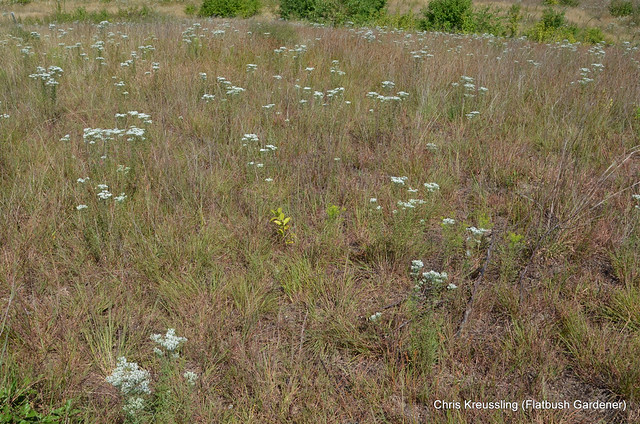
Hempstead Plains
Hempstead Plains on the grounds of Nassau Community College in East Garden City, Nassau County, NY. The white-flowering plants are Eupatorium hyssopifolium, Hyssop-leaf Throughwort.

On Sunday, August 25, I joined three other native plant lovers for a whirlwind tour of Hempstead Plains. We had only an hour; I could have spent several hours there. For me, this was a pilgrimage. I spent most of my childhood on Long Island.

2013-08-23

Brooklyn Botanic Garden's Slash and Burn "Campaign for the 21st Century"

Sign the Petition to Restore Science to Brooklyn Botanic Garden! (Added 2013-09-16)

Updates:
2013-08-29: Added more links. I will continue to do so as this story begins to get more exposure.
2013-08-24: Expanded analysis. Added more external links to relevant sections of BBG's Web site.
2013-08-23 18:00: Added response from BBG.

Contents


I was alarmed to read the following on Twitter yesterday [2013-08-21]:
Brooklyn Botanic Garden suspends science program and lays off botany staff. Express concerns to president Scot Medbury scotmedbury@bbg.org.
- New York Flora Association, 2013-08-22, ~06:00 EDT

My Letter

For over a century, since its founding, science has been a foundation of the Brooklyn Botanic Garden. It is a primary reason why I have supported them. This morning [2013-08-23] I wrote the following email to Scot Medbury, President, Brooklyn Botanic Garden (BBG), and the Director of Major Gifts at BBG's Development Department:

2013-08-18

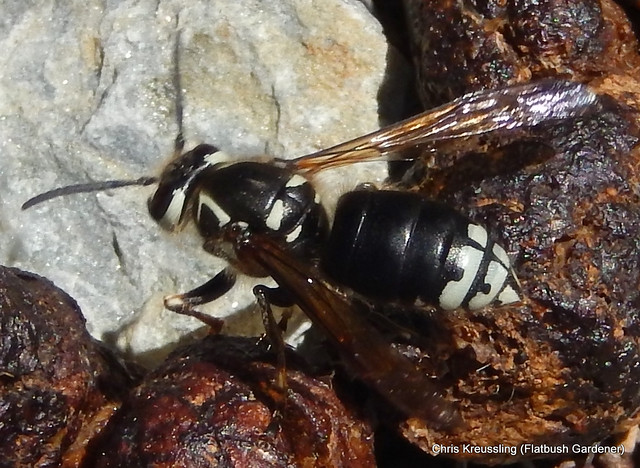
The Supermodel in the Sewer: /Dolichovespula maculata/, Bald-Faced Hornet

Setting aside for a moment the less-than-appealing staging, this is a beautiful creature.
/Dolichovespula maculata/, Bald-Faced Hornet
This is Dolichovespula maculata, the Bald-Faced Hornet. Despite its prevalence, this is my first direct encounter with one.

2013-08-13

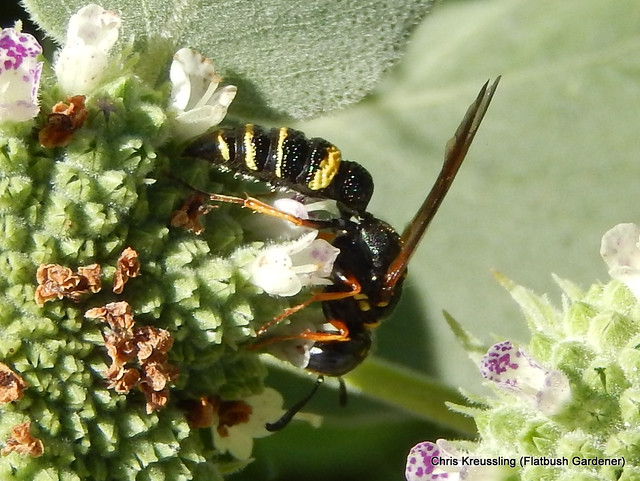
Cry Wolf: /Philanthus gibossus/, Beewolf

Philanthus gibossus, Beewolf, on Pycnanthemum muticum, Clustered Mountain-Mint, in my native plant gardens this past weekend.
/Philanthus gibbosus/, Beewolf, on /Pycnanthemum muticum/, Clustered Mountain-Mint

This thirsty little wasp face down in a cup of nectar is a Beewolf, so-named because they provision their larvae with bees. Despite the size of the image, these wasps are small; the individual flowers of this Pycnanthemum are about the size of a pencil point.

2013-08-03

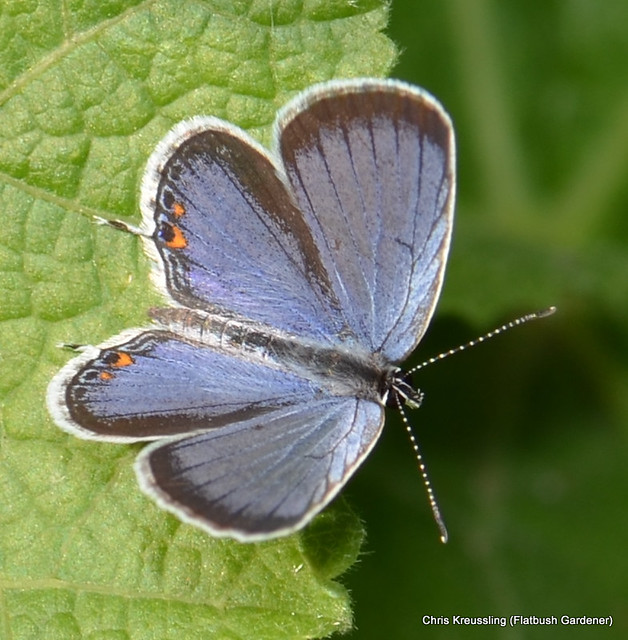
Cupido comyntas, Eastern Tailed-Blue

Cupido comyntas, Eastern Tailed-Blue.


A lifer butterfly for me. Very lucky to get a few good shots of it while it was resting, wings open, to take in some sun. They're small and fast.

2013-07-02

Rainbow Garden

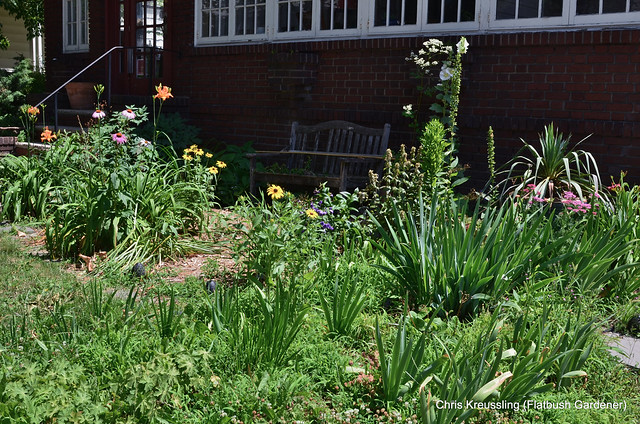
My front garden bloomed all the colors of the rainbow just in time for this past Pride Weekend.
Rainbow Garden

The plants in bloom include natives, heirlooms, passalongs from past plant swaps, and weeds. Not everything in bloom is visible in the photo. Some are too small to stand out at this scale. Others are just off-frame to the right.

2013-06-29

Physocephala tibialis, Thick-Headed Fly

2013-12-29: Identified as Physocephala tibialis by Aaron Schusteff, Contributing Editor of BugGuide.

A few weeks ago, I tweeted:
2013-06-11 19:57: Found - or rather one of our cats did - an incredible wasp-mimic fly. Chilling in refrigerator for later identification.

2013-06-11 20:01: The fly looks very similar to /Physocephala/
http://bugguide.net/node/view/7190/bgimage except all-black at first glance. Will examine more closely later.
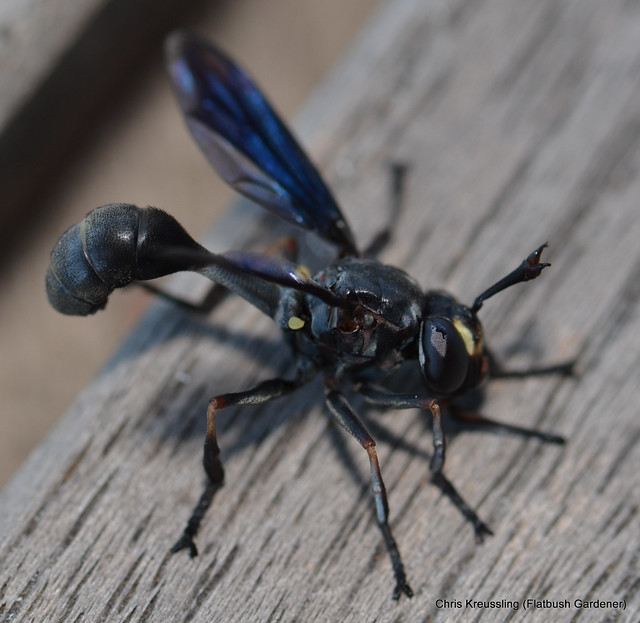
This is what she found:
Physocephala, Thick-headed Fly

Yes, that is a fly, not a wasp. You can tell it's a fly from the antennae in the center of the face, instead of the top of the head, the large, rounded eyes that cover both sides of the face, instead of being restricted to the upper part of the head, and the "forked" feet.

Amphion floridensis, Nessus Sphinx Moth

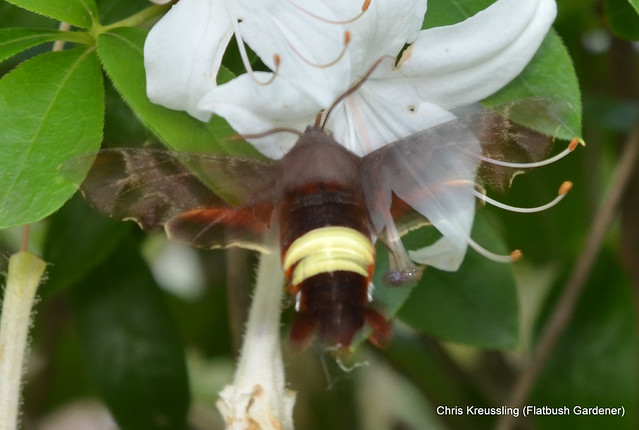
Amphion floridensis, Nessus Sphinx Moth, on Rhododendron viscosum, Swamp Azalea, in my urban backyard native plant garden and wildlife habitat. The two bright yellow bands are a key for this species.
Amphion floridensis, Nessus Sphinx Moth, on Rhododendron viscosum, Swamp Azalea

Another lifer moth for me, I saw this in my backyard a few weeks ago. Fortunately, I had my camera with me. Unfortunately, I didn't have time to break out the flash, or the tripod. This was a fast-moving moth.

2013-06-05

Long Island Native Plant Sale, June 7&8, 14&15

2013-06-09: Updated from my visit on Saturday, 6/8.

The Sale

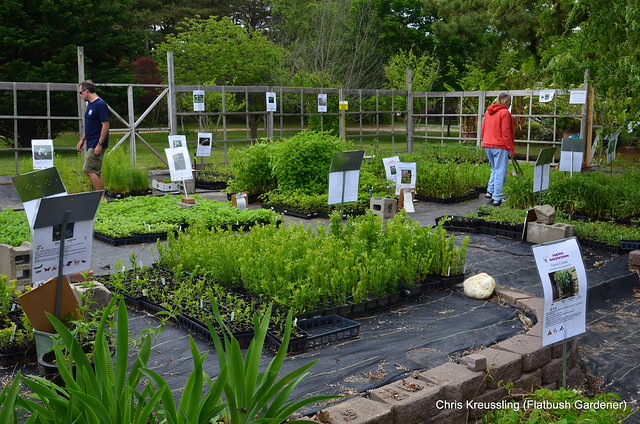
Long Island Native Plant Initiative (LINPI) Plant Sale

This Friday and Saturday, June 7 and 8, and next week as well, June 14 and 15, is a rare opportunity to purchase local ecotypes - plants propagated from local wild populations - of plants native to Long Island. The sale is organized by the Long Island Native Plant Initiative (LINPI). Proceeds benefit LINPI.